October Breeders' Cup Schedule Skews Financial Reports

Held Entirely In October, Breeders’ Cup Leads To Inflated Financials
The 2026 Breeders’ Cup was held entirely on the last two days of October at Keeneland.
That calendar shift has created a statistical illusion in the monthly financial reports released Thursday by Equibase.
Last year’s Breeders’ Cup was split across October 31 and November 1, spreading its economic impact across two months.
This year, all $24 million in purse money on Breeders’ Cup Saturday fell inside October.
That single change inflated nearly every October metric.
Total wagering on U.S. races in October reached $958.7 million.
That is a 10.41% improvement over October 2025.
Available purse money for the month hit $148.1 million.
Actual paid purse money reached $140.2 million.
Both purse figures were ahead by roughly 28% compared to the same month last year.
Daily average wagering on U.S. races in October was just over $3.2 million.
That represents an improvement of 12.64%.
Available purses per day were just shy of $497,000.
That showed an increase of 30.79%.
These are the numbers that will appear in headlines and industry summaries.
But they tell only part of the story.
Equibase also released year-to-date figures covering the first 10 months of 2026.

Those numbers paint a very different picture.
Total wagering on U.S. races from January through October declined 2.71% to $9.29 billion.
That means the October spike was not a recovery.
It was a calendar artifact.
Available purses over the first 10 months were up around 3%.
Paid purses were also up around 3%.
Average wagering per day across all 10 months was $3.04 million.
That is only fractionally ahead of the same period last year.
The Breeders’ Cup is the sport’s championship event.
It offers the richest purses of the year and draws the highest betting handle.
When those dollars all land in one month, that month looks exceptional.
When the same dollars were split across two months, neither month looked as extreme.
The 2025 Breeders’ Cup was held Friday, October 31 and Saturday, November 1.
October 2025 captured only one day of Breeders’ Cup wagering and purses.
November 2025 captured the other day.
This year, October got both days.
The comparison is therefore not apples to apples.
Equibase is the official database for Thoroughbred racing in North America.
Its monthly economic indicators are widely used by owners, breeders, racetracks and regulators to assess the health of the sport.
When those indicators show a 10% handle increase, the industry reads that as a positive sign.
When they show a 28% purse increase, tracks and horsemen’s groups use those numbers in budget planning and contract negotiations.
But if the increase is purely a calendar shift, the actual trend is flat or negative.
The year-to-date figures confirm that.
Total handle of $9.29 billion through October is down from the comparable period last year.
The decline is modest at 2.71%, but it is a decline.
That is not a recovery.
That is a continuation of a pattern seen in recent years.
Handle on U.S. races has been under pressure from competition with sports betting, casino gambling and other entertainment options.
The number of race days has also declined as tracks have shortened meets.
Fewer race days mean fewer opportunities to bet, which suppresses total handle even if per-day wagering holds steady.
The per-day average of $3.04 million is only fractionally ahead of last year.
That suggests the sport is not growing its audience or its betting base.
It is simply concentrating the same amount of betting into fewer days.
The Breeders’ Cup weekend at Keeneland featured 14 championship races.
The Saturday card alone carried approximately $24 million in purse money.
That purse money is paid out to owners, trainers and jockeys.
It is also counted as part of the monthly purse figures Equibase reports.
When $24 million lands in October, it lifts every purse-related metric for the month.

Available purses of $148.1 million for October are a record for the month.
But available purses for the year are only up 3%.
That 3% is roughly in line with inflation.
In real terms, purse money is not growing.
The Thoroughbred Daily News first reported the discrepancy in its analysis of the Equibase data.
The report noted that the 2026 figures “benefitted from the roughly $24 million in purse money that was on offer on Breeders’ Cup Saturday at Keeneland.”
That phrasing is neutral, but the implication is clear.
The numbers are real.
They are just misleading without context.
Industry analysts who track wagering trends have long warned about the effect of calendar shifts on monthly comparisons.
When a major event moves from one month to another, the month that gains it looks strong and the month that loses it looks weak.
The underlying trend is visible only when you aggregate over a longer period.
In this case, the longer period shows stagnation.
The Breeders’ Cup itself is healthy.
Handle on the two-day event was strong, and the races drew competitive fields.
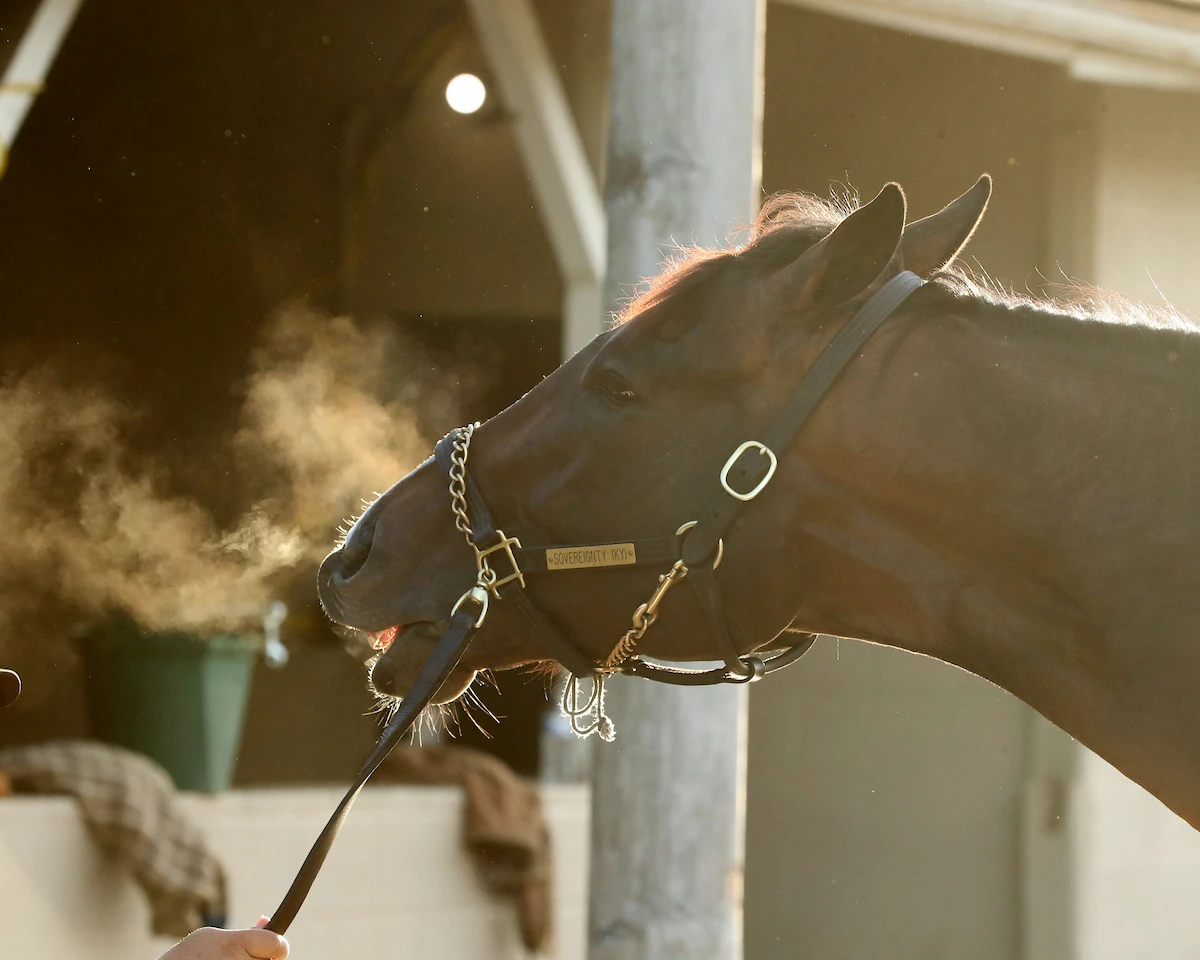
Sovereignty won the $7 million Classic by 1 ¾ lengths over longshot The Puma.
Forever Young, last year’s Classic winner, finished fifth as the 8-5 favorite.
That was the first time Forever Young had been out of the money in a 17-race career.
But the health of the Breeders’ Cup does not automatically translate to the health of the broader sport.

The Breeders’ Cup is a two-day event.
The rest of the year is 363 other days.
Those other days are where the sport’s long-term challenges lie.
Declining foal crops, shrinking field sizes and competition from other forms of gambling are structural issues that no single weekend can solve.
The Equibase report does not offer solutions.
It only reports the numbers.
But the numbers, when read carefully, tell a story that the October headlines will miss.
The month looks great.
The year looks flat.
The trend looks concerning.
For owners and breeders who make decisions based on purse trends, the difference matters.
If they see a 28% purse increase in October, they may overestimate the sport’s financial health.
If they see a 3% increase for the year, they will recognize that the sport is treading water.
The Breeders’ Cup will remain at Keeneland through at least 2027.
After that, the event may move to other tracks.
Each move will create its own calendar quirks.
Each quirk will require careful reading of the monthly reports.
The lesson for anyone who follows racing finances is simple.
Look at the year-to-date numbers.
Ignore the monthly spikes.
The spikes are real money, but they are not real growth.
Advertisement
You may also like
Watch Dallas Stars vs Blue Jackets Live Free on TV
NHL.LIVE: Dallas Stars vs Columbus Blue Jackets Live Free NHL Games On TV Channel Nov 6.2026. The Dallas Stars face the Columbus Blue Jackets…
Church Downs picks: Expert predictions for Friday, Nov 6
Churchill Downs Horse Racing Picks and Predictions Today for Friday, November 6. Mr. Ed has returned to his regular twice-a-week VSiN beat after a…
Garcia Exposes LIV Golf’s ‘Good, Bad and Ugly’ After Quitting
The PGA Tour and DP World Tour now have an obvious decision to make with the likes of Sergio Garcia and Lee Westwood. Garcia,…

Tom Brady Names His Top 4 NFL MVP Picks for 2024
Tom Brady earned three NFL Most Valuable Player awards during his career with the New England Patriots. That gives him more than enough authority…

TMZ Roasted for Creepy Article About Ella Langley’s Bikini Photo
Country singer Ella Langley Highlights Bikini Body In Stunning Selfies. But a recent post from TMZ has turned that into a controversy. The celebrity…

Reds Trade Bombshell Drops on Elly De La Cruz
The Cincinnati Reds closed out a forgettable 2026 campaign with little to show for it beyond the continued rise of Elly De La Cruz.…