Aliyah Boston stunned by NBA draft rule that doesn’t exist in WNBA
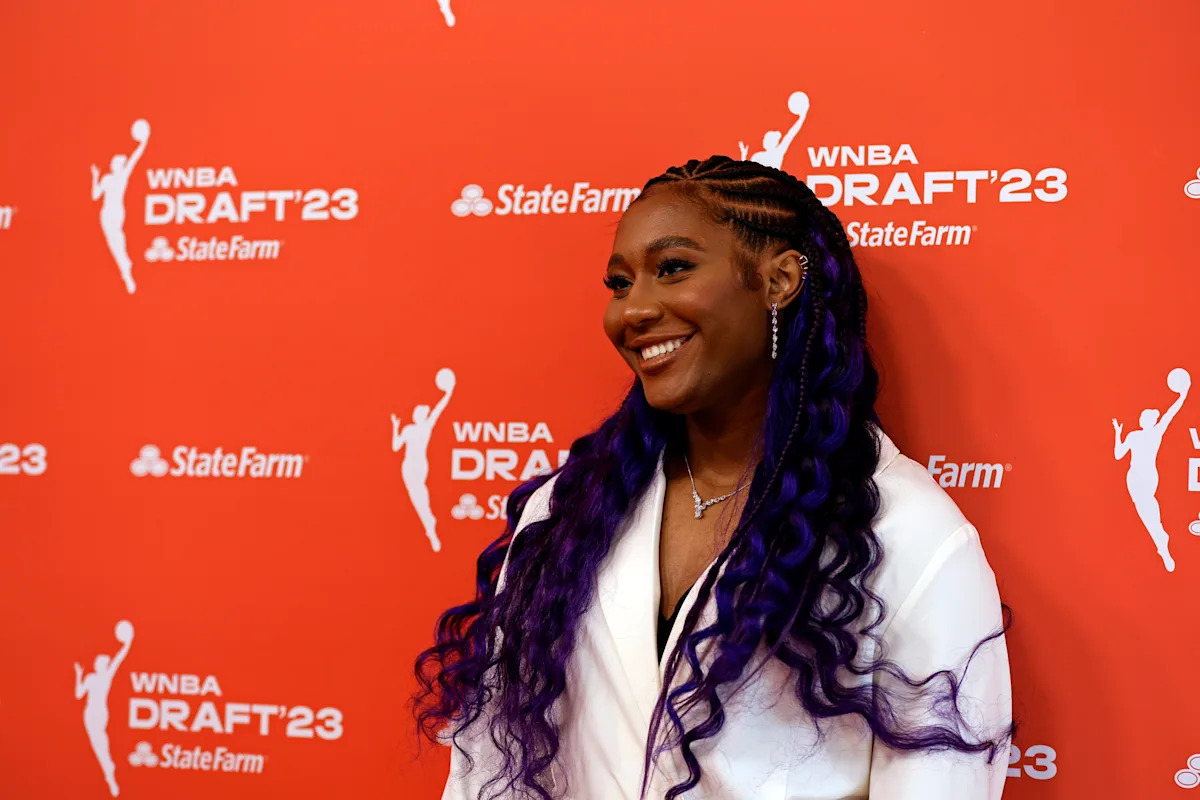
Aliyah Boston couldn't believe her ears when she heard how the NBA's draft eligibility rules compare to the WNBA's.
The Indiana Fever star was sitting with Candace Parker on the latest episode of Post Moves when Parker read the two sets of rules side by side.
Parker explained that the WNBA requires US players to turn 22 within the calendar year of the draft, or graduate from a four-year college within three months of the draft, or be at least four years removed from high school.
"I hate the comparison because I think it's two completely different leagues," Parker said, "but NBA draft eligibility requires US players to be at least 19 years old during the calendar year of the draft or must have been out of high school for at least one year."
Boston's response was immediate.
"That's so crazy."
She paused, then went deeper.
"Honestly, I don't think our rules are bad. Like, I think it takes — like I couldn't imagine coming out after my sophomore year of college and being ready for the W. Like, I just don't think I would have been ready. Like, the physicality, the speed, everything."
Boston spent four years at South Carolina under Dawn Staley, winning a national championship in 2023 before entering the WNBA draft.
She was the No. 1 overall pick in 2023 and immediately became a force for the Fever.
In 2026, she put up 16.1 points and 8.0 rebounds per game while shooting 40.6% from three-point range — a massive leap for a player who had barely attempted threes in previous seasons.
She also represented Team USA in the World Cup, where she held her own against 7'4" Chinese center Zhang Ziyu.

But the draft rule conversation hit a nerve.
The NBA has allowed players to enter the draft one year after high school since 2006, when the league changed its rule from the previous requirement that players be at least 18 and a year removed from their high school graduation.
The WNBA has maintained a much stricter age limit since its inception.
Players must be 22 in the calendar year of the draft unless they graduate from a four-year college within three months of the draft, or are at least four years removed from high school.
That means most American players spend four years in college before turning pro.
Some international players have entered the WNBA younger because of different eligibility pathways, but the rule effectively keeps US-born players in college until they are at least 22.
Boston said she believes the rule serves a purpose.
"I just don't think I would have been ready," she repeated.
"The physicality, the speed, everything."
She pointed to her own experience as evidence that waiting can pay off.
At South Carolina, she was a three-time All-American and won the 2023 Naismith Trophy as the national player of the year.
She entered the WNBA at 22 and was immediately one of the league's best post players.

But not everyone agrees that a strict age limit is necessary.
USC star Jazzy Davidson recently said the WNBA's age limit feels "a bit outdated," though she added that she is in no rush to leave college.
Davidson said earning a degree and bonding with teammates matter, but she still thinks young players deserve the freedom to turn pro whenever they're ready.
The debate mirrors conversations that have happened in the NBA for years.
When the NBA changed its rule in 2006, it created a one-and-done system where top high school players spent one year in college before entering the draft.
That system produced stars like Kevin Durant, Anthony Davis, and Zion Williamson.
But it also produced players who struggled with the transition.
The NBA eliminated the one-and-done rule in 2022, allowing players to enter the draft directly from high school again.
Now, players like Victor Wembanyama can enter the NBA at 19 and succeed immediately — Wembanyama was 19 when he entered the draft in 2023 and has become one of the league's best players.
Yaxel Lendeborg, by contrast, entered the NBA at 24 and has also found success.
There is no single path.
Boston's comments come after a season in which she dealt with a lateral meniscus tear in her right knee.

She played through the injury for much of the 2026 season, missing only four of the Fever's 44 regular-season games.
After the season, she underwent surgery — her first procedure of any kind.
She recently confirmed she will sit out the 2027 Unrivaled season to prioritize a full recovery.
Her contract keeps her in Indiana until 2029.
On the podcast, Boston and Parker also ranked Boston's most viral moments of the 2026 season.
The list included her thumbs-down at a referee, a corner three-pointer, a stare-down with a Las Vegas Aces player, her "You guys like my cup?" clip, and a bench celebration with Caitlin Clark.
Boston still disagrees with the call that led to the thumbs-down.
"Oh, I felt that one," she said.
"It was not a good call, I felt like."
But she added that the referee, Catherine, was smiling.
"So like, you know, that's why I probably didn't get in trouble for it."
Boston also said an Aces player "overly played" contact during their stare-down moment.

"I did not even hit her like that. For her neck to get thrown all the way back, though, she played."
The Fever's season ended in three games against the Aces in the playoffs.
Indiana won Game 2, 99-89, at Gainbridge Fieldhouse on Sept. 29, but lost Game 1 and Game 3.
Boston averaged 19.7 points in the series.
She made her fourth All-Star team in 2026.
Parker said the memes are "a microcosm" of Boston.
"I just really love because I know you, people know you, but these memes are a microcosm of you," Parker said.
"And it gives me so much joy."
Boston smiled.
"I can't help it," she said.
"I can't help it. Like, I can't help it. Sometimes it just comes out."
The draft rule conversation, though, is what has people talking.

It raises a question the WNBA has not yet answered: should the league lower its age limit?
The league has faced pressure from some players and agents who argue that top prospects should have the freedom to turn pro earlier.
Others, like Boston, believe the current system protects players from entering the league before they are ready.
There is no indication the WNBA is considering a rule change.
But the debate is not going away.
For now, Boston is focused on recovery.
She said the hardest part of surgery was the basics.
"I'm a do-it-myself person," she said.
"So I was yelled at a lot because they were, like, 'You can't.'"
She also described a particularly frustrating part of the process.
"Keeping a leg out of the shower so the stitches don't get wet," she said.
"What do you want me to do? I enjoy my showers."
The Fever has a long runway with Boston under contract through 2029.
If she returns at full strength, she could be the centerpiece of a contender for years.
And if the draft rule ever changes, the next generation of players might have a different path than she did.
Advertisement
You may also like
Oprah’s studio became McDonald’s global HQ 28 years later
In 1990, Oprah Winfrey opened Harpo Studios in Chicago. Twenty-eight years later, McDonald’s opened its global headquarters on the same site. The 480,000-square-foot building…
Curt Cignetti destroys ESPN for SEC bias with one undeniable fact.
Curt Cignetti did not come to the microphone to complain. He came with a spreadsheet. The Indiana head coach used his weekly radio show…
Marta the Soccer Queen Gets Her Own Movie Trailer
Open & Shut: Marta al Mare; Oohhs & Aahhs; Silver Queen Cafe Baltimore's restaurant scene saw a shakeup this week with a high-profile opening,…
Reed Fires Back at DP World Tour While Eyeing PGA Return
Patrick Reed has made his position clear on the potential return of Jon Rahm to the PGA Tour. The 2018 Masters champion believes that…
Fritz defeats Fils in Paris, sets up Alcaraz quarterfinal.
Taylor Fritz kept his Turin hopes alive with a straight-sets win over Arthur Fils at the Rolex Paris Masters on Thursday night. The 11th…
Sania Mirza and Bhupathi take charge to save Indian tennis.
Mahesh Bhupathi and Sania Mirza have been elected to the Executive Committee of the All India Tennis Association (AITA). The two Indian tennis legends…