Guy Kinnings Accuses LIV Golf Of Creating A False Economy To Destroy DP World Tour
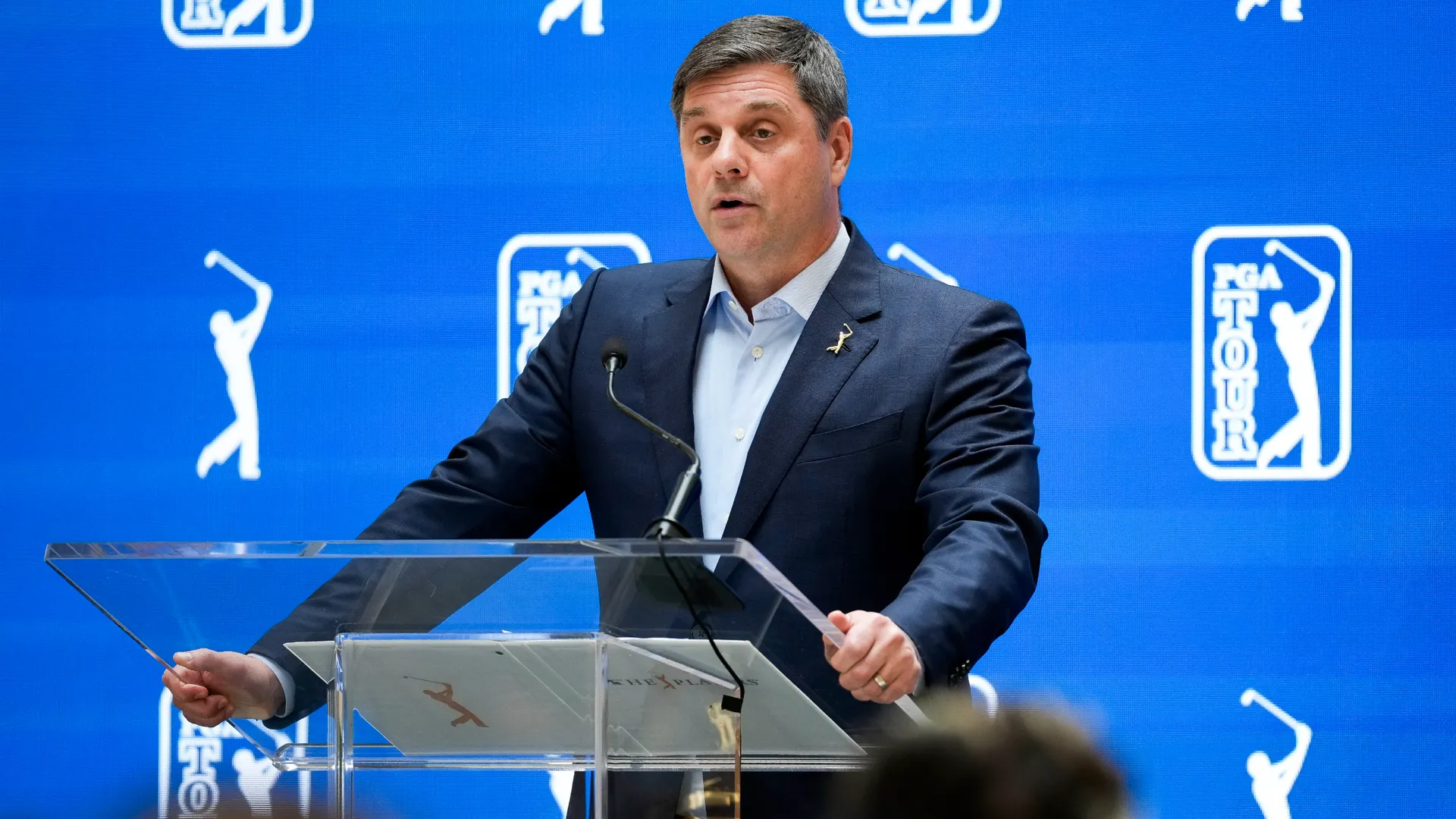
Guy Kinnings, chief executive of the DP World Tour, has accused LIV Golf of spending more than $7 billion with an explicit ambition to destroy the European circuit.
In an exclusive interview with The Scotsman, Kinnings revealed that industry contacts he has known for over 30 years told him the Saudi-backed league aimed to wipe out the 50-year-old tour.
“We’ve got to protect that special culture that we have on the Tour,” Kinnings said.
“But we also have to protect the Tour against an entity who spent, so we are told, over $7 billion, with one of their aims being to ‘destroy the DP World Tour’.”
He added that he had heard this from “so many different people they talked to, who I have known for over 30 years within the game and who I trust implicitly.”
The accusation lands as the DP World Tour enforces a hardline membership policy for 2027.
Players who sign with LIV Golf for its 2026 season — referred to internally as “LIV 2.0” — will not be permitted to play on the DP World Tour.
This is a reversal from 2025, when the tour granted exemptions to LIV players including Jon Rahm, Tyrrell Hatton and Tom McKibbin.
Kinnings framed the ban as a defensive measure, not an offensive one.
“Clearly when you are faced with statements like that, and then people then ask why we are doing what we are doing with our membership and invite policy for 2027, then I think the answer becomes pretty obvious,” he said.
The DP World Tour, founded in 1972, operates across Europe, Asia, Africa and the Middle East.
It has long served as a developmental and competitive pathway for players outside the PGA Tour’s primary structure.
LIV Golf launched in 2022 with massive financial backing from Saudi Arabia’s Public Investment Fund.
Its model offers guaranteed contracts and record prize purses to attract top talent.
Kinnings described that spending as a “false economy” that has distorted the sport.
“What LIV did was take prize funds to an artificially high level and, as has been shown recently, on the back of an entirely unsustainable economic model,” he said.
He pointed to the DP World Tour’s own financial stability as evidence that the tour can survive without matching LIV’s spending.
“We have over a billion dollars currently contracted across the Tour in sponsorship,” Kinnings said.
That figure includes multi-year deals with Rolex, DP World and other global brands.
The tour also generates revenue through broadcast rights, event hosting fees and its strategic alliance with the PGA Tour.
Kinnings confirmed that a new Strategic Alliance deal with the PGA Tour is currently being negotiated.
“Brian Rolapp’s been very clear,” Kinnings said, referring to the PGA Tour’s president of media and international.
“He has said he wants to extend the Strategic Alliance and that’s exactly the goal that I have. We’re working on it right now.”
The PGA Tour and DP World Tour first formalized their Strategic Alliance in 2020, deepening ties on scheduling, media rights and revenue sharing.
A renewed deal could give the DP World Tour additional financial firepower as it navigates the LIV threat.
Kinnings also outlined major schedule changes coming in 2028.
The PGA Tour is expected to compress its regular season into a February-to-August window with the introduction of a Championship and Challenger Series.

That would leave a five-month gap in the global golf calendar from September through January.
“In 2028, with the PGA Tour operating from February to August, that gives us an amazing opportunity from September through to the end of January almost without anything else going on, to truly shine a light on international golf as golf’s global Tour,” Kinnings said.
He said the DP World Tour is exploring a restructured schedule with a new focus on Rolex Series events and national opens.
The tour is also considering bringing in capital investment to bolster tournament purses and infrastructure.
“Our 2027 schedule starts in a couple of weeks, but we have got to make sure that we’re ready for what 2028 brings,” Kinnings said.
“2028 is going to look different. The PGA Tour is already shaping it in America and we need to do the same for the rest of the world.”
The backdrop to Kinnings’ comments is a growing sense of unease among LIV Golf players.
Reports from multiple outlets — including Yahoo Sports and EssentiallySports — describe “widespread panic” in LIV locker rooms over the 2027 ban.
Players such as Lucas Herbert have acknowledged the harsh backlash awaiting those who attempt to return to the DP World Tour.

Herbert told Korean outlet Chosun Ilbo that he understands the resentment from traditional tour members.
The DP World Tour’s membership rules for 2027 require players to earn their place through merit-based criteria rather than past status or exemptions.
That means LIV players who left the tour cannot simply rejoin without qualifying through the standard pathway.
Kinnings framed the policy as a matter of fairness to the tour’s loyal members.
“Myself and everyone at the DP World Tour have a duty to our members to protect our Tour,” he said.
“We are proud of that and are proud that we treat everyone who works for the Tour, whether that be staff, suppliers, contractors, everyone, with respect and dignity.”
He added: “Our Tour that has been in existence for over 50 years and it stands for everything that is good, right and proper in the game is worth fighting for and that is precisely what we have done and what we will continue to do.”
The $7 billion figure cited by Kinnings refers to the total investment the Public Investment Fund has poured into LIV Golf since its inception.
That includes player contracts, event costs, prize money and operational expenses.

LIV Golf has not publicly disputed the scale of its spending, though it has consistently argued that its model is sustainable long-term.
Critics, including Kinnings, point to the league’s reliance on a single state-backed fund as evidence that the model cannot survive without ongoing subsidy.
The question now facing the sport is whether the DP World Tour’s hardline stance will force a reckoning.
If LIV players are locked out of the European circuit, their ability to earn world ranking points and qualify for majors could be severely limited.
That would reduce the incentive for top players to join LIV in the first place.
But LIV has countered by investing in its own ranking system and expanding its global schedule.
The two tours are effectively in a cold war, with no unified resolution in sight.
Kinnings’ accusation — that LIV aimed to “destroy” the DP World Tour — is the most direct charge yet from a sitting tour executive.
It reframes the conflict not as a business rivalry but as an existential battle.
Did LIV Golf create a damaging false economy that threatens the entire professional game?
Or is the DP World Tour simply shielding its own legacy model from necessary disruption?
Kinnings has made his answer clear.
The coming months will determine whether the rest of the sport agrees.
Advertisement
You may also like
Jessica Pegula Caught on Hot Mic Calling Rival a ‘Diva
Jessica Pegula was caught on a hot mic trashing rival Mirra Andreeva during a practice session at the WTA Finals in Indian Wells. The…
Family of Ellen's producer begs DeGeneres for more after tiny $5,000 gift
Exclusive: Matt Wright's loved ones urge Ellen DeGeneres to 'do more' after $5K donation Ellen DeGeneres donated $5,000 to the family of her late…
Ossoff, mocked as a Pee-wee lookalike, now beats Vance in 2028 odds.
Jon Ossoff, mocked by Donald Trump as a 'Pee-wee Herman lookalike,' now leads JD Vance in 2028 betting odds. Two days after winning reelection,…

Rangers need to lock in Tye Kartye long-term.
The New York Rangers should re-sign Tye Kartye to a long-term deal. Tye Kartye is on one of the best bargain contracts in the…

CMA Awards reveal first performers: McGraw, Musgraves, Langley
Tim McGraw, Ella Langley, and Kacey Musgraves are among the first performers announced for the 60th CMA Awards. The Country Music Association revealed the…
McIlroy admits he almost broke the DP World Tour rule.
Rory McIlroy has revealed he came within a single conversation of giving up his DP World Tour membership in 2019 — a decision that…