LIV Golf timeline: 17 key events that doomed the breakaway league
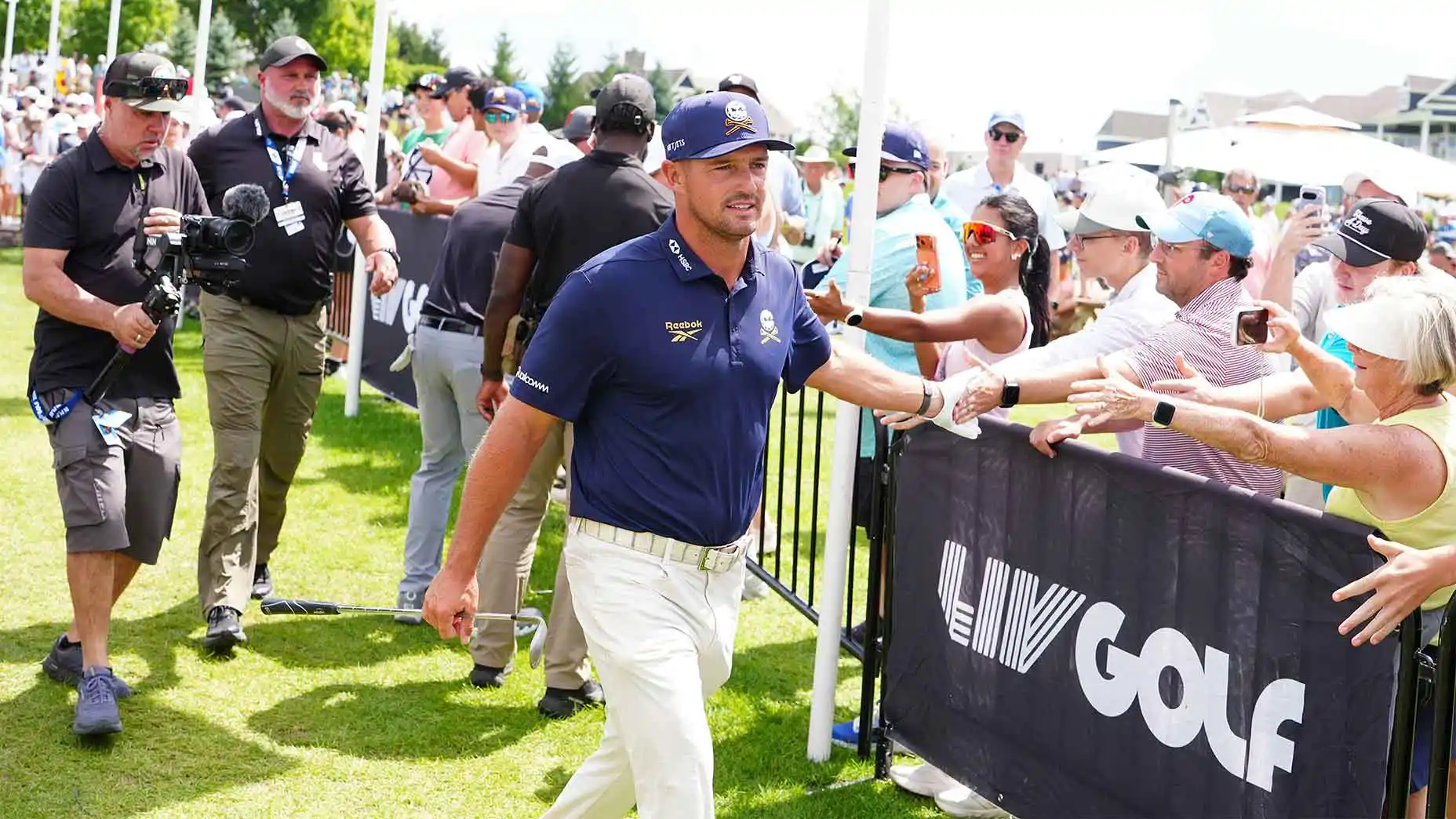
LIV Golf is officially dead.
Lawyers for the Saudi-backed league announced in a New Jersey bankruptcy court on Thursday, November 5, 2026, that LIV will not proceed with its planned LIV 2.0 restructuring.
Instead, the league will liquidate.
"The debtors are not currently proceeding with the LIV 2.0 plan," attorney Matthew Williams of Gibson Dunn said in the hearing.
"Instead, the debtors are toggling to a value-maximizing wind-down in their business."
The announcement came one day after reports that BC Partners Credit had decided to pull the $300 million it had pledged to help the league through bankruptcy.
Saudi Arabia's Public Investment Fund, or PIF, had already cut off the $5 billion in cash flow that launched and maintained LIV through five turbulent seasons.
BC Partners issued a statement explaining its withdrawal.
"BC Partners Credit supported a transaction that aligned the interests of players and investors, offering a credible path toward building a sustainable future for LIV Golf," the firm said.
"While there was great support for the league, we are disappointed that mutually acceptable terms could not be reached among the various stakeholders."
LIV Golf filed for Chapter 11 bankruptcy protection in New Jersey in September 2026 after months of speculation about its future.
League officials had insisted the bankruptcy filing was intended to facilitate the launch of a player-owned version of the tour for the 2027 season.
LIV announced a deal worth up to $300 million with BC Partners on October 5, 2026.

That deal included an initial investment of $4 million as part of a restructuring support agreement.
But executing the formal agreement always hinged on the commitment of a group of "requisite players" that BC Partners determined were necessary to ensure LIV could continue as a "bona fide golf league."
A strategic initiative committee formed as part of the Chapter 11 proceedings ultimately determined a wind down was "the best path to maximize value for stakeholders," according to Williams.
Williams said the decision to end LIV Golf business operations was "made last night and into this morning."
"This was not an easy conclusion for anyone who believed what LIV Golf built, but it is right for these estates and these circumstances," he said.
More than a dozen notable LIV golfers had said publicly they would not be joining LIV 2.0.
Major stars such as Jon Rahm and Tyrrell Hatton were among those who announced they were leaving.
Rahm agreed to forfeit all claims against LIV — said to be worth some $100 million — to get out of his contract.
He is back playing on the European tour, with hopes there will be a path back to the PGA Tour.
The PGA Tour currently has a one-year ban dating to players' last LIV appearance.
Bryson DeChambeau had become the face of the proposed LIV 2.0.
DeChambeau's status moving forward remains uncertain, as his most recent comments suggested he was still hopeful LIV would live on in some form.
LIV 2.0 had reportedly secured 30 players for next season.

There were 10 additional players who were considering joining, but had not made their decision by an October 25 deadline.
Even as reports filtered out that LIV was on life support, some players tried returning to the negotiating table with BC Partners but were turned down.
LIV Golf paid $15.6 million to retain seven of its executives in the months between PIF and LIV filing for bankruptcy.
That included $6.375 million to CEO Scott O'Neil.
Those payments are not unusual for a company trying to emerge from bankruptcy.
The question now is whether those payments can be voided since LIV is not going forward.
Here is the timeline of 17 crucial events that shaped LIV Golf's rise and fall.
OCTOBER 2021
Greg Norman announces he has accepted the position of CEO for LIV Golf Investments.
The majority stakeholder is the Public Investment Fund of Saudi Arabia.
MARCH 2022
LIV Golf officially announces a slate of eight 2022 events, beginning in London on June 9 at the Centurion Club.
The prize money for the total series is set at $225 million.

MAY 2022
Dustin Johnson signs with LIV for a reported $125 million.
He is joined by up-and-comer Talor Gooch and European legends Sergio García, Lee Westwood, Ian Poulter and Martin Kaymer.
JUNE 2022
Phil Mickelson signs a multiyear contract with LIV ahead of the league's first tournament.
Onsite, additional recruits are revealed: Patrick Reed, Bryson DeChambeau and Pat Perez.
Weeks later, after the U.S. Open, Brooks Koepka joins too, along with Carlos Ortiz and Matthew Wolff.
AUGUST 2022
Reigning Players and Open Champion Cameron Smith — then the No. 2 player in the world — joins LIV Golf.
He is joined by Marc Leishman, Joaquin Niemann, Harold Varner III, Anirban Lahiri and Cameron Tringale.
MARCH 2023
Brooks Koepka wins the 2023 PGA Championship for his fifth career major title.
He becomes the first active LIV player to win a major championship.

JUNE 2023
PGA Tour Commissioner Jay Monahan and PIF governor Yasir Al-Rumayyan sign a five-page "framework agreement."
The agreement effectively ends litigation and announces the intent to form a mutually beneficial new entity.
The framework agreement never officially comes to fruition.
DECEMBER 2023
Jon Rahm signs with LIV.
MARCH 2024
Anthony Kim returns from a 12-year pro-golf hiatus to compete on LIV.
JUNE 2024
Bryson DeChambeau wins the U.S. Open to become the second active LIV player to win a major championship.
JANUARY 2025
Scott O'Neil replaces Greg Norman as LIV Golf CEO.
JANUARY 2026

Brooks Koepka leaves LIV to return to the PGA Tour.
SEPTEMBER 2026
LIV Golf files for Chapter 11 bankruptcy protection in New Jersey.
OCTOBER 5, 2026
LIV announces a deal worth up to $300 million with BC Partners Credit.
NOVEMBER 5, 2026
BC Partners pulls its $300 million commitment.
LIV attorneys announce in bankruptcy court that the league will liquidate instead of pursuing LIV 2.0.
In total, LIV Golf spent more than $5 billion across five seasons and 62 tournaments.
The league changed professional golf in numerous ways.
Most markedly, LIV's influence normalized the idea of super-sized purses in professional golf.
The PGA Tour now regularly offers $20 million in its Signature Events.
The major championships have nearly doubled their purse offerings since 2021 to keep pace.
What remains unclear is what happens to the remaining LIV players who did not secure exit deals.
The PGA Tour's one-year ban for former LIV players remains in place.
Whether the tour will adjust that policy now that LIV is gone is an open question.
The liquidation process will determine how much money, if any, is returned to creditors.
For now, the experiment that promised to reshape professional golf is over.
Advertisement
You may also like
Kim Kardashian’s co-stars call her the greediest woman on set.
Kim Kardashian's All's Fair co-stars brand her the 'greediest woman' they have ever met. Niecy Nash-Betts said it on Good Morning America. Kim eats…
Kyle Larson's Secret Marathon Plan for NASCAR Title Revealed
“More Thought Behind This Than the Chase”—Kyle Larson Reveals Unorthodox Marathon Regimen Fueling Championship Bid Kyle Larson is training for his first marathon. He…
WTA Finals Drama: Group Photo Canceled Over Svitolina-Andreeva Feud
Road to the WTA Finals: The eight doubles teams heading to Indian Wells. The 2026 WTA Finals Indian Wells doubles field is a mix…
WWE Blocked Chad Gable’s GCW Debut at the Last Minute
GCW promoter Brett Lauderdale revealed on November 5, 2026 that WWE superstar Chad Gable was booked for Josh Barnett's Bloodsport X in April 2024.…
Sophie Cunningham shuts down 'dumb' internet fury over Team USA no-shows
Sophie Cunningham, a shooting guard for the Indiana Fever, has publicly questioned why WNBA players miss so many wide-open layups. She did not hold…
Shedeur Sanders Sparks Backlash Before Even Taking the Field
BEREA — Quarterback Deshaun Watson missed his second straight practice Thursday due to a concussion. That makes it increasingly likely Shedeur Sanders will start…