Regulatory Double Standards Spark Clash Over Uncapped Horse Racing Machines And Online Wagering

While Massachusetts casinos are restricted to three designated zones with negotiated host agreements, the proposed racing amendment sets no caps on machine counts and includes language allowing online wagering.
This structural divide has triggered an intense policy clash across the Commonwealth of Massachusetts.
Established casino operators are actively mobilizing to halt the horse racing expansion before it becomes law.
The debate centers on an amendment attached to a major economic development bill approved by the Massachusetts House of Representatives.
That legislative measure, which cleared the House chamber in July, would authorize historical horse racing machines at two former racetracks.
The designated locations are Suffolk Downs in East Boston and Raynham Park in southeastern Massachusetts.
Both sites historically held parimutuel licenses to conduct live racing within the state.
Under the House proposal, historical horse racing machines would operate under the authority of those legacy racetrack licenses.
Historical horse racing terminals rely on data from previously run horse races to generate wagering outcomes for players.
Although governed by parimutuel concepts, the digital machines closely resemble standard video slot machines found on casino floors.
The Massachusetts Senate took a vastly different approach to the broader economic package.
State senators omitted the racetrack gaming provision entirely from their version of the economic development bill.
Because the two chambers passed competing drafts, the issue was sent to a bicameral conference committee, as reported by The Boston Globe.

Lawmakers appointed to the conference committee must now negotiate the final terms of the legislation.
REGULATORY DIVIDE BETWEEN CASINOS AND RACETRACKS
The most controversial element of the dispute involves the disparate standards applied to commercial casinos compared to proposed racing venues.
Commercial casino development in Massachusetts remains bound by strict geographic and regulatory constraints.
State law deliberately separated Massachusetts into three distinct geographical zones for full-scale casino resort development.
Under this established framework, commercial operators underwent extensive licensing evaluations before securing approval.
Licensed operators were required to negotiate detailed community agreements with municipal host governments.
These host agreements established binding local mitigation payments and stringent regulatory compliance requirements.
In stark contrast, the proposed House amendment contains no statutory limits on the number of historical horse racing machines.
The amendment also omits restrictions on the specific physical locations where racing operators could place secondary facilities.
Furthermore, the legislation features statutory language that could permit operators to conduct online historical horse racing wagering.
Existing commercial casinos do not possess the statutory right to operate unrestricted machines or run open-ended online casino wagering across Massachusetts.
Casinos argue that allowing racetracks to deploy uncapped terminals creates an unfair regulatory double standard.
COMPETING VISIONS FOR STATE REVENUE
Supporters and opponents of the measure have advanced sharply conflicting financial forecasts.
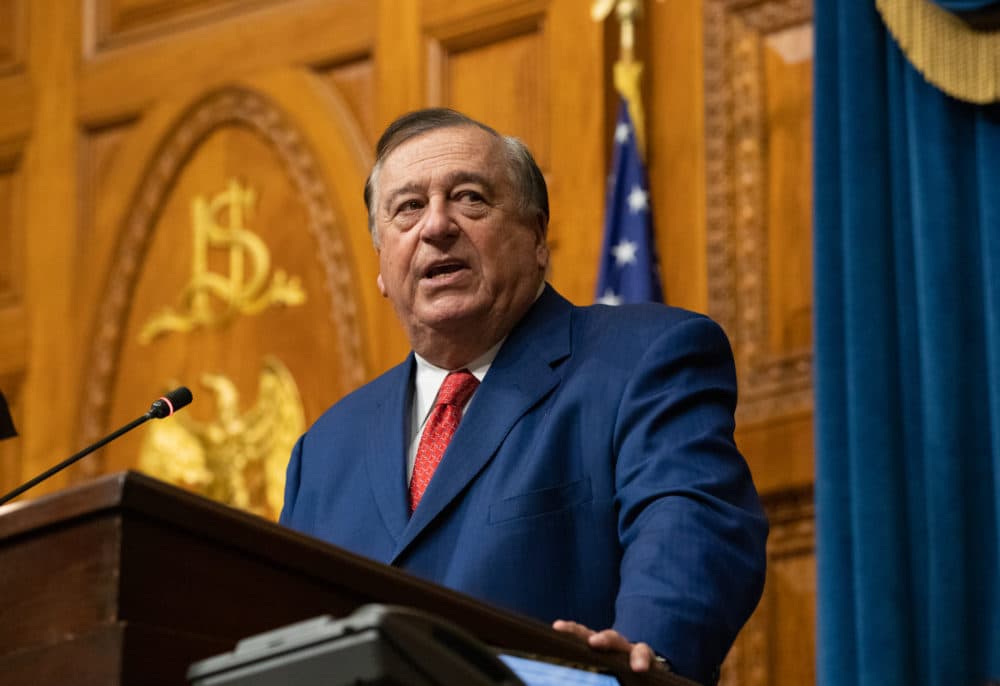
House Speaker Ron Mariano has emerged as the most prominent defender of the historical horse racing initiative.
Mariano has framed the gambling measure as a vital mechanism to generate dependable public revenue for healthcare services.
The House proposal mandates that 2.5% of the total amount wagered on the racing machines flow directly to the state Health Safety Net trust fund.
The Health Safety Net trust fund provides dedicated financial support to local hospitals and community health centers.
Those healthcare institutions rely on the trust fund to cover medical care for uninsured and underinsured Massachusetts residents.
Proponents of the racetrack expansion estimate that the new betting operations could generate up to $120 million annually by their third year.
Commercial casino operators, however, strongly reject that $120 million projection.
The state's three licensed gaming venues have publicly urged state lawmakers to reject the House proposal.
Those operating properties include Encore Boston Harbor in Everett, MGM Springfield in western Massachusetts, and Plainridge Park Casino in Plainville.
To counter the legislative push, the three casinos commissioned an economic impact study from Morowitz Gaming Advisors and Global Gaming and Hospitality.
The independent consultants concluded that historical horse racing operations would severely cannibalize existing gaming revenues.

According to the consultant findings, historical horse racing venues could siphon between $131 million and $216 million from established casinos.
The study warned that this diversion would reduce public collections, costing state and municipal governments between $45 million and $73 million annually.
In addition to tax revenue shortfalls, the study cautioned that the policy shift could trigger job losses and harm auxiliary vendors.
THE ONLINE WAGERING BATTLEGROUND
The statutory wording addressing digital wagering represents another primary flashpoint in the legislative fight.
Commercial casinos operate within fixed physical footprints that require patrons to wager inside licensed facilities.
The House amendment includes language that could enable historical horse racing operators to provide remote online wagering to consumers.
Critics highlight that online historical horse racing betting would introduce direct private competition against state-run gaming programs.
The Massachusetts Lottery recently launched its own dedicated online wagering platform to modernize retail ticket sales.
Introducing online historical horse racing wagering could pull discretionary spending directly away from the state lottery's digital footprint.
Because lottery profits flow back into local municipal budgets across Massachusetts, critics fear an online racing market could damage city aid.
TRIBAL SOVEREIGNTY AND REGIONAL COMPETITION
The legislative proposal has also encountered formal opposition from regional tribal leadership.

The Mashpee Wampanoag Tribe has voiced firm objections to the proposed historical horse racing expansion.
The tribe maintains gaming operations at the First Light Casino located in Taunton, Massachusetts.
First Light Casino operates in southeastern Massachusetts, placing it in geographical proximity to Raynham Park.
Mashpee Wampanoag Tribal Chairman Brian Weeden formally raised concerns regarding the economic consequences of the proposed bill.
Weeden cautioned that authorizing unregulated historical horse racing terminals could directly damage tribal economic interests.
He also stated that the legislative initiative poses a direct threat to the sovereign rights of the tribal government.
Tribal leaders argue that their gaming enterprise was planned under established federal and state understandings that protected regional market stability.
INVESTOR AMBITIONS AND BEACON HILL SCRUTINY
The legislative push coincides with substantial corporate interest in revitalizing the state's former racetrack sites.
Suffolk Downs investor Richard Fields has publicly pursued plans to construct a major entertainment and gaming facility.
Fields has also expressed a direct business interest in purchasing Raynham Park from the Carney family.
Raynham Park has long functioned as a regional simulcast betting venue following the conclusion of live dog racing.
The Carney family has held ownership of the southeastern Massachusetts facility for decades.
House Speaker Ron Mariano acknowledged that he maintains a personal relationship with George Carney, whose family owns the Raynham venue.
Mariano addressed the connection publicly, insisting that the legislation was drafted solely to advance public state interests.
The House Speaker emphasized that the policy was designed to fund healthcare programs rather than benefit specific commercial operators.
Nonetheless, existing casino leaders contend that exempting former racetracks from standard caps delivers an unwarranted competitive advantage.
Commercial resort operators invested billions of dollars to build within their designated geographical zones under the original Expanded Gaming Act.
Those operators assert that rewriting the regulatory playbook to permit uncapped machines and digital wagering undermines market trust.
THE PENDING CONFERENCE COMMITTEE DECISION
The fate of the historical horse racing initiative now rests entirely with the legislative conference committee.
Negotiators from the House and Senate must determine whether to retain, amend, or remove the racing language entirely.
If the provision remains in the compromise bill, the governor would ultimately face the decision of signing or vetoing the expansion.
If negotiators strip the amendment, the former racetracks will remain limited to their current business operations.
Commercial casinos continue to argue that any expansion of electronic gaming machines should adhere to the same structural safeguards.
Proponents counter that the potential $120 million for healthcare services justifies modernizing the legacy parimutuel licenses.
The final outcome of the conference committee will establish the regulatory baseline for gaming in Massachusetts for years to come.
Should historical horse racing machines face the exact same geographic and machine caps as licensed casinos?
Advertisement
You may also like

Kris Jenner Breaks Silence on Kim's Scary Health Diagnosis
Kim Kardashian's ultra-plunging latex dress is so rare it will send fans wild. But behind the glamorous photo shoots and vintage Paco Rabanne looks,…

UNC Athletics Unveils Golfing Rameses Logo, Finley Collection Of Merch
The University of North Carolina Department of Athletics has introduced a new golfing Rameses logo, Carolina and deputy athletic director/chief revenue officer Rick Barakat…

Jessica Pegula Slammed as "Outrageous" After Shading Coco Gauff and Mirra Andreeva
“Jessica Pegula Should Be Banned.” “Outrageous.” That is the reaction flooding social media after a courtside microphone picked up the World No. 5 criticizing…
Perkins: Draymond Green is now more liability than asset
Kendrick Perkins has delivered a blunt verdict on Draymond Green. "Draymond Green has been more of a liability than an asset," Perkins said. The…
Adrian Meronk reveals 4 reasons LIV Golf players are leaving
LIV Golf star Adrian Meronk has revealed the four major reasons why players are leaving the embattled league. Meronk, a one-time winner on the…

Toto Wolff was right about Esteban Ocon as Haas drops him before Brazil.
Toto Wolff was right all along about Esteban Ocon. The Mercedes team principal flagged the French driver as 'too combustible' to partner Lewis Hamilton…