Samil Serrano Rises in Baseball America’s Nats Prospect Rankings
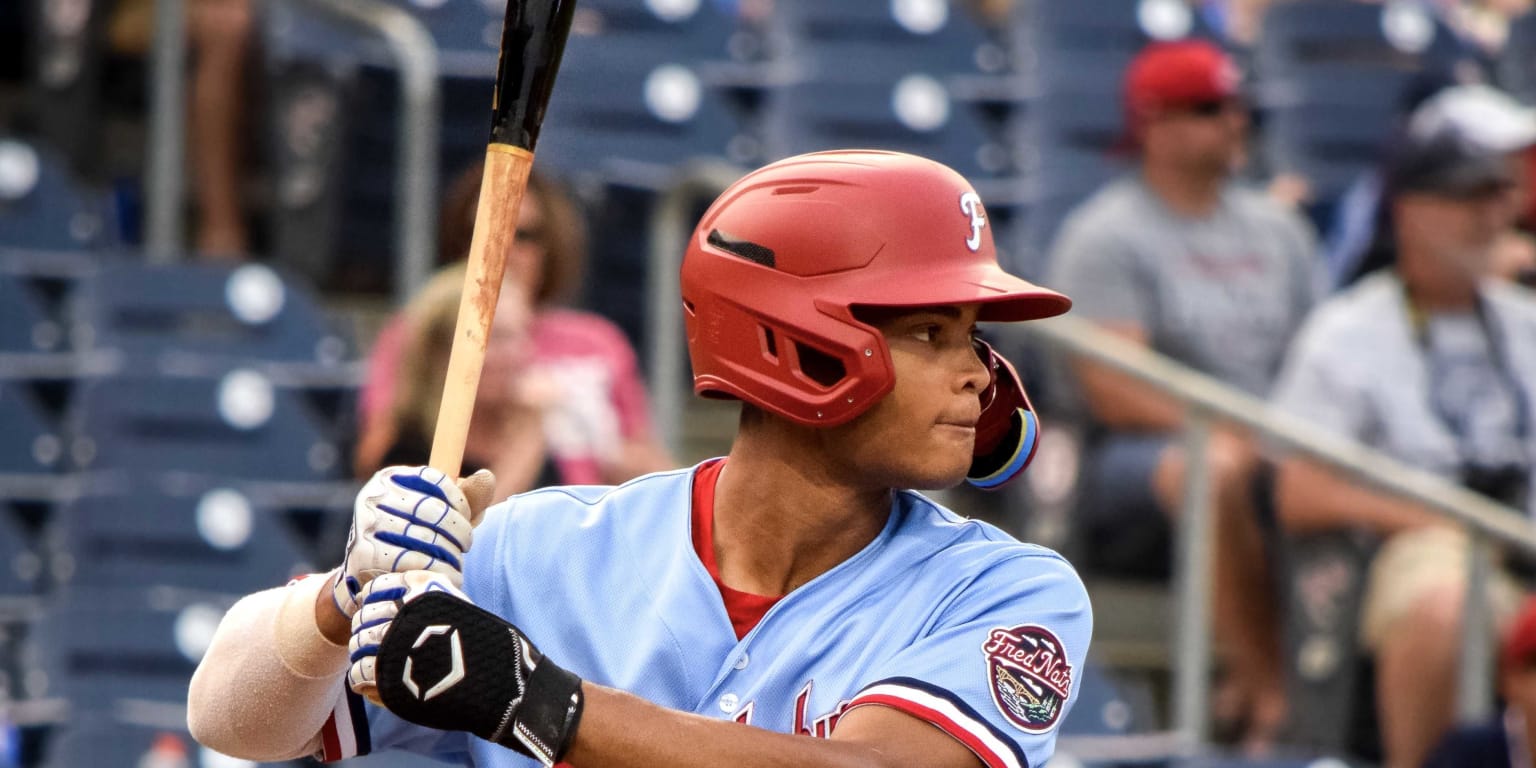
Samil Serrano is a notable riser on Baseball America’s Washington Nationals prospect update.
This morning, the great folks at Baseball America released an updated top 10 list of Washington Nationals prospects.
I really respect the work that BA does, so this list holds a lot of weight to me.
While most of the list consisted of familiar names, there were a couple surprises as well.
As you can see, Eli Willits was ranked as the Nats number one prospect, and his tool grades are very impressive.
His hitting ability and speed are considered elite tools.
Meanwhile, his fielding and arm are above average while his power is seen as average.
Willits is a well-rounded player, who also has standout tools.
In the writeup, BA said that his pure bat to ball skills were merely above average instead of elite.
However, his plate discipline is so good that it helps boost his hit tool.
We saw that in his first full professional season, where Willits walked at a 17.7% clip.
Power has always been seen as his weakest tool, but even that was better than expected in 2026.
The 18 year old hit 14 homers, 27 doubles and 8 triples in 114 games this year.
Willits posted a 100.4 MPH 90th percentile EV, which is below average, but some of the other numbers are more encouraging.
His average exit velocity was 89.2 MPH, which is actually slightly above big league average.
Meanwhile, his max exit velocity was over 110 MPH, which is very good for an 18 year old.
Power will never be the best part of his game, but this season Willits showed he has plenty of juice.
At the end of his writeup, BA said that Willits is tracking like an All-Star shortstop who could lead the league in stolen bases and runs.
With 62 steals on the season, Willits' base running ability is elite.
When I saw him in person, that aggression on the basepaths was one of my main takeaways.

We already know a lot about Eli Willits though.
He was the number one overall pick in the draft and is a player Nats fans have been following.
However, Samil Serrano is a teenaged prospect fans might not be as aware of.
The biggest surprise of this BA list is that Serrano was ranked as the Nats 5th best prospect.
He was ahead of bigger names such as Devin Fitz-Gerald and Chris Hacopian.
Serrano is a very young player, having just turned 18 a few days ago.
He was the Nats biggest international signing this past year, inking a deal with $1.97 million.
International signings are a different pathway into MLB than the amateur draft.
Players from countries like the Dominican Republic, Venezuela, and other nations sign with teams through the international bonus pool system, often as teenagers.
These signings are high-risk, high-reward gambles.
Most international prospects take years to develop, and many never reach the majors.
But when a player like Serrano jumps into a top-5 organizational ranking within months of signing, it signals that the team's scouting department sees something special.
Baseball America's rankings are compiled by analysts who talk to scouts, front office executives, and player development staff across the league.
A ranking this high for a newly signed 18-year-old means evaluators believe his ceiling is significantly higher than most of his peers.
Serrano's rapid ascent in the rankings also reflects the Nationals' broader strategy under general manager Paul Toboni.
The front office has been stockpiling young talent through both the draft and international market.
In recent years, Washington has invested heavily in building a deep farm system.
The Nationals are reportedly eyeing extensions with their current major league stars, including James Wood and CJ Abrams, as noted by Jim Bowden of The Athletic.
Wood, a Rockville, Maryland native, could sign a long-term deal with his hometown team.
Abrams, meanwhile, is entering the offseason with a chance to stick at shortstop after manager Blake Butera pointed to his elevated play over the final six weeks of the regular season.

The Nationals also recently announced a new contract for right handed pitcher Cade Cavalli through 2030 with a team option for 2031.
Those moves signal that the front office is serious about building a sustainable contender.
But the foundation of any long-term success in baseball is a steady pipeline of young talent.
Prospect rankings like Baseball America's provide a snapshot of which players are expected to contribute at the major league level in the coming years.
A prospect ranked No. 5 in an organization is typically viewed as a potential everyday player or a high-leverage pitcher.
For Serrano to hold that spot so early in his professional career suggests his tools are already drawing comparisons to some of the game's best young players.
The international signing process itself is a complex and competitive landscape.
Teams have limited bonus pools each year, and they must allocate those funds strategically.
Signing a player for nearly $2 million — as the Nationals did with Serrano — represents a significant investment.
That kind of bonus is usually reserved for the top international prospects available in a given class.
Scouts spend months, sometimes years, tracking these players in their home countries.
They evaluate everything from raw athleticism and baseball instincts to makeup and work ethic.
Serrano's quick rise in the rankings indicates that the early returns on that investment are positive.
It also puts a spotlight on the Nationals' international scouting operation.
Under the current collective bargaining agreement, teams are limited in how much they can spend on international amateurs.
This creates a level playing field where smart scouting and player development can give a team a competitive advantage.
The Nationals have been aggressive in recent years in Latin America, signing several high-profile prospects.
Serrano is the latest and most promising of that group.
At just 18 years old, he has years of development ahead of him.
He will likely begin his professional career in the Dominican Summer League or the Florida Complex League.

From there, he will progress through the minor league system — from Low-A to High-A, then Double-A and Triple-A — before reaching the majors.
Each level presents new challenges.
Pitchers throw harder and have better secondary stuff.
The game speeds up.
Adjustments must be made quickly.
Not every prospect makes it.
But the ones who do often share certain traits: elite hand-eye coordination, advanced pitch recognition, and the mental toughness to handle failure.
Baseball is a sport defined by failure.
Even the best hitters fail seven out of ten times.
What separates future stars from the rest is how they respond to those failures.
Serrano's early ranking suggests he has the tools to succeed.
But the real test will come when he faces professional pitching day after day.
The Nationals' player development staff will play a crucial role in his growth.
They will work with him on mechanics, approach, and game planning.
They will help him adjust to life in a new country, away from his family and support system.
That transition is often harder than the baseball itself.
Teams that invest in player development infrastructure — hitting coaches, strength trainers, mental skills coaches, and cultural liaisons — tend to see higher success rates with their international signings.
The Nationals have made strides in this area in recent years.
Their minor league affiliates have seen improvement in player performance and development metrics.
Serrano's rise in the prospect rankings is a testament to that work.

It also creates excitement among the fan base.
Nationals fans have been through a rebuilding process since the team's 2019 World Series championship.
Key players from that title team have moved on.
The roster has been overhauled.
But the farm system is now one of the most promising in baseball.
With players like Willits, Serrano, Fitz-Gerald, and Hacopian in the pipeline, the future looks bright.
The question is how quickly these prospects will develop and when they will start contributing at the major league level.
For Serrano, the timeline is likely several years away.
But his ranking as the No. 5 prospect in the organization puts him on the radar.
Scouts and analysts will be watching his progress closely.
Each season, Baseball America updates its rankings based on performance, scouting reports, and player development.
A player can rise or fall quickly depending on how they perform.
Serrano's challenge now is to live up to the hype.
He has the talent.
The organization believes in him.
The rest is up to him.
For now, Nationals fans have a new name to track on their prospect lists.
Samil Serrano.
Remember it.
He might be a household name in Washington before long.
Advertisement
You may also like
Caitlin Clark Skips 2026 ANNIKA Pro-Am After Reported Rift
Sources confirm Caitlin Clark will not return to the ANNIKA Pro-Am in 2026. The Indiana Fever guard has played the event for two straight…

Armenians edge closer to visa-free EU travel, official confirms
European Commissioner for Enlargement Marta Kos has confirmed that Armenian citizens are one step closer to being able to travel to the European Union…

World No. 1 pickleball star returns to Manila for December showdown
World No. 1 pickleball player Anna Leigh Waters will return to the Philippines for a series of exhibitions at the Smart Araneta Coliseum on…
Drake Maye named AFC Offensive Player of the Month
Drake Maye is the AFC offensive player of the month. The New England Patriots quarterback received the honor Wednesday from the NFL. It is…
Paul Finebaum questions the appeal of FSU's opening
Paul Finebaum questions the appeal of FSU's opening. The ESPN analyst said on McElroy and Cubelic that he does not view the Florida State…
Russell Westbrook jersey retirement ignites Kevin Durant feud
The Oklahoma City Thunder are retiring Russell Westbrook’s jersey. General manager Sam Presti made the surprise announcement earlier this November during the franchise’s Day…