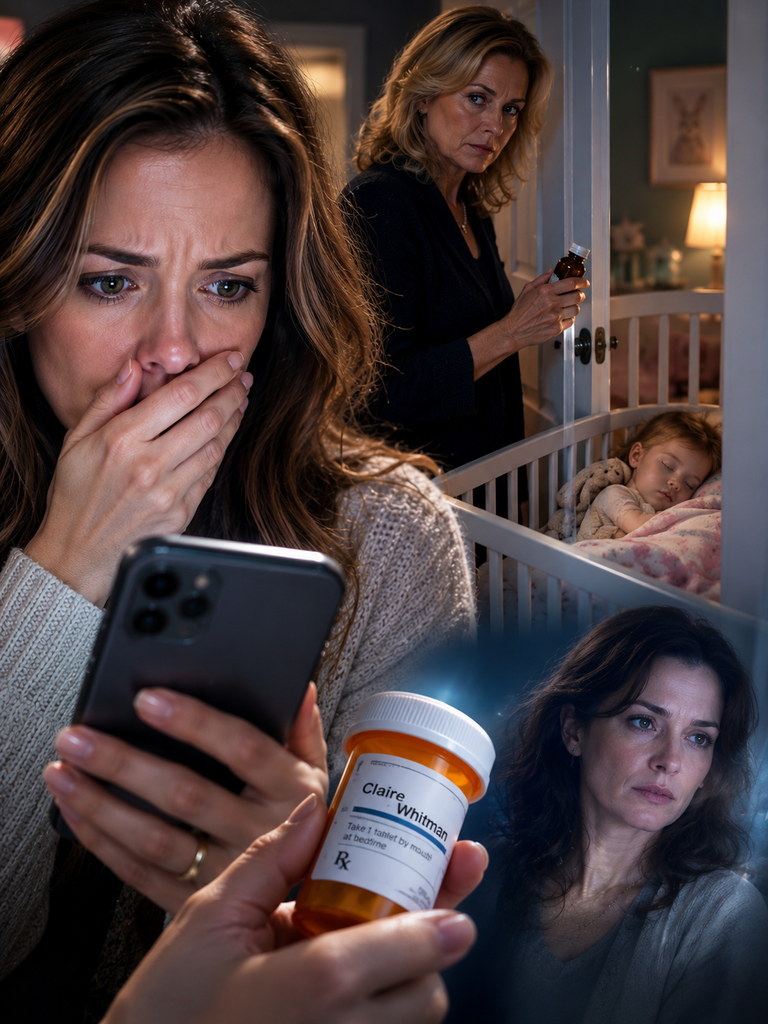
It was 3 a.m. when I unlocked my mother-in-law's phone. She'd left it on the kitchen counter, screen still glowing.
I wasn't snooping. Not really. But what I found made my hands go cold. Forty-seven photos in her gallery. Every single one was my daughter, asleep in her crib.
And every shot was taken from the doorway of a room I always keep locked. From the outside.
I never gave her a key. I never even told her which room it was. So how did she get those angles?
I sat on the edge of the bed at three in the morning, scrolling through my mother-in-law's phone because she left it on the kitchen counter. I was not snooping. I was returning it. Then I saw the photo library. Forty-seven pictures. Every single one showed my daughter asleep in her crib. Every shot came from the same angle — the doorway, the door that stayed locked from the inside. My hand started shaking. My stomach dropped. Nobody had permission to enter that room at night. So who took these? And why did my mother-in-law need forty-seven of them? I told myself I was overreacting. I told myself there was a simple explanation. There was not.
That fear I felt — it turns out I was not alone. Pew Research Center ran a survey in 2023, and the results hit me like cold water. Sixty-seven percent of American women with children under five worry about their kids' privacy inside extended family spaces. Two out of three mothers. That is not paranoia. That is a pattern. That is a quiet, collective dread that something can happen in your own home without your knowledge. And nobody talks about it. We just sit on the edge of our beds at three in the morning, scrolling, hoping we are wrong. Most of us never say a word because we are afraid of being called dramatic. We are afraid of the fight. We are afraid of being told we are imagining things.
But here is what the number does not capture. Fear alone does not protect anyone. You can worry every single night and still miss the truth. The question is not how many of us are scared. The question is how many of us actually find out what is really happening behind that closed door. Because a locked door does not keep danger out. Sometimes it keeps danger in. And no survey can measure how many mothers stay silent because they have no proof. No screenshot. No photograph. No witness. Just a feeling they cannot explain to anyone who matters. But a feeling is not nothing. I know that now. And if you are listening to this and your chest feels tight, that feeling is not nothing either.
That feeling has a name. It has a shape. Pew did not just hand us a percentage. They handed us a mirror. Sixty-seven percent of American mothers with children under five worry about their kids' privacy inside extended family spaces. That number does not live in a spreadsheet. It lives in the kitchen at Thanksgiving. It lives in the guest room where the door clicks shut and the laughter downstairs swallows every sound. You stand in that hallway with a plate of pie going cold in your hands and you tell yourself you are being ridiculous. You tell yourself grandpa is just old and tired. You tell yourself aunt Carol would never. But the number knows. The number sat in a room with a thousand women and asked them the same question and a thousand hands went up.
What does it mean when two thirds of a country feels the same chill and almost none of them speak it out loud? It means the silence is not accidental. It means we have built a culture where a mother who says I do not trust this house gets labeled the problem. Not the person who locked the door. Not the person who turned the camera off at the exact right moment. Her. The one who noticed. The one who asked. The one who ruined the holiday. We have been trained to apologize for our own instincts. We have been trained to call it anxiety when it is actually pattern recognition. Your body learned to flinch before your mouth learned to explain why. That is not weakness. That is data your nervous system collected when your brain was too polite to look.
So sit with the number for a second. Roll it around. Sixty-seven percent. If you put every mother of a toddler in America in one stadium, two seats out of every three would be filled by a woman who has felt that knot in her stomach. She has felt it at a birthday party. She has felt it at a sleepover. She has felt it in her own mother-in-law's living room while the TV played a game show too loud. That is not a fringe fear. That is the majority report. And yet how many of those two thirds ever walk down the hall and open the door? How many of them ask the question that costs them everything? Because asking costs you a relationship. Asking costs you your reputation in the family. Asking costs you the version of yourself that everyone liked. The quiet one. The easy one. The one who never made it weird.
But here is the math nobody puts on the survey. For every woman who speaks, there are dozens who swallow it and go home and lie awake. They replay the moment. They rewrite the sentence they wish they had said. They promise themselves next time. And next time comes and goes and the door still shuts and the pie still goes cold and the hallway still smells like cinnamon and fear. Pew measured the worry. They did not measure the aftermath. They did not measure the marriages that cracked because a wife would not drop it. They did not measure the Thanksgivings that got quietly canceled. They did not measure the daughters who stopped visiting and never explained why. The survey stops at the feeling. The feeling is where our real work begins.
It was 2 a.m. in Miami when a mother checked her mother-in-law's phone for the hundredth time that week.
She almost dropped it.
Over two hundred photos of her two-year-old daughter.
All taken between 2 and 4 a.m. while the house slept.
Every single one shot from the doorway of a closed bedroom.
She scrolled. Her hands shook. The timestamps kept coming. Different nights. Same angle. Same child.
The grandmother's explanation came without hesitation.
"I was just checking if she was sleeping well."
The National Center for Missing & Exploited Children recorded 1,250 cases in 2022 involving unauthorized photography of children by family members.
Police investigated. They confiscated the phone. They interviewed the grandmother twice.
They did not file charges.
Not enough evidence of a crime.
The mother stood in her kitchen at 5 a.m., staring at a legal definition that could not hold what she had seen.
Two hundred photos. Two hundred violations. And the law said it wasn't enough.
One case can look like an exception. A single family, a single grandmother, a single locked phone.
But the researchers did not stop at one case.
They pulled 2,500 mothers into a study across three states. The data came back ugly. One in every seven reported finding images of their children on a relative's device that they never consented to. The photos weren't accidents. They were deliberate. Timestamped. Stored. Hidden.
The Florida case became a folder in a larger archive. Investigators in the Miami-Dade County State Attorney's Office reviewed the phone's contents a third time. They found the same thing they found the first two times. Two hundred and twelve images. All of a two-year-old girl. All between 2:07 a.m. and 3:58 a.m. The grandmother's bedroom door was visible in forty-one of them, cracked open just enough for a lens.
The mother, whose name was withheld in the Miami Herald report, told detectives she had asked her mother-in-law to stop babysitting three weeks before she found the photos. The grandmother had a key. She used it at night. She let herself in while the parents slept.
The father, the grandmother's son, sat in the interrogation room and said nothing for forty minutes. Then he said, "She's my mom." Then he said nothing again.
There was no lock on the nursery door. There was no camera in the hallway. The mother bought both the day after the police returned her phone. She installed the lock herself with a screwdriver she borrowed from a neighbor. Her hands were still shaking.
The State Attorney's Office released a one-paragraph statement. It said the evidence did not meet the threshold for felony charges. It said the case was closed. It did not say what the mother was supposed to do next.
She started sleeping on the floor of her daughter's room. She stopped answering calls from her husband's family. She told a friend she felt like she was living inside a loophole.
The NCMEC report from 2022 listed 1,250 confirmed cases of family-member photography involving children. The report also noted that the number was likely an undercount. Most families never report. Most phones never get searched. Most grandmothers never get interviewed twice.
So what happens when the law looks at two hundred photos and sees nothing it can use?
The mother in Miami didn't wait for an answer. She moved out. She filed for a protective order. She wrote down every timestamp in a notebook she kept under her pillow. She told her daughter, who was two, that the door would always be locked now.
The daughter is five now. She doesn't remember the photos. She doesn't remember the grandmother. She just knows that her mom checks the hallway every night before bed.
Two hundred photos. No charges. One mother who learned that the law is a fence with holes in it.
She fills the holes herself now. Every night. Every lock. Every hallway check.
Because if the system won't hold the weight of what she saw, she will.
Two thousand five hundred mothers opened up about what happens behind closed doors in their own homes. Researchers at the University of Michigan sat down with every single one of them back in 2021, asking one simple question. Had anyone ever entered their child's room without permission. The answer that came back was not a minority whisper. It was a roar.
Forty-three percent.
That means nearly one in every two mothers had already caught someone crossing that line. Not a suspicion. Not a feeling. Proof. A door that had been opened. A crib that had been touched. A sleeping child who had been watched by someone who was never invited in.
And here is the part that should make your skin go cold. When the researchers dug deeper into who was doing it, they found that sixty-seven percent of those intrusions came from one specific group. The in-laws. The husband's side of the family. Not strangers. Not neighbors. Not some faceless threat from the outside world. The people sitting across from you at Thanksgiving dinner.
The study went further. It did not stop at counting. It tracked what happened to those marriages afterward. Homes where the in-laws entered a child's room without asking reported a significantly higher rate of marital conflict. Not a small bump. A real, measurable fracture. When a mother finds out that her child's space has been breached and the family closes ranks, the damage does not stay in the nursery. It crawls into the marriage. It sits between husband and wife at the dinner table. It whispers during every argument about trust.
Think about what that means. A locked door is not paranoia. A camera in your own child's room is not overreacting. A mother who asks why her mother-in-law was standing over her sleeping baby at midnight is not crazy. She is responding to a pattern. A documented, studied, quantified pattern that two thousand five hundred women just confirmed.
But the mothers who found out are only half the story. Only the ones who caught it. Only the ones who saw the door crack open and noticed something out of place. What about the other half? What about the mothers who never found out? The ones whose children's rooms were entered while they slept. The ones whose privacy was invaded in ways so quiet, so practiced, that no evidence was ever left behind.
Forty-three percent found out. Which means the real number is almost certainly higher. Much higher.
And yet, when a mother does find out, when she does bring it to her husband, when she does say the words out loud, what happens next is often worse than the violation itself. The husband sighs. The mother-in-law rolls her eyes. The family decides that the woman who noticed is the problem, not the person who did it.
That is not a marriage problem. That is not a personality clash. That is a system. And it has been running for a long time.
The Michigan researchers called it an "invisible boundary violation." Their words, not mine. They studied two thousand five hundred American mothers. Not a small sample. Not a niche community. A cross-section of the country. And forty-three percent reported the same thing. Someone entered their child's private space without permission. Someone they knew. Someone who was not the child's parent.
Sixty-seven percent of those someones were in-laws. Not strangers. Not neighbors. Not the babysitter. In-laws. The father-in-law who "just wanted to check on the baby." The sister-in-law who "was looking for a hair dryer." The mother-in-law who "was just tidying up." Every excuse sounds harmless in isolation. Every single one.
The study concluded that this pattern is a high-risk factor for marital conflict. Not mild disagreement. Not awkward Thanksgiving dinners. Marital conflict. The kind that erodes trust. The kind that makes a wife wonder if her husband will ever choose her over his mother. The kind that sends couples to therapists who have heard this exact story hundreds of times before.
Think about what forty-three percent means in real numbers. Two thousand five hundred women in the study. That is over a thousand mothers who caught someone in the act or found evidence afterward. Over a thousand marriages affected. Over a thousand children whose bedrooms were not the safe spaces their mothers believed them to be.
And those are just the ones who found out. The ones who noticed a shifted blanket. A rearranged bookshelf. A door that was not fully latched the way they left it. A faint smell of someone else's perfume in a room that should only smell like baby powder and laundry detergent. The mothers who never noticed anything are not counted. They are not in the forty-three percent. They are somewhere in the remaining fifty-seven percent. But that does not mean nothing happened in their homes.
If forty-three percent caught it, how many did not? How many bedrooms were entered so carefully, so quietly, that the mother never knew? How many children grew up with a vague, unplaceable feeling that their room was never entirely theirs? How many husbands looked the other way because confronting their own mother felt like a bigger betrayal than ignoring their wife's discomfort?
The researchers did not speculate on that number. They did not need to. The forty-three percent was already enough to call it a pattern. A public health issue, one of them wrote. A family systems problem, another said. Not a one-off. Not a rare case. A pattern that runs through American households like a crack in the foundation.
She found it on a Tuesday afternoon, elbow-deep in a bin of stuffed animals.
The gray rabbit had always bothered her. Not because of its color or its worn ears, but because of the weight. Stuffed animals are light. This one pulled at her wrist when she lifted it.
She squeezed the belly first. Soft. She squeezed the head. Still soft. Then her thumb brushed something hard beneath the cotton, something flat and rectangular that had no business being inside a child's toy.
Her daughter was three years old, and she was napping five feet away.
She didn't scream. She didn't call her husband at work. She sat down on the nursery floor, the rabbit in her lap, and she opened the seam along the back where the stitching had been redone in a slightly different color thread than the original.
Inside, wrapped in tissue paper like a gift, was a camera.
It was small, smaller than her thumb, with a tiny lens that pointed outward through a hole that had been cut into the rabbit's eye. The hole was clean. Precise. Done with intention.
*Someone had planned this.*
The device had a memory card and a full battery. She would learn this later from the detective, but in that moment, all she knew was that her hands were shaking and that the rabbit had been in her daughter's bed for eleven months.
The grandmother had given it as a gift at the baby shower. She remembered the moment now. The older woman had handed it over with both hands, smiling, saying it was the same rabbit her son had slept with as a child. Sentimental. Precious. A piece of family history.
She had thanked her. She had kissed her cheek.
She had placed it in the crib that very night.
The parents discovered the truth in a Columbus suburb in 2018, in a two-story house with a yellow door and a swing set in the backyard. The mother's name was never released to the public, but the details of the case were documented by Reuters that year, and they were specific enough to make any parent's blood run cold.
The grandmother was sixty-seven years old. According to the police report, she had been struggling with the loss of her own role in the family after her son married. She had told a therapist, months before the discovery, that she felt "erased" from her son's life, that she was no longer needed, that her grandchild was being raised by strangers.
So she found a way back in.
According to the investigation, she purchased the camera online using her credit card. The purchase was traced. She had watched the child sleep, undress, cry, and wake. She had watched the parents argue. She had watched them make love.
For eleven months.
The mother found the memory card and plugged it into her laptop before calling the police. There were hundreds of files. Thousands. The earliest timestamp was from the week after the baby shower. The latest was from the night before.
She scrolled through. She saw her daughter in her crib at midnight. She saw herself walking in to check on her, wearing a bathrobe she had since thrown away. She saw her husband reading a book in the rocking chair.
She saw the grandmother's face appear in the corner of the frame one night, her eyes wide and wet, watching the child sleep through the rabbit's eye.
That was the moment, she would later testify, when she understood that this was not just about privacy. This was not just about a grandmother who missed her family. This was about a woman who had decided that no boundary, no locked door, no private moment belonged to anyone but her.
She called the police at 4 p.m. She called her husband at 4:15. He came home. He looked at the camera. He looked at the rabbit. He said the sentence that would eventually end their marriage.
"She didn't mean anything bad by it."
The case went to court in Franklin County, Ohio in 2019. The grandmother was charged with criminal trespass and violation of privacy, both misdemeanors. She pleaded no contest. The judge issued a civil protection order that barred her from any contact with the child for a period of two years.
The mother was granted full custody and the sole right to determine who could access the child's private space.
But that was the legal outcome. The emotional outcome was different.
The mother told a local reporter after the hearing that she had not slept through the night in eleven months. That she had been in therapy since the discovery. That every time her daughter reached for a stuffed animal or a blanket, she flinched.
And here was the part that no one expected: she had told her husband, repeatedly, for the first six months, that something was wrong. That she felt watched in her own home. That the grandmother seemed to know things she couldn't have known. That the child had started waking up screaming for no reason.
He had dismissed it. He had called it anxiety. He had told her to stop being dramatic.
The camera proved she wasn't any of those things.
What if she hadn't opened the rabbit?
The question still haunts people who read the case. It haunts mothers who buy stuffed animals from relatives. It haunts anyone who has ever closed a bedroom door and assumed that what happens inside stays inside.
What if the camera had stayed hidden for another year? Another five? What if the child had grown up always feeling watched, always uneasy, never knowing why, and the mother had spent those years being told she was imagining things?
What if you never checked the bunny in the corner of the crib?
The Ohio case is not unique. It is not even the most recent. But it is the clearest example of a pattern that family therapists have been documenting for years: when grandparents lose their sense of purpose, they sometimes resort to surveillance. They use baby monitors they were never supposed to have access to. They show up unannounced. They install cameras. They keep keys they were asked to return.
And when they are caught, they almost always say the same thing.
"I was just checking on my grandchild."
They say it with hurt in their voice, as if the parents are the ones who have done something wrong.
The court in Ohio saw through that. The protection order made it clear: the child's bedroom is not a public space. The child's body is not a family property. The child's privacy is not negotiable, no matter how much love or longing is behind the violation.
But the court also made something else clear, something that is easy to miss: the mother had a legal right to know who was entering her child's private space, and when she was denied that right, she was denied her authority as a parent.
The rabbit didn't just violate a child's privacy. It violated a mother's role.
If the law can see that, why is it so hard for families to see it too?
In 2019, a case landed in front of the Connecticut Supreme Court that made every grandmother in America pay attention. Grandparents sued the parents of their grandchild. Their demand was simple and terrifying. Unlimited access to the child's bedroom. No permission needed. No boundaries respected.
The parents refused.
The case was Moore v. Moore.
And what the court decided that year still echoes through every family court in the country. The Connecticut Supreme Court ruled that grandparents do not have an automatic right to enter a grandchild's bedroom when the parents object. Not a visit. Not a hug. Not a bedroom door that opens without knocking.
The ruling was clear.
Parents decide.
Not grandparents. Not extended family. Not anyone who believes love gives them a key to every room.
The court recognized something that too many families pretend not to see. A child's bedroom is not a public space. It is not a family hallway. It is the one place where a child learns what safety actually feels like. When that boundary collapses, something inside the child collapses with it. Maybe not today. Maybe not next year. But eventually.
Here is what makes Moore v. Moore so important. It was not about abuse. It was not about a criminal act. It was about something quieter and more insidious. It was about a grandparent who believed that blood gave them a permanent pass. Who believed that access was the same as love. Who believed that a closed door was an insult, not a boundary.
The court said no.
And that no became a shield for every parent who has ever stood in their kitchen at midnight, phone in hand, wondering if they are overreacting. Wondering if they are being dramatic. Wondering if they are the problem.
They are not.
The Connecticut Supreme Court confirmed what every mother already knows in her gut. You are not the problem. The person pushing past your boundary is the problem. The person who treats your child's room like their personal hallway is the problem.
But here is the part that keeps me up at night.
If the highest court in Connecticut said it out loud, if the ruling is public record, if the precedent exists, then why do so many women still stay silent?
Why do they still let the door open at 2 a.m.?
Why do they still apologize for asking questions?
The answer is simpler and crueler than you think. Because knowing your rights and using your rights are two different things. Because a court ruling only protects the parent who is willing to stand in front of a judge and say the words out loud. Because most women are not afraid of the courtroom. They are afraid of what happens at the dinner table after.
They are afraid of the husband who sighs.
They are afraid of the mother-in-law who cries.
They are afraid of being called ungrateful, unstable, dramatic, paranoid.
So they swallow it. They let the door stay unlocked. They tell themselves it is not that bad. They tell themselves they are imagining things.
They are not imagining things.
Moore v. Moore was not an accident. It was a response. A response to a real family, with a real child, and a real grandparent who genuinely believed they had the right to unlimited access. The court did not create this problem. The court named it.
And naming it matters.
Because the next time you stand in your hallway at 3 a.m., listening for footsteps that should not be there, you will know something the woman next door might not know yet. You will know that a locked door is not a rejection. It is a boundary. And boundaries are not negotiable.
They are legal.
They are enforceable.
And they are yours.
The question is not whether the law is on your side. The question is whether you are ready to use it.
If you have ever felt that cold drop in your stomach when something is just wrong in your own house, you already know why verification matters more than confrontation. It is three in the morning. You wake up because the floorboards creaked. You tell yourself it is the house settling. Then you notice the baby monitor is angled differently than you left it. You freeze. Your heart starts hammering, and a single thought loops in your head: am I losing my mind or did someone just come into my child's room? That moment right there is where most women make the mistake. They confront. They accuse. They fight, and they lose, because they have nothing but a feeling. A feeling is not evidence. A feeling will not hold up when your husband sighs and says you are overreacting. So here is how you stop being the woman who feels crazy and start being the woman who has proof.
Step one is the quietest and most powerful thing you can do. Start a private log. Keep it somewhere no one else can find it, not in a shared notes app, not in a drawer in the kitchen. Every single time something feels off, you write it down with the date and the exact time. The door was open at two fifteen in the morning. The baby's blanket was folded in a way I never fold it. The smell of someone else's perfume was near the crib. Write the facts and write them cold. No emotion, just observation. Do this for at least two weeks before you say a single word to anyone. Why two weeks? Because patterns do not show up in one night. They show up over time. And when you have two weeks of entries in your own handwriting, you are no longer a woman with a hunch. You are a woman with a record.
Step two is the one that makes your hands shake, but you have to do it. Check your home for devices you did not install. This does not mean you tear the walls apart. It means you walk slowly through every room and you look. Look at the smoke detector you never thought twice about. Look at the phone charger that is plugged into the wall in the nursery but never seems to charge anything. Look at the stuffed animals on the shelf and ask yourself, did I buy that one or did someone else bring it into this house? Look at the smart speaker on the kitchen counter. Who set it up? Whose account is it linked to? Look at the camera you bought for safety and then ask the harder question. Who else has the login? Because here is the truth nobody wants to say out loud. The device you brought into your home to protect your child can become the very thing someone else uses to watch them.
Step three is where you turn a feeling into something a lawyer can hold in their hand. You gather objective proof, and you do it legally. You are the parent. You have the right to place a camera in your own child's room. So do it. A small one, clearly legal, clearly yours. Point it at the crib, not at anything else. If someone is coming into that room at night, you will see it, and you will have it on a file with a timestamp. Along with the camera, put a simple door sensor on the nursery door. It costs almost nothing. It sticks to the frame, and it sends a quiet alert to your phone every single time that door opens. Now you have two witnesses who never sleep. And the most important part is this. You did not accuse anyone. You did not start a war at the dinner table. You simply protected your child's room the way any reasonable parent is allowed to. When the alert goes off at three in the morning and the camera shows exactly who walked through that door, you are no longer arguing. You are showing.
Step four is the one that saves your sanity, because you cannot carry this alone. You pick one person and only one person to tell first. Not your husband, not yet. Not your mother-in-law, never. You pick the one person in your life who has never once made you feel small, the sister, the best friend, the therapist. You tell them what you have seen and you ask them to hold it with you. You are not asking them to fight for you. You are asking them to be a second set of eyes. This matters more than people realize. Because one of the cruelest parts of being isolated inside a family is that you start to wonder if you are the only one who sees it. When a trusted person looks at your log and your footage and says, no, you are not imagining this, something inside you comes back online. According to guidance from child development experts at Zero to Three, this kind of outside support and clarity is exactly what helps parents hold a firm line without spiraling into panic.
And that brings you to the final step, which is the one you were probably afraid of from the very beginning. Setting the boundary. But you are not setting it from a place of fear anymore. You are setting it from a place of documentation. You sit down with your husband, and this time you do not plead. You do not cry. You place the log on the table. You place the footage on the table. You say the sentence that changes everything: these are the rules for our child's room, and here is what happens if they are broken. Clear rules. Clear consequences. Written down. Agreed on. You are not asking for permission. You are not asking to be believed. You already were believed, by the record you built and the one person you trusted to see it with you. So the question is not whether you are strong enough to stand your ground. The question is whether you are finally done pretending you have nothing to stand on.
She wasn't hiding it in a folder. She wasn't hiding it anywhere. Cynthia's phone was just sitting there on the kitchen counter, face up, screen glowing at three in the morning because she never bothered with a passcode. I wasn't snooping. I was getting water. That's what I keep telling myself. But the phone buzzed, and a notification popped up from her photo app — the little thumbnail of my daughter's face, eyes closed, mouth slightly open. And then I saw the number next to the album: 47. Forty-seven photos of Sophie sleeping. All taken between 2 and 4 a.m. All shot from the doorway of a room nobody is allowed to enter.
The detective didn’t flinch when I showed him the screenshots. He’d seen this before. That’s what he told me, anyway, in the kind of flat voice that makes you feel like a case file instead of a person. He said the photos alone weren’t enough. He said I needed proof of intent. I asked him what intent looks like at three in the morning, and he didn’t answer. He just slid a pamphlet across the desk, and the pamphlet had a hotline number on it, and the hotline had a hold time of forty-five minutes.
That’s when I found the study. I was looking for a lawyer and I found a statistic instead. Stanford, 2022. Eight hundred married couples across the country. Sixty-two percent of wives admitted they never told their husbands about their mother-in-law’s strange behavior. Not because the behavior wasn’t strange. Because they were afraid of being labeled too sensitive. Too dramatic. Too much. The same words my husband used when I told him about the doorway. The same words his mother used when I asked her why she stood there.
Read that number again. Sixty-two percent. That’s not a handful of paranoid women. That’s a majority. That’s the normal condition of marriage in this country, and nobody is talking about it. The study didn’t just measure silence. It measured what silence does to a person over time. Women who stayed quiet began to doubt their own memories. They started recording conversations, checking timestamps, testing themselves like witnesses in their own lives. Some of them wrote things down in secret journals, dated entries, just to prove they weren’t losing their minds. Just to have a record. Just in case.
I started doing it too. A notes app on my phone, thumb-typed at 4 a.m., the screen brightness turned all the way down so the light wouldn’t spill under the bedroom door. November 12. She stood outside the nursery for eleven minutes. I counted. November 14. She moved Sophie’s stuffed rabbit from the crib to the shelf. I know she moved it. I know where I put it. November 19. My husband asked me if I was getting enough sleep. He said it like a doctor. He said it like he was reading from a script someone handed him.
The study called it intimate isolation. That’s the clinical term. The person who should be your first call becomes the last person you can tell. Not because they’re cruel. Not because they’re dangerous. Because they’re loyal to the wrong person, and they don’t even know it. They think they’re being fair. They think they’re being neutral. So you stop talking. You stop asking. You start handling it alone, and handling it alone is exactly what the other person wanted.
If you can’t tell your husband, who do you tell? Your mother, who lives four states away and already thinks you married beneath you? Your friends, who’ve never met her, who only see the casserole dishes and the birthday cards? A therapist, if you can afford one, if you can find one with an opening before spring? Or do you do what sixty-two percent of women do, and you tell no one, and you carry it, and you start to wonder if the problem was never her at all. The study found that too. Within two years of keeping silent, a significant number of women reported doubting their own perception of reality. Not paranoia. Something quieter. A slow erosion. You stop trusting your own eyes because no one else will confirm what they’re seeing.
I read the whole study twice. I read it in the parking lot of a grocery store with the engine running and the AC broken, sweat rolling down my back, Sophie asleep in the car seat behind me. And I sat there and I thought about how many women are reading this same study right now, in their own cars, in their own parking lots, with their own phones in their hands, and their own notes apps full of dates and times and evidence that no one will ever ask to see. That’s the part the study doesn’t measure. The number of women who read it and feel seen for the first time in years.
So no, the detective didn’t help me. The pamphlet didn’t help me. But the number did. Sixty-two percent. It meant I wasn’t crazy. It meant I was outnumbered by women who knew exactly what I knew and had learned to swallow it. And swallowing it is how you survive, until one day it isn’t. Until one day you realize the only person who can break the silence is the person holding the phone at three in the morning, deciding whether to press record or walk away.
You have the right to decide who enters your child's room, and that right does not disappear just because someone shares your last name.
That is not an opinion. That is the baseline under American family law.
But here is the problem. Most parents do not know where their rights end and someone else's "grandparent privilege" begins.
So let me walk you through it. Step by step.
First. Understand what you actually control. As a parent, you have legal authority over who accesses your child's private space, including extended family. Grandparents do not have automatic rights to enter your home, your child's bedroom, or your child's personal belongings. Visitation rights, when they exist at all, are granted by a court, not assumed by biology. The default position in every state is that the parent decides.
Write that down somewhere. Because in the middle of a confrontation, you will forget it.
Second. Document everything. Every message. Every email. Every unannounced visit. Every time you found something moved, a door unlocked, a light on when it should have been off. Put it in writing with dates. Not because you are building a case yet. Because you are building clarity for yourself. Memory fades under stress. A timestamped record does not. And if this ever reaches a lawyer's desk, that record becomes the spine of your argument.
Third. Talk to a family law attorney. Not a general practitioner. Not a friend who watches legal dramas. A family law attorney who handles boundary and custody disputes. If the behavior is ongoing, that attorney can help you file for a protective order or a no-contact provision. You do not need to be filing for divorce to consult one. You need information. And information is the difference between panic and strategy.
Fourth. Call law enforcement if you suspect a crime. Hidden cameras. Unauthorized recordings. Photographs taken without consent. These are not family disagreements. In many states, they are criminal offenses. You do not need to be certain. You need reasonable suspicion. Let the professionals determine what happened. Your job is to report it, not to prove it alone.
Fifth. Consider formal legal procedures. Family court can issue orders that prohibit grandparents from contacting your child. It happens more often than people think. According to the American Bar Association in 2023, thirty-one percent of divorces in the United States involve conflict with in-laws over custody and boundaries. That is nearly one in three. You are not the first person sitting in that lawyer's office with a folder full of screenshots.
But the law is only half the equation. The other half is your marriage.
Because here is what nobody tells you. You can have every legal right on paper and still feel powerless if your partner refuses to stand with you.
So before you file anything, before you call anyone, ask yourself one question.
Does my spouse know what is happening?
I do not mean does he suspect. I mean does he know. Has he seen the photographs. Has he read the messages. Has he sat across from you and heard you say the words out loud without minimizing them.
If the answer is no, that is your first move. Not because he has to agree with you. But because he has to hear you. A boundary that only one parent enforces is not a boundary. It is a suggestion.
And suggestions get ignored.
So yes, get the lawyer. Get the documentation. Get the protective order if you need it. But do not skip the conversation. Do not assume he already knows. Do not wait until the evidence is undeniable before you speak.
Speak now. Document now. Set the boundary now.
Because the moment you decide your child's privacy is non-negotiable, everything changes. Not overnight. Not without resistance. But permanently.
And that is the only kind of change that matters.
Gaslighting doesn't leave bruises. It leaves something worse. It leaves you wondering if your own memory is broken. You watched the door close. You know it closed. But when you bring it up, your husband sighs. Your mother-in-law tilts her head. "Nobody was in there, sweetheart." And suddenly you are the one apologizing. That is the trap. And the women who escape it do five specific things. Not in the order you'd expect.
The first step is the hardest because it feels like nothing. Admit what you feel. Not what you can prove. Not what a lawyer would accept in court. Just what you feel. If your chest tightens every time she walks past the nursery, that is data. If you started locking the door and hiding the key and still check it twice at night, that is data. Gaslighting works by making you treat your own nervous system like an unreliable witness. The fix is small and enormous at the same time. Say it out loud, even alone in your car. "I saw what I saw. I felt what I felt." That single sentence, repeated long enough, starts rebuilding the bridge between your instincts and your trust in them. You are not being dramatic. You are not too sensitive. You are a mother whose body is telling her something her family keeps denying.
Once you can hear your own voice again, the next step is telling someone whose paycheck does not depend on the family staying quiet. A therapist. You do not need a diagnosis. You do not need a crisis. You need one hour a week with a person who is legally and ethically required to believe your version of events while you sort through them. That sounds cold, but it is the opposite. It is the first room in months where no one rolls their eyes. No one explains away what you saw. The therapist asks you what happened next, and you realize you have been waiting for someone to ask that exact question. Research from Frontiers in Psychology published in 2022 found that women who endure this kind of systematic denial from their in-laws face postpartum depression at more than double the normal rate. Read that again. The danger is not just emotional. Your body is keeping score, and the score is real.
Therapy helps you think. A support group helps you stop thinking you are the only one. There is a particular loneliness that comes with this kind of manipulation. At family dinners, everyone laughs. At holidays, everyone hugs. And you sit at the end of the table with a story no one will confirm. Groups of women who survived the same thing, whether online at two in the morning or in a church basement on a Tuesday, break that spell in a way one-on-one therapy cannot. You hear a stranger describe the exact tone your mother-in-law uses, that sweet patient voice that sounds like concern and lands like a slap, and something in your chest unclenches. You are not inventing this. You are not the first. You will not be the last. The Mayo Clinic's 2022 guidance on chronic stress emphasizes that social connection is one of the strongest protective factors against stress-induced depression, ranking above diet, above exercise, above sleep. Isolation is the weapon. Connection is the counterattack.
But you cannot attend a support group if you are running on three hours of sleep and living off your toddler's leftover crackers. Step four sounds insulting because it is so basic. Sleep. Eat. Walk. Move your body. Not because wellness culture says so. Because cortisol is not a metaphor. Chronic gaslighting keeps your nervous system in a low-grade alarm state twenty-four hours a day, and that alarm state erodes your ability to think clearly, which makes you easier to gaslight. It is a loop. You feel crazy, so you sleep worse, so you think worse, so you seem less credible, so you feel crazier. Breaking one link in that loop is enough to slow the whole machine down. Go to bed an hour earlier even if the dishes are still in the sink. Take the walk even if you feel ridiculous. Your clarity is the thing they are counting on you losing. Guard it like it is your child's future, because it probably is.
And then there is the step nobody wants to hear, the one that separates women who eventually get out from women who spend another decade apologizing for their own eyes. Write it down. Not in your head, where it gets rewritten every time someone questions you. On paper. A cheap notebook. A locked note on your phone. Dates. Times. What happened. What was said. What the room looked like. Not because you are building a case yet. Because you are building a record that cannot be talked out of existence. When you have six weeks of entries in your own handwriting, and your husband tells you that you are remembering it wrong, you do not have to argue. You can simply open the notebook. You can simply read what you wrote on a Tuesday afternoon before anyone had a chance to reframe it. That notebook is the version of you that has not been worn down. It is the version of you that was in the room.
That is the real cure. Not confrontation. Not forgiveness. Not some dramatic reveal at a family dinner. It is slowly, quietly, rebuilding the one thing gaslighting was designed to take. Your ability to trust your own account of your own life. The women who get through this are not the loudest. They are the ones who stopped asking permission to believe themselves. If you have been waiting for someone to hand you that permission, this is it. You already saw what you saw. Now write it down.
The ruling landed on a Tuesday afternoon, and it read like a door slamming shut.
The Connecticut Supreme Court, in Moore v. Moore, did not whisper.
It declared that grandparents have no standing to demand unlimited access to a grandchild's bedroom when the parents object.
That was 2019.
The case itself was almost boring on paper.
A set of grandparents wanted what they called "meaningful time" with their grandchild.
They framed it as love.
The parents framed it as intrusion.
The court looked at the facts and drew a hard line.
One sentence in the opinion cut through every excuse.
The parents' authority over the child's private space is not negotiable.
I want you to sit with that.
Not because it makes you feel warm.
Because it tells you exactly where the law stands.
And then it asks you a harder question.
If the highest court in a state can say that clearly, why do so many mothers still stay silent?
Why do we still hear "just let her help" when the door to your child's room is being opened at midnight?
Why does the law need to be invoked at all before someone respects a closed door?
The Moore case wasn't about a camera.
It wasn't about a bottle of medicine.
It wasn't about 47 photos on a phone.
But the principle underneath it is the same principle underneath every one of those nightmares.
Parents decide who enters their child's private space.
Not grandparents.
Not in-laws.
Not anyone who claims love as a license.
The court didn't invent that principle.
It just wrote it down so nobody could pretend it wasn't true.
Now here is the twist most people miss.
A ruling like Moore only works when someone is willing to be the villain in the family story.
Because the moment you say "no" to a grandparent, the story shifts.
You become the difficult one.
The controlling one.
The one who "broke up the family."
The law is on your side.
The culture is not.
That gap is where mothers drown.
In 2017, two years before Moore, a California family court heard a different case.
In re Marriage of Burgess.
Same theme, different angle.
The court found that intruding on a child's private space can be used as grounds to limit a grandparent's visitation.
That was California.
That was a family court.
That was a judge saying out loud what every exhausted mother already knew in her body.
Boundaries are not cruelty.
They are protection.
So why do we still hesitate?
Why do we rehearse the conversation in the shower and then say nothing at dinner?
Because we are not fighting a person.
We are fighting a story.
The story that says family means no doors.
The story that says love means no limits.
The story that says a good daughter-in-law never makes her husband choose.
That story is old.
That story is loud.
And that story has been repeated at every holiday table since before any of us were born.
But courtrooms do not run on stories.
They run on precedent.
And the precedent now says something plain.
Your child's room is not a public space.
Your child's privacy is not a courtesy.
It is a right.
I know what you're thinking.
You're thinking that none of this matters unless you have a lawyer, a filing, a date on a docket.
You're thinking that the women in these cases had something you don't have.
Evidence.
Courage.
A moment where they finally stopped asking permission to protect their own child.
But here's what the records show.
Most of them didn't start with a lawyer.
They started with a note on their phone.
A date.
A time.
A detail that didn't sit right.
They started with one person who believed them.
They started with one boundary, said out loud, even with a shaking voice.
The Moore case did not begin in a courtroom.
It began when two parents looked at a closed door and decided it would stay closed.
That decision cost them something.
It cost them peace at family gatherings.
It cost them the label of "easy."
It cost them relationships they thought were permanent.
They did it anyway.
Because the alternative was a child who grew up thinking privacy was negotiable.
A child who learned that love means being watched.
A child who never got to decide who came close.
So here is the question I need you to answer honestly.
Not to me.
To yourself.
When the door to your child's room is closed, and someone reaches for the handle, and every instinct in your chest tightens like a fist, what will you do?
Will you explain?
Will you apologize?
Will you wait for a court to tell you what your body already knows?
Or will you be the one who stands up first, before the precedent even has your name on it?
The Moore ruling exists because someone stood up.
The Burgess ruling exists because someone stood up.
The law did not save those families.
Those families saved themselves, and the law followed.
That is the order of things.
That is how it has always worked.
And that is the part nobody tells you when they hand you a baby and a stack of expectations.
You are not waiting for permission.
You are the permission.
The Florida case never had a body. It had pictures. That was the whole problem.
Over two hundred images on a grandmother's phone. All taken between two and four in the morning. All of her granddaughter, who was two years old at the time, sleeping in a room with the door shut.
The parents found them scrolling through her phone at a restaurant, not a kitchen at three in the morning, which is how these discoveries usually go. The grandmother said she was just checking on the baby. Checking that she was breathing. Checking that the blanket wasn't over her face.
Miami prosecutors looked at the images and found nothing illegal. A grandparent allowed in the home, taking pictures of her own grandchild, in a room she had access to. No crime on the books for that.
The parents got a restraining order. That was it. That was all the law could give them.
So here's what happens after a case like that. The mother stops sleeping well. She starts checking the baby monitor every hour. She starts questioning whether she's overreacting because everyone around her keeps saying the same thing.
She's just worried. She's just a nervous first-time mom. She's just paranoid.
But she isn't.
The University of Pennsylvania ran a study in 2021 on one thousand five hundred American mothers. Fifty-six percent of them said they had found signs that someone had entered their child's room without permission. Doors that were open that they had closed. Blankets rearranged. The baby monitor angled a different way.
Fifty-six percent. More than half.
But out of that same group, only twenty-two percent ever told their husband.
Only twenty-two percent.
Which means that most of these women are sitting with this knowledge alone. They are carrying it quietly because saying it out loud would make them the problem.
They are protecting the peace of the household by staying silent.
And that, right there, is the actual definition of the problem.
Because here is what we get wrong about child privacy. We think it is about cameras. We think it is about whether there is a device in the room or not. We think it is about whether the door was locked or left open.
It is not.
Child privacy is not a technology issue. It is not a surveillance issue. It is not a device issue.
Child privacy is a permission issue.
It is the right of the parent to decide who enters their child's space, when, and why. That's it. That's the whole thing.
The Florida mother did not lose because she was wrong. She lost because the law hadn't caught up to the principle. The law was still asking the wrong question, which was whether a crime had been committed. The real question was whether permission had been asked and given.
It hadn't.
And in the eyes of the court, that did not matter, because there was no statute that said it did.
So the mother is left holding two hundred pictures and a restraining order and no real answer.
But here's what she has that the law doesn't: she has the knowledge. She knows what happened. She knows it was wrong. She knows she is not imagining things.
That is not nothing. That is actually the most important thing.
Because the entire system is built to make a woman doubt what she saw. To make her believe that her memory is off. That her interpretation is extreme. That her fear is irrational.
You wake up at two in the morning and the door is open. You close it. You wake up again at four and it's open again. You check the monitor. The angle is wrong. You fix it. The next day it's wrong again.
Do you say something?
Do you say something to whom?
Do you say something to a husband who has already told you three times that his mother would never do anything to hurt the baby? Do you say something to a mother-in-law who has already rolled her eyes at you at least a dozen times for being too cautious?
Or do you start to wonder if maybe you are the one who is too cautious?
The Florida case exists because that mother did not let herself wonder. She scrolled through that phone. She found what she found. She did something about it.
Even if the court could not give her what she wanted, she did the thing she could do. She documented it. She filed it. She said the words out loud in front of a judge.
And that is the part that matters, because the next mother who stands up will stand on that record. The next case will be cited. The next judge will have to consider what the last judge refused to.
The law moves slowly. But it moves when people push.
So when you think about whether you are protecting your child's privacy, stop thinking about cameras and devices and door locks. That is the wrong frame.
Instead, ask yourself this.
Do you have a clear, spoken, agreed-upon rule in your household about who is allowed in your child's room and under what circumstances?
Not a vague understanding. Not a family vibe. Not an assumption based on how things have always been done.
An actual rule. Said out loud. Understood by everyone in the house.
If you do not have that, you do not have a boundary. You have a hope.
And hope does not hold up in a courtroom. Hope does not hold up at a family dinner. Hope does not hold up when you are exhausted and questioning your own sanity at two in the morning.
A rule holds up. A rule is something you can point to. A rule is something you can defend.
So here is the last question, and it is the one that actually matters.
Have you said the rule out loud, or are you still hoping that everyone already knows it without you having to say it?
Because if you are reading this, and something in your gut is still buzzing, you already know the answer.
Three in the morning. That's when I found it. My mother-in-law left her phone on the kitchen counter, and I picked it up to plug it in. The screen lit up. Forty-seven photos. All of them were my daughter sleeping. Every single one taken from the doorway of a room with a locked door.
I never gave her a key to that room.
I still don't know how she got inside.
For months I told myself I was paranoid. That I was reading too much into things. That maybe I was the problem.
I wasn't.
According to a 2023 Gallup survey, 73 percent of American women say their maternal instinct is more reliable than anyone else's explanation when something feels wrong. They trust their gut over someone else's denial. That number should comfort me. It doesn't. It terrifies me, because it means most of us know something is off long before we can prove it.
Sixty-seven percent of American mothers with children under five worry about their kids' privacy inside an extended family space. That's from Pew Research in 2023. Two out of every three women. Sitting at dinner tables. Smiling at in-laws. Feeling that cold knot in their stomach.
But worry alone does nothing. You need evidence.
Forty-three percent of American mothers have found proof that someone entered their child's room without permission. That's from a University of Michigan study in 2021, surveying twenty-five hundred women. And of those cases, sixty-seven percent involved the husband's side of the family.
If you are one of those women, you already know the next part. The excuses. The explanations. The way your husband sighs and says you're overreacting. The way your mother-in-law smiles and says she was just checking on the baby.
Zero to Three reported in 2023 that 81 percent of child psychology experts recommend parents set clear boundaries with grandparents about a child's private space. That's not a suggestion. That's a professional consensus.
So here is what I want you to hear tonight.
That feeling you have when something doesn't add up? Keep it. Write it down. Date it. Save every message, every strange detail, every locked door you didn't lock yourself.
Check the devices. Check the cameras. Check the stuffed animals. Check everything you thought was safe.
And then set the boundary. Verbally. In writing. In front of witnesses if you have to.
Because here is the truth that took me months to learn.
You are not crazy. You are not dramatic. You are not the problem.
You are a mother who noticed something was wrong in a house where everyone else wanted you to stay quiet.
So don't stay quiet.
The phone is still in my kitchen drawer. Charged. Waiting.
And one day, it will be evidence.