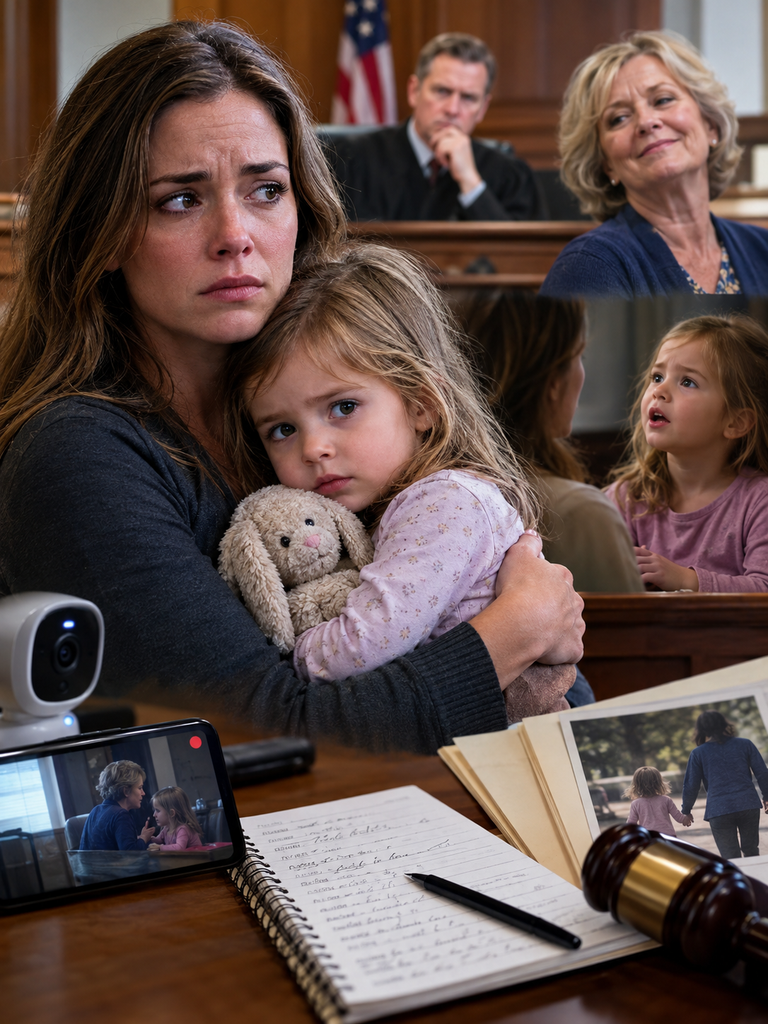
She said four words I never taught her.
I heard them through the door.
They were about me.
I work six and a half hours a day.
She's three.
Someone taught her that.
And it only happens after she stays with Grandma.
Your three-year-old looked up from the carpet and said a sentence you never taught her.
Something about you.
Something ugly.
She said it in that sweet, clumsy voice only toddlers have.
You froze with the dish towel still in your hand.
You work six and a half hours a day away from her.
You kissed her forehead at seven in the morning.
You came home at five.
That sentence did not come from you.
So you started writing things down. Tiny notes. Dates. Times.
And what you found made your stomach drop.
The same sentence kept showing up. Always after the days she spent at grandma's.
Every three-year-old carries around a thousand words in her mouth.
That sounds small.
But she understands two to three thousand more.
She can repeat a whole sentence back to you, word for word, even when she has no idea what it means.
That is the part parents miss.
They hear the words and think she is just babbling.
She is not.
She is a recorder.
And she has been recording someone.
Researchers who study how children pick up language found something strange years ago.
Kids do not only learn words when you sit them down and teach them.
They learn by overhearing.
They listen to adult conversations that are not even aimed at them.
By age three, a child can pick up a new word just from hearing it float past her in the next room.
Nobody sat her down for a lesson.
Nobody handed her a flashcard.
She just heard it.
Again. And again. And again.
Which means the person who taught her that sentence never had to face her.
They only had to talk near her.
Now think about what a toddler does with a sentence that carries weight.
Between ages two and four, a child can hold onto a phrase she heard and repeat it back perfectly.
Not in an hour.
Not the next day.
Weeks.
Researchers at Emory found that emotionally loaded sentences stick far longer than flat, neutral ones.
The brain tags them.
Files them somewhere deep.
And pulls them out later, in the exact right moment, like she is reading from a script she never knew she had.
Here is what most parents do not want to hear.
A three-year-old cannot tell the difference between a joke and the truth when it comes to family and feelings.
When you say something like mommy does not really love you, she does not hear a joke.
She does not hear an exaggeration.
She does not hear an adult being careless.
She hears a fact.
She files it under things that are true about my life.
Researchers at Harvard who study early childhood development put it plainly: at three, a child takes emotional statements at face value.
There is no filter.
There is no skepticism.
There is no wait, that does not sound right.
There is only the sentence, landing, staying.
And judgmental language does not just stick.
It sticks faster.
A team at the Max Planck Institute found that sentences loaded with judgment are absorbed by a three-year-old about two and a half times faster than neutral ones.
Two and a half times.
That is not a small gap.
That is the difference between a sentence rolling off her and a sentence sinking in.
So when someone says a cruel thing about you near your daughter, her brain does not treat it like background noise.
It treats it like a headline.
You were not there for those hours.
You were at your desk.
You were driving home.
You were making dinner.
And in that window, someone was feeding your child a version of you that you have never met.
The notes in your drawer were not paranoia.
They were a pattern.
You just did not want to believe it yet.
Because believing it meant asking a question no mother wants to ask.
If she remembers every word, then who has been speaking those words into her?
And how long has it been going on?
Twenty-six percent of children under five in America are cared for by their grandparents while their parents work.
That is not a small number.
That is one in four toddlers spending their weekdays with someone who is not their mother.
And that someone has unlimited access to their vocabulary.
Meanwhile, the average working mother spends six and a half hours a day away from her young child.
Six and a half hours.
That adds up to thirty-two and a half hours every single week.
Almost a full work week of separation between a mother and a three-year-old.
Do you see the math yet?
The child spends twenty-seven hours a week with a grandparent who serves as the primary caregiver.
Twenty-seven hours.
That is more than fourteen hundred hours a year of exposure to a second household's rules, habits, and words.
What happens in fourteen hundred hours?
A lot can be planted in fourteen hundred hours.
Fifty-eight percent of children under five are in non-parental care while their mother works.
Fifty-eight percent.
That means more than half of American toddlers are in environments where no one is monitoring what language they absorb.
No one is taking notes.
No one is checking what phrases they bring home.
And here is the part that makes your stomach drop.
Twenty-seven percent of children under five in the U.S. live with or near their grandparents.
That is not occasional visits.
That is constant proximity.
That is weekly exposure.
That is a grandparent who sees your child more waking hours than you do.
You leave for work at seven.
You come home at five-thirty.
In between, your child ate breakfast, had a snack, took a nap, and learned three new sentences.
You were not there for any of them.
You do not know who said what in those thirty-two and a half hours.
You do not know what tone of voice was used.
You do not know what message was repeated three times, five times, ten times until it stuck.
The grandparent is not just watching your child.
The grandparent is shaping your child's inner voice.
And there is no camera in the room.
There is no transcript of the day.
There is no log of what words were spoken in front of a three-year-old who absorbs everything and forgets nothing that carries emotional weight.
So ask yourself the question that will not leave you alone.
If a child spends thirty-two and a half hours a week with someone who is not you, who is actually raising that child's perception of you?
Fifty-eight percent of children under five are in non-parental care while the mother works. That means more than half of all young children in America spend their daytime hours in an environment where the mother has no linguistic authority. She cannot veto a sentence. She cannot correct a nickname. She cannot stop a story that gets told every single afternoon at three o'clock, the one where grandma laughs and says oh your mother was exactly the same way, so stubborn, so difficult, and the child hears it as a permanent label, not a joke.
Twenty-six percent of these children are cared for regularly by grandparents. The grandmother who watches your son from eight to four has her own vocabulary. She has her own opinions about your career. She has her own memories of your childhood, and she has her own way of telling them. When she says your mother never listened, she is not just talking. She is programming. The child absorbs the tone, the sigh, the eye roll, the little laugh that follows. None of that shows up in a text message you receive at lunch.
Twenty-seven hours a week with grandparents when they are the primary caregiver. Over one thousand four hundred hours a year. That is more instructional time than a full school year. That is more hours than your child will spend with any teacher until kindergarten, and there is no curriculum, no oversight, no parent-teacher conference. Just a kitchen table, a television in the background, and a grandmother who talks while she cooks.
What gets taught in those hours? How to speak about your mother. How to speak about work. How to speak about bodies and money and marriage. Whether women complain. Whether men leave. Whether love is something you earn or something you are owed. A three-year-old does not distinguish between opinion and fact. He hears a sentence once and files it under truth. He hears it ten times and files it under identity.
Now do the math on your own week. Six and a half hours a day away from your child. Thirty-two and a half hours a week where your voice is absent and another voice is present. If your mother is the caregiver, that is one thousand six hundred ninety hours a year. If it is a daycare worker, it is the same number of hours with a stranger who has her own beliefs, her own patience threshold, her own bad mornings.
What is being said in that room at ten in the morning when your child is crying and the caregiver is tired? What sentence does she repeat? What word does she use for your child's body, for his fear, for his anger? Do you know? Can you know? There is no log. There is no recording. There is only a child who comes home and repeats something one day, something you have never said, something that makes you stop cold in the doorway with your keys still in your hand.
Thirty-two and a half hours a week. Grown adults pay thousands of dollars for therapy to undo sentences spoken in that exact time slot by that exact person. The child does not get to choose the narrator. The mother does not get to approve the script. Whoever holds the child for thirty-two point five hours a week holds the pen.
Gaslighting didn't start as a family issue. It started as a play.
A 1938 thriller called Gas Light. A husband slowly dims the lights and tells his wife she is imagining it.
She believes him.
She shouldn't.
But she does.
The term entered psychiatric literature in 1969, when Barton and Whitehead described the same pattern in real marriages.
The same pattern that now plays out between a mother and her mother-in-law.
The same pattern nobody talks about.
Not the dramatic version.
The quiet one.
A mother scans the room for her child's cup. Her mother-in-law says she never left it there.
The mother knows she did.
But she starts to doubt.
The doubt is the weapon.
A study of 301 women found something almost nobody expects.
Seventy-four percent had experienced gaslighting in their relationship with a mother-in-law or the in-laws' family.
Not a fight. Not a disagreement. Denial.
Your own memory used against you.
And it gets darker.
Sixty-two percent said the denial was so constant they began to question their own recollection.
Not their judgment. Their memory of what they saw with their own eyes.
That is what makes this so hard to catch.
The victim isn't confused.
The victim is trained.
Trained to stop trusting the one thing every mother has.
Her gut.
Psychologists call it motherhood intuition. It sounds soft. It sounds like something people roll their eyes at.
It isn't soft.
It's biology.
A 2015 study using brain imaging found that oxytocin heightens a mother's ability to detect danger signals from her child by about 40 percent.
Forty percent.
That is not anxiety. That is not paranoia. That is the nervous system doing exactly what it was built to do.
And that is why the dismissal works.
Because when she says she noticed something, she isn't guessing. She is using a signal system that has been calibrated for years.
But here is the trap.
Seventy percent of mothers in a large U.S. survey said they never spoke up about their doubts.
Why.
They were afraid.
Afraid of being called jealous. Afraid of being called dramatic. Afraid of being called the one who has a problem.
Read that again.
The person with the evidence stays silent because she is scared of how she will look.
The person doing the damage never has to say a word in her own defense.
Parents Magazine asked mothers another question in 2020.
Sixty-five percent said their child had said something strange they couldn't trace.
A phrase. A word. A sentence.
Forty percent later traced it back.
To a grandparent. Or a caregiver.
Not the mother. Never the mother.
So the mother now has two jobs.
Raise her child.
And investigate every sentence that comes out of that child's mouth.
Who has time for that.
Who has the energy for that.
That is exactly why it works.
Gaslighting doesn't need a locked room. It doesn't need a raised voice. It needs repetition and a person exhausted enough to stop fighting it.
Every dismissal is small. Every dismissal is deniable.
And every dismissal teaches the mother one more lesson.
That her version of events will always lose.
But here is the part that has to land.
This isn't a competition between two adults. There is a third person in the room.
The child.
A three-year-old who repeats what they hear. A three-year-old who doesn't know the difference between a joke and a truth. A three-year-old who is being taught something the mother hasn't been told yet.
If the mother is being gaslighted, what is the child learning?
Not just words. Patterns. Permission.
Permission to believe the version of reality that someone else is offering.
So watch what gets said in front of a child. Watch who denies what. Watch whose memory gets called into question.
And ask the one question nobody wants to ask out loud.
If she is being told she is imagining things, what is she actually seeing?
A three-year-old can repeat a sentence she has no way to understand.
That is where this starts.
Not with a fight. Not with a threat.
With a string of words she cannot yet unpack but can already store whole.
What does a three-year-old actually know?
She has roughly one thousand words in her own mouth. She understands somewhere between two and three thousand more. According to the American Speech-Language-Hearing Association, that gap between speaking and understanding is where the damage quietly lives. She can carry a sentence she hears without knowing what it means. She can hand it back to you days later, perfect and terrible.
So where does she learn it?
Not from you.
She learns it from the room.
Akhtar, Jipson and Callanan found that children pick up speech mainly by overhearing adults who are not talking to them. By three, a child can absorb new words from a conversation that was never aimed at her. She is background noise in someone else's day. And she is recording.
Now add the part nobody wants to sit with.
Bauer's work on early memory shows that children between two and four can hold a sentence for twenty-four hours, sometimes weeks, and replay it with accuracy, especially when that sentence carries an emotional charge. A neutral line fades. A loaded line sticks.
Ask yourself why that is.
A three-year-old does not sort real from play when the sentence is about family feeling. The Harvard Center on the Developing Child reported that a child hears a line like "your mother doesn't love you" and files it as plain truth. No filter. No joke tag. No context. Just a fact, copied down in permanent ink.
And the speed?
A judgmental sentence reaches a three-year-old two and a half times faster than a neutral one, according to the Max Planck Institute for Psycholinguistics. Emotion opens the door before meaning even arrives. That is why some lines never leave.
They settle.
They wait.
And then they come back.
Days later, in your kitchen, in your arms, from the lips of your own child. Not rehearsed. Not malicious. Just replayed, exactly as recorded, tied to the same feeling it was wrapped in the first time.
That is the part that stops your breath.
You did not teach her this line. You were not there when she learned it. But someone was. Someone was there long enough, often enough, close enough, that the sentence found a home in her before you ever heard it leave her mouth.
Ask yourself what else she has been handed.
Ask what else she is storing right now, in this moment, waiting for the right day to hand it back.
Then there is the pattern that finally makes it worse than a one-time slip.
The American Psychiatric Association, working from the fifth edition of the diagnostic manual, describes something called emotional grooming. It is not a single act. It is repetition. A caregiver says the same wounding sentence over and over in front of a small child, and the child begins to believe a lie about someone they love. The harm is not in the words themselves. It is in the rhythm of them, day after day.
That rhythm shows up in something clinicians call the toxic grandmother pattern.
It has a shape.
Talking badly about the mother while the child listens.
Treating the child as if she belongs to the grandmother first.
Quietly teaching the child to see the mother as a danger, not a home. Psychology Today documented this pattern through family therapists in 2019. It is not rare. It is not a misunderstanding. It is a known shape.
And it works.
Attachment theory, from Bowlby's line of work, described what happens inside a three-year-old after just a few weeks near a person like that. She builds an internal working model. A quiet map. On one side of the map are people who are safe. On the other are people who are not. If the grandmother is the closest voice for enough weeks, the mother can end up on the wrong side of a map the child did not even know she was drawing.
Then the body answers.
The Harvard Center on the Developing Child found that emotional neglect, including the quiet teaching of avoidance toward the mother, can raise cortisol in a three-year-old by up to thirty percent in moments of uncertainty. That is not drama. That is chemistry. The child is told by her own nervous system that something is wrong, and she has no language for it yet.
So she stores it as a sentence.
And she keeps it.
Researchers at Emory University's memory lab found something quiet and ugly. A three-year-old will hold onto a striking sentence for more than two weeks. And when she meets the person tied to that sentence again, she does not just remember the words. She remembers the room. The tone. The feel.
That is why the sentence returns at your dinner table.
That is why it comes back in your arms.
Not because she chose it.
Because someone put it there and it is still doing its work.
Now ask the question that will not sit still.
If a child can be taught to believe a lie about her own mother in a handful of weeks, what evidence could ever prove that it happened?
And who does a court believe, when the witness is three?
The first sign was small. Almost nothing. A three-year-old saying something odd. But her body knew before her brain did. Her chest tightened. Her hands went cold. Something was wrong.
That feeling has a name. And it is not anxiety. It is not paranoia. It is biology.
Oxytocin does more than bond a mother to her child. It sharpens her radar. One fMRI study published in Nature Neuroscience in 2015 found that oxytocin increases a mother's ability to detect danger signals from her child by roughly forty percent. Her brain is literally wired to catch what others miss. The tone that is slightly off. The pause that lasts too long. The phrase that does not belong.
She noticed. She just did not trust herself yet.
That is the part nobody talks about. The delay. The gap between knowing and acting. Researchers at the University of California, Irvine, studied over twelve hundred mothers and found something that stopped me cold. Women who were under pressure from a mother-in-law waited an average of eleven months before asking for help after the first sign. Eleven months. Not eleven days. Not eleven weeks. Nearly a year of watching. Of doubting. Of telling themselves they were overreacting.
Why?
Because the pressure works. It is designed to work. It makes a mother question her own eyes. Her own memory. Her own love.
Now add a full-time job to that. A mother who works forty hours a week, who leaves before sunrise and comes home after dark, who trusts the person watching her child because what choice does she have. A study out of the University of Toronto in 2018 found that these mothers are one point seven times more likely to miss the signs of psychological manipulation in their children compared to mothers who stay home. Not because they love less. Because they see less. Hours matter. Proximity matters. Presence matters.
And the cost does not stay small.
The University of Michigan tracked twenty-five hundred mother-daughter pairs over years. What they found should be printed on every pediatrician's wall. When tension between a mother and the grandmother goes unaddressed, the child's mental health suffers for the next seven years. Seven years of anxiety. Seven years of confusion. Seven years of a bond that should have been unbreakable, quietly eroded by words whispered when no one was listening.
But here is where it gets real.
There was a mother in California. Thirty-four years old. Two kids. She worked full-time and left her three-year-old son with her mother-in-law every weekday. For almost a year, she felt something was off. Her son seemed distant some evenings. He would say strange things. But she told herself it was normal. Kids say weird things. She was tired. She was stressed. She did not want to be that woman. The one who accuses. The one who causes drama.
Then came Thanksgiving.
The whole family was at the table. Aunts. Uncles. Cousins. And her son, in front of everyone, looked at her and said, "Grandma says you don't love me."
Silence.
You could hear a fork drop.
The mother's face went white. Her husband laughed it off. His mother smiled and said, "Kids. They make things up." But the mother did not laugh. She did not smile. She sat there with a ringing in her ears and one thought pounding behind her eyes.
She had known. For eleven months. She had known.
That moment changed everything. Not the Thanksgiving dinner. Not the embarrassment. What changed everything was that she finally stopped waiting for permission to trust herself.
Her intuition was not a feeling. It was information. Her body had been collecting evidence for nearly a year while her mind kept filing it under "probably nothing."
She started writing things down that night. Every strange sentence. Every odd behavior. Every date her son had spent with his grandmother. She was not overreacting anymore. She was documenting.
And that is the turn. The moment a mother stops apologizing for her instincts and starts acting on them. Not with rage. Not with accusations. With paper. With dates. With patterns.
Because the truth is this: you are not crazy. You are not dramatic. You are not jealous. You are a mother whose nervous system has been screaming at you for months while everyone around you told you to calm down.
The question now is not whether you noticed. You did. The question is what happens when you finally have enough proof to do something about it.
A mother in Ohio counted eleven times her three-year-old said her mother did not love her. Eleven times in thirty days. Each time, the words came the morning after the child had spent the day at grandma's house.
She wrote every sentence in a spiral notebook. Date. Time. Who the child saw in the last twenty-four hours. By day thirty, the pattern was impossible to ignore.
Researchers at the University of Cambridge found the same thing. When you log a child's unusual statements for thirty days, the pattern of manipulative behavior from a caregiver becomes visible. The method is simple. The results are not.
You start with a notebook. Nothing fancy. Write down the exact words your child says that feel off. The ones that sting. The ones that sound nothing like you. Put the date and time next to each one. Then write who your child saw in the twenty-four hours before they said it.
Do not paraphrase. Do not clean it up. Write it exactly as your child said it. "Mommy doesn't love me." "Mommy is bad." "Grandma says you're mean." The raw words matter more than your memory of them.
Next, mark the ones that repeat. Highlight anything that circles the same negative theme about you. You will start to see clusters. Three, four, five entries that all point in the same direction. That is not coincidence. That is a pattern.
The third step is where the truth usually breaks open. Cross-check your childcare calendar. Look at where your child was in the twenty-four hours before each statement. If every strange sentence lands after a day with grandma, you have your answer.
Wait. There is something most mothers miss here. You have to write it down in the moment. Not later that night. Not the next morning. Right after your child says it. Memory shifts. Panic erases details. The notebook only works if you fill it while the words still hang in the air.
After thirty days, count. How many entries share the same theme? If the number is three or more, that is a sign. Three or more times the same message about you, coming from a child who cannot yet tie their own shoes, means someone is feeding it.
A mother in the suburbs worked eight hours a day in an office. Her daughter was three. She left the child with her mother-in-law every weekday. One night, at the dinner table, the little girl looked at her and said, "Grandma says you don't love me."
The mother froze. She did not yell. She did not cry. She went to the kitchen drawer, pulled out an empty notebook, and wrote the sentence down. Date. Time. Grandma's house that afternoon.
Over the next thirty days, she filled eleven pages. Eleven separate sentences. All about her. All after grandma days. When she finally showed the notebook to a therapist, the therapist read it twice and then asked one question. "How long has this been happening?"
The mother did not know. That was the point. Without the notebook, she would have kept telling herself she was imagining things.
The research backs this up. Investigators at Cambridge found that the thirty-day written record is one of the most reliable ways to catch what they call "covert manipulation" by a caregiver. Covert because it happens in whispers. In small phrases. In moments the mother never sees.
Your child is not making it up. Your child is repeating.
When you write it down, you do not have to argue. You do not have to convince anyone. The notebook speaks. Eleven entries in thirty days speaks louder than any accusation you could throw across a dinner table.
Start tonight. Blank page. Date at the top. The next strange sentence your child says, write it down before you do anything else. The pattern is there. You just have not seen it yet.
A camera in your living room can capture six separate incidents of a grandmother telling a three-year-old that her mother is a bad person. The footage sits on a memory card for weeks before anyone thinks to check it. That tiny device becomes the single piece of evidence that shifts a custody hearing.
In thirty-eight of fifty states, recordings from home cameras and phone voice memos are admissible in family court proceedings. The courts draw one line: the recording cannot invade reasonable privacy in a place where someone expects to be alone. A living room where a grandparent watches a child is not that place.
The National Conference of State Legislatures confirmed this standard in 2022. The same review found that courts in those thirty-eight states have admitted home camera footage in custody disputes, protective order hearings, and grandparent visitation cases. The footage does not need to be cinematic. It needs to be unedited.
A Motherly Survey from 2021 found that roughly forty-five percent of mothers reported recording or writing down something unusual their child said to use as evidence later. Nearly half. That means millions of women already sensed something was wrong long before they had words for it.
Here is where most mothers make their first mistake. They wait until the situation feels severe enough to justify recording. They tell themselves they are overreacting. They worry the footage will look like a setup. So they record nothing, and the pattern continues unchecked for another month.
But there is a legal framework that protects you the moment you decide to act.
Step one begins before you press record. You need to know your state's consent law. Twelve states require two-party consent for audio recordings, meaning every person being recorded must agree. The other thirty-eight operate under one-party consent, which means as long as you are part of the conversation or you are recording in your own home where you have a legal right to be, the recording is lawful.
Check your state statute before you touch your phone. A recording made in the wrong state under the wrong consent rule is not just inadmissible. It can expose you to civil liability.
Once you know your state's rule, step two is about how you capture your child's words. This is the step where good intentions destroy good cases.
You cannot ask your three-year-old, "Did grandma say something mean about mommy?" That is leading. A judge will throw it out. A guardian ad litem will flag it as coached testimony. You have just handed the other side their best argument.
Instead, you record the child speaking naturally. You capture the unprompted moment when she looks up from her crackers and says something she has no reason to invent. You let the words arrive on their own. That is what holds up.
Step three is about preservation. Every original file carries metadata: the date, the time, the device that created it. The moment you trim the clip, add subtitles, or export it to a new format, you strip that metadata away. You turn evidence into an artifact that opposing counsel can challenge.
Save the original. Make a working copy for your attorney. Never touch the original again.
Step four is the one most people skip because it feels redundant. Write it down anyway.
Keep a parallel written log. Date. Time. What the child said. Who was present. Who the child had seen in the twenty-four hours before. If another adult witnessed the moment, ask them to sign a brief statement confirming what they heard.
That signature transforms a solo claim into corroborated testimony. It is the difference between "she says the child said this" and "two adults confirm the child said this in their presence."
Consider what happened to one mother working night shifts. She left her three-year-old with her mother-in-law five nights a week. After three weeks, the child started calling her "the bad one." She did not confront anyone. She installed a camera in her own living room, which was legal in her state, and let it run.
Over the next month, the footage captured six separate instances of the grandmother speaking directly to the child, repeating variations of the same message. The mother handed the unedited footage to her attorney. The case did not go to trial. The other side settled the week after the files were reviewed.
That is what evidence does. It does not win arguments. It ends them.
Now ask yourself the question that changes the timeline. If you already sense something is being said to your child when you are not in the room, how many more weeks will pass before you start documenting it?
The courtroom in Texas smelled like old wood and floor wax.
Maria sat in the back row with her hands folded so tight her knuckles had gone white. Her daughter Sofia was three. Sofia had a stuffed rabbit she dragged everywhere. Sofia also had a phrase she had never learned from Maria.
"The bad mommy."
Maria heard it the first time on a Tuesday. She had picked Sofia up from her mother-in-law's house after work. Sofia was quiet in the car seat. Then she said it. Flat. Certain. Like something she'd practiced.
The second time was a Thursday.
The third time was a Sunday.
The word "bad" locked onto "mommy" like it had always belonged there.
By the time the court date arrived, Maria had forty-one separate notes in a spiral notebook. She had dates. She had times. She had who Sofia had seen in the twenty-four hours before each phrase came out. Every single one landed on the same place.
Her mother-in-law's kitchen.
The judge in that Texas courtroom listened for almost three hours. Maria's lawyer brought in a court-appointed psychologist. The psychologist had tested Sofia with a standard attachment measure. The results were not ambiguous. The child had a distorted internal script about who was safe and who was dangerous.
Then came the report.
Diane, the grandmother, had repeated the phrase in front of Sofia dozens of times. Not once. Not twice. Dozens. Always when Maria was at work. Always when no one else was around.
The court limited Diane's visitation.
It did not remove it. It did not put anyone in jail. It just said the thing nobody in the family had been willing to say out loud — that what happened in that kitchen was not normal, and the state now had a record of it.
One year earlier, a different case played out in Ohio.
A mother there had been called "the fake one" by her own two-year-old. She wasn't the biological mother. She was the stepmother. The biological mother had lost custody years before. She still had a phone. She still had a voice. She still had her own mother — the child's biological grandmother — willing to say anything into a toddler's ear.
The stepmother did something most people would never think to do.
She pressed record.
She didn't coach. She didn't prompt. She just let the phone sit on the counter, angled toward the play mat, and waited. Three weeks. Four recordings. On the fifth, she got it.
"You don't have to listen to her. She's the fake one."
A two-year-old repeating a sentence a two-year-old could not have invented.
That recording went into a custody hearing. The judge did not need a psychologist to explain what he was hearing. The audio alone changed the outcome of the visitation schedule. It did not change the case in one dramatic sweep. It changed it enough.
Now jump forward three years, to Florida, 2021.
A mother there had been documenting the same pattern. Her three-year-old son had begun calling her "the one who left." She had never left. She worked. She picked him up. She tucked him in. She read him the same book six nights in a row.
But his grandmother had begun telling him a different version of the same story. That version said his mother had chosen something else over him. That version said he was not the priority. That version was not true, but that version was being spoken into his ear on a loop while his mother was at her desk eight hours away.
The Florida court ruled on it. The ruling itself was technical. The point of the ruling was not.
It was the first time in that state a court had formally limited a grandparent's visitation based on documented verbal interference with the parent-child bond. Twenty-three other states had similar cases in progress. Florida was just the one that landed.
Then there is Troxel v. Granville.
That one goes all the way to the top.
The year was 2000. The Supreme Court of the United States ruled six to three. The question was whether grandparents had a constitutional right to visit their grandchildren against the parents' wishes. The answer, in plain terms, was no. Not a free-standing one. The Court said the parents' right to direct the upbringing of their own children is one of the most fundamental liberty interests the Constitution protects.
That decision is over two decades old now. It still stands.
It still gets cited. It still gets read aloud in family courtrooms by lawyers who are tired and by mothers who are not.
So what do these cases actually prove?
They prove the system is not invisible.
They prove that a notebook with dates in it and a phone left on a counter can move a judge. They prove that a phrase repeated to a three-year-old is not a private family matter — it is a documented act with legal weight. They prove that a grandmother's voice is not automatically protected just because she is family.
But here is the part that does not get said often enough.
The system only works for the mothers who get there.
The system only works for the mothers who press record. For the mothers who write it down. For the mothers who find a lawyer before the pattern hardens into a child's default way of seeing them. For the mothers who did not spend eleven months wondering whether they were losing their mind.
Maria did not do that. She waited almost a year. She thought she was overreacting. She thought her mother-in-law was just trying to help.
Then her daughter walked through the door one Tuesday afternoon and said a sentence that would later be read aloud in a courtroom.
The phrase mattered. Not because of the words. Because of what the words proved.
They proved that somewhere in that kitchen, while Maria was at work, someone had decided that the safest place for Sofia to stand was the opposite side of her mother.
Now here is what you do with that.
You do not wait for one day.
You write the first note the first night. You write the date. You write who your child saw in the previous twenty-four hours. You write the exact words that came out of your child's mouth, word for word, in your own handwriting, that same night, before your brain starts telling you that you might have imagined it or misheard it or blown it out of proportion.
Because your brain will start telling you that. That is what brains do when the person doing the damage sits at your dinner table.
You also press record.
You leave the phone where it can hear the room. You do not set it up for drama. You do not set it up for revenge. You set it up so that the version of you that lives three months from now has a file with timestamps, not a memory with doubt.
And if you are not sure whether you are in that situation yet, ask one question.
Has your child ever walked in and said something you did not teach them — and you spent the next hour trying to talk yourself out of being upset about it?
If the answer is yes, that is the first note.
And the courtroom does not need forty-one.
A judge in California can order a psychological evaluation of a three-year-old when there is reason to believe a grandparent has been quietly poisoning the child against the mother. That is not a small thing. That is the law stepping in. The average cost runs between five thousand and fifteen thousand dollars. And yes, it happens more often than most mothers realize.
So what does that process actually look like?
First, you find the right professional. Not a general therapist. Not a family friend with a license. You need a child psychology center that specializes in attachment and parental alienation. These are two very specific fields. Attachment tells you how the child bonds. Parental alienation tells you how that bond gets broken on purpose.
Ask them directly. Do you conduct formal attachment evaluations for children under five? If they hesitate, keep calling. You do not have time for hesitation.
Second, you request a formal evaluation using standardized tools. The Strange Situation is one. The Attachment Q-Set is another. These are not casual observations. These are structured protocols that have been used in research for decades. They measure how a child reacts when the mother leaves the room and comes back. They measure how the child seeks comfort. They measure whether the child avoids the mother entirely.
That last one matters most. A three-year-old who suddenly avoids his own mother after spending time with a grandparent is not being shy. That is a data point.
Third, you do not wait for the evaluation to finish before you talk to a lawyer. You do both at the same time. Find a family law attorney who has handled grandparent visitation cases. Not every family lawyer has. Ask them one question. Have you argued against a grandparent visitation petition before? If the answer is no, find someone else.
Here is why the timing matters. All fifty states recognize some form of grandparent visitation. But that right is not automatic. The grandparent has to prove that cutting them off would harm the child. That is the legal standard. Harm. Not inconvenience. Not hurt feelings. Actual demonstrable harm.
And that is where your file comes in.
While the psychologist is running the attachment evaluation, you are building the paper trail. The thirty-day journal. The audio recordings. The dates and times and names. Every note you wrote when your child said something he could not have invented on his own. Every screenshot of a text message where your husband dismissed your concern.
That file goes to the evaluator. That file goes to the attorney. That file becomes the spine of your case.
The evaluation itself usually takes several sessions. The psychologist will observe the child with the mother. With the father. Sometimes with the grandparent. They will interview each adult separately. They will review your documentation. Then they will write a report that the court can actually use.
That report is not cheap. Five thousand dollars on the low end. Fifteen thousand on the high end. But a report from a qualified evaluator carries weight that no amount of arguing in a courtroom ever will.
One more thing. The evaluator is not on your side. They are not on the grandparent's side either. They are on the child's side. That is exactly why their findings matter. When a neutral professional says the child shows signs of alienation, the judge listens. When a neutral professional says the mother's account is consistent with the documented pattern, the judge listens.
Your job is not to convince the evaluator. Your job is to hand them the truth and let them see it for themselves.
The best interest of the child is the standard the court uses. And in New York, in California, in every state that has ruled on this, a stable bond with the mother is weighed more heavily than the visitation rights of a grandparent.
You do not need to prove you are a perfect mother. You need to prove that someone has been working to make your child believe you are not.
That is a different case. And that case, you can win.
The first time someone finally believed her, she had already been carrying the weight alone for eleven months.
That is what the research keeps pointing to.
Women who face pressure from a mother-in-law wait an average of eleven months before asking anyone for help after the first warning sign.
Eleven months.
That number comes from a study at the University of California, Irvine, published in Family Relations in 2019, surveying over twelve hundred mothers.
Here is what that delay actually costs.
Every week spent silent is another week the child stays in the environment where the damage happens.
Every month of waiting is another month the mother second-guesses her own memory.
So the first step is not legal.
It is not psychological.
It is one conversation, within seven days.
Not seven weeks.
Not seven months.
Seven days.
Tell one person you trust.
A sister.
A best friend.
A coworker who has watched you change and said nothing because she did not know how.
One person.
That single act breaks the isolation that gaslighting depends on to survive.
Gaslighting is not powerful because the lies are convincing.
It is powerful because it happens in silence.
The moment another person hears what you noticed, the spell weakens.
Because now there are two memories in the room instead of one.
Now there is a witness to your sanity.
That is why the seven-day window matters so much.
Not because something magical happens on day seven.
But because the longer you wait, the more the doubt hardens into belief.
The more you start thinking maybe you are the problem.
Maybe you are too sensitive.
Maybe you imagined it.
That is the trap.
And it closes slowly, one dismissed observation at a time.
The second step is finding other women who have lived through the same thing.
Not to vent.
To compare patterns.
Online groups exist for mothers dealing with controlling in-laws.
Offline support circles exist in most cities through family therapy centers.
The value is not comfort.
The value is pattern recognition.
You hear another woman describe the exact phrase your child repeated.
The exact timing.
The exact shift in behavior after a weekend visit.
And suddenly it is not your imagination.
It is a playbook.
It has been run on other families before yours.
There is also something deeper happening, according to therapists who study these dynamics.
About one in three cases of controlling grandmother behavior has a generational component.
The mother-in-law who controls was often controlled herself by her own mother.
Psychology Today reported this pattern in 2021.
That does not excuse the behavior.
But it explains why it feels so practiced.
It is not new.
It is inherited.
And inherited patterns only stop when someone decides to break them.
That someone is you.
The third step is quieter and harder.
Write down every time your husband dismissed what you noticed.
Not to build a case against him.
To build a case against your own doubt.
Because gaslighting does not only come from the person doing the manipulating.
It comes from everyone who refuses to see it.
Every sigh.
Every rolled eye.
Every "you are overreacting."
Write it down with the date.
Write what you said.
Write what he said.
Write what your child did that day.
After thirty days, read it back.
You will see a pattern you could not see while living inside it.
You will see that your observations were consistent.
And his dismissals were consistent.
That contrast is evidence.
Not just for a lawyer.
For your own mind.
The fourth step is the one most mothers skip.
Find a therapist for yourself.
Not for your child.
For you.
Not because something is wrong with you.
Because you need someone trained to separate real intuition from manufactured anxiety.
Those two feel identical when you are inside the fog.
A therapist can tell the difference.
Your body already knows.
Oxytocin sharpens a mother's ability to detect threat signals from her child by about forty percent, according to brain imaging research published in Nature Neuroscience in 2015.
That is not paranoia.
That is biology.
But biology gets buried under months of being told you are wrong.
A therapist helps you dig it back out.
And therapy is not a sign of weakness.
It is maintenance.
The same way you would not run a car for a year without checking the oil.
You should not carry this alone for a year without checking your own mind.
One conversation.
One support group.
One journal.
One therapist.
None of these solve everything.
But together, they build a floor under your feet.
A floor that does not move when someone tells you nothing happened.
A floor that holds when you start to wonder if you made it all up.
Because you did not.
And you will not have to prove that alone.
So what actually happens to a three-year-old who is taught, again and again, that their mother is the enemy? The answer is not small. It is not temporary. And it does not stay inside that child's head.
Ten years of data from the University of Minnesota followed children who were cut off from their mothers early, and the finding was brutal. Those kids were two point three times more likely to develop an anxiety disorder by the time they turned eighteen. Two point three times. Not because their mothers were bad. Because someone spent months teaching them that their mother was.
Now put that next to what researchers at the University of Pennsylvania found. When negative statements about the mother get repeated over a thirty-day window, the attachment model of a three-year-old can actually shift toward avoidance. Not confusion. Not temporary upset. A rewired response to the safest person in that child's life.
And here is where the law finally catches up to what mothers already feel in their gut. New York courts are required to prioritize the best interest of the child, and within that standard, stability of the mother-child relationship is weighed higher than a grandparent's visitation claim. Higher. Not equal. Higher.
That is not a small detail. That is the legal system saying out loud what gaslighting tried to bury: the bond between a mother and her child is not a negotiation.
The American Bar Association Family Law Section reported that between fifteen and twenty percent of custody disputes in the U.S. now involve a grandparent actively interfering in the mother-child relationship. One in five. That is not rare. That is a pattern.
So go back to the beginning. A three-year-old said a sentence the mother never taught her. The mother did not know where it came from. She does now. And she has the notebook, the recordings, the psychologist's report, and a courtroom that has already ruled that her place in her child's life comes first.
The sentence did not come from nowhere. It came from someone who was counting on her never finding out. She found out.
A ten-year study from the University of Minnesota tracked children separated from their mothers early in life and found something the family court system rarely says out loud. By age eighteen, those children were two point three times more likely to develop an anxiety disorder than children who stayed with their mothers. Two point three times. Not a small bump in a statistic. A fracture that widens for a decade.
Then researchers at the University of Pennsylvania found something even harder to swallow. Repeat a negative sentence about a mother to a three-year-old for thirty days straight, and you can shift that child's attachment pattern toward avoidance. Thirty days. That is all it takes to rewire how a toddler reaches for comfort. The mother in this story did not lose her child in thirty days. She lost her in a series of small, deliberate, repeated sentences.
Who teaches a three-year-old to say a sentence her mother never spoke? The answer is not complicated. It is someone who wanted the mother erased from that child's mouth before the child could even understand what erasure meant.
That is why the New York ruling matters beyond one courtroom. It is a wall. The law now stands between a mother and anyone who tries to rewrite her child's memory of her. Stability of the mother-child bond is not a preference. It is a protected interest.
The mother kept every recording. Every notebook page. Every timestamp. Not out of spite. Out of evidence. When the courts finally ask what is best for the child, she will not answer with anger. She will answer with proof.
And the sentence? A three-year-old spoke it. The mother knows where it came from. So does everyone else now.