David Falk on what fueled Michael Jordan’s killer instinct
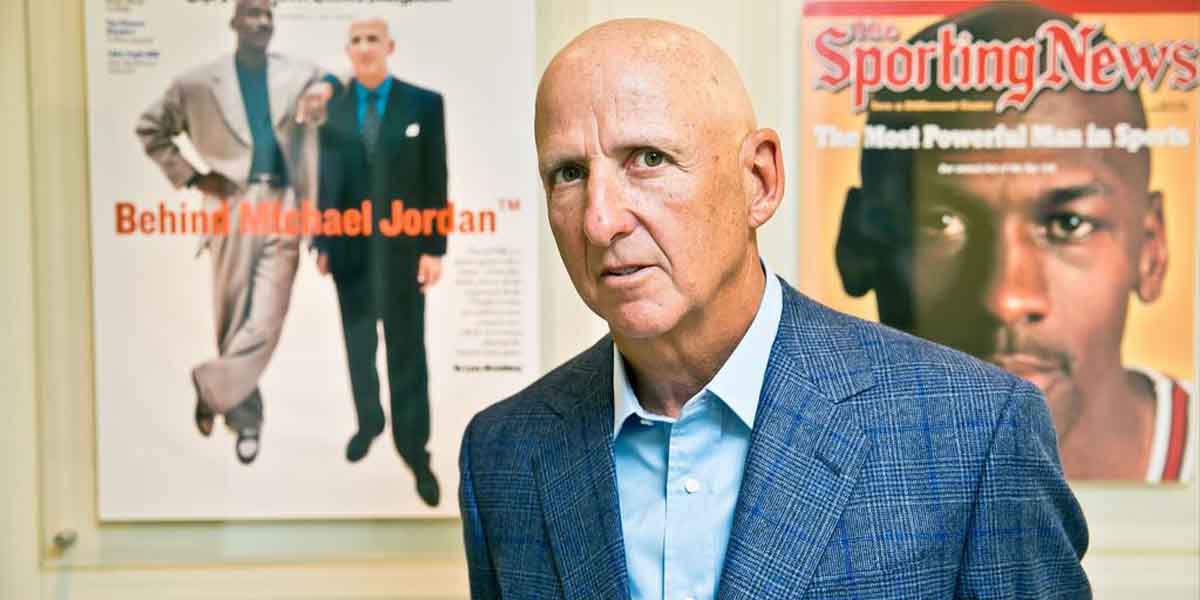
David Falk, the longtime agent who represented Michael Jordan for decades, finally broke down what truly drove the Chicago Bulls legend’s relentless competitive fire.
Speaking on the “20&20 Podcast” in early 2023, Falk made one thing clear: money was never the motivator.
“It’s not the money. You could pay Michael Jordan a trillion dollars or 10 cents, and he’d tear your eyes out [on the court],” Falk said.
That statement carries weight coming from the man who negotiated Jordan’s landmark Nike deal in 1984 — the same partnership that still generates a fortune for the Hall of Famer today.
Falk, a Long Island native, founded FAME and began representing Jordan at the start of his NBA career.
He helped shape the most iconic athlete-brand partnership in sports history.
But according to Falk, the financial rewards were never what pushed Jordan to dominate.
The agent then drew a parallel to his own life to explain the real source of that drive.

“If you knew me at all, you’d know what drives me is not the money, it’s not fame, it’s my interior desire to please my mother, who is an amazing mentor to me, a woman of very high achievement,” Falk explained.
“She had two master’s degrees, she spoke eight languages, she raised three kids, you know, while she was working, with a dad who didn’t provide very much. And so I always, always wanted to please my mother in what I was doing.”
Falk described the result as a “compulsive drive to achieve.”
That drive, he emphasized, “has nothing to do with money or fame or publicity.”
Falk made clear that Jordan operated on the same internal frequency.
Intrinsic motivation — the desire to compete for its own sake, to prove something to oneself — was the engine behind Jordan’s six NBA championships and five MVP awards.
Falk didn’t stop at Jordan.
He noted that other all-time greats shared that wiring: Magic Johnson, Larry Bird, Patrick Ewing, and Kobe Bryant.

Each of them, Falk suggested, was driven by something deeper than external rewards.
This insight offers a rare window into the psychology of arguably the greatest basketball player ever.
Jordan’s killer instinct has been mythologized for decades — the competitive rage, the relentless practice habits, the willingness to punish opponents mentally and physically.
But Falk’s explanation reframes that intensity as something more personal than a simple will to win.
It was a drive rooted in identity, not reward.
The timing of Falk’s comments, from a January 2023 episode, adds context to a broader conversation about motivation in sports.
In the current NBA season, players like Luka Doncic and Stephen Curry are drawing comparisons to Jordan for their scoring feats and competitive fire.
Doncic recently became the first player since Jordan to score over 300 points through his first eight games of a season, totaling 308 points compared to Jordan’s 303 in 1988-89.

Steve Kerr, who played alongside Jordan and now coaches Curry, recently drew direct parallels between the two.
“Honestly, it really does remind me of what it was like to play with Michael Jordan back in the day,” Kerr said.
“Every single night you just are amazed, and you marvel at what he’s capable of doing no matter what the defense does, but also just the longevity of it.”
These comparisons keep Jordan’s legacy alive in every new generation of NBA stars.
But Falk’s revelation goes beyond stats and highlights.
It digs into the psychological core that made Jordan Jordan.
According to Falk, that core wasn’t about the money — it was about a deep, almost compulsive need to achieve.
A need that, in Falk’s view, mirrored his own drive to please his mother.

The question that lingers: can that kind of fire be taught, or is it something a player either has or doesn’t?
Falk’s answer, by implication, suggests it comes from within.
For fans trying to understand why Jordan was different, Falk’s words offer the clearest explanation yet.
It wasn’t the sneakers.
It wasn’t the fame.
It wasn’t the championships.
It was something far more personal — and far less visible.
That may be the most revealing part of all.
Advertisement
You may also like
Tense Elena Rybakina Hot-Mic Moment Sparks Fan Outrage
"Just sue WTA." "So messy." That is the reaction spreading across social media after a second hot-mic incident in three days at the WTA…
Olivia Miles reveals the one thing that makes Caitlin Clark 'annoying' to face
Olivia Miles, the 2026 Kia WNBA Rookie of the Year, did not hold back when asked what it is like to guard Caitlin Clark.…
Kyle Larson’s title could slip away at Homestead—here’s how
Kyle Larson enters Homestead-Miami Speedway with a 67-point lead over Christopher Bell and a 70-point lead over Denny Hamlin. A third NASCAR Cup Series…
Rory McIlroy fires back at rare penalty that cost him 2 shots
Rory McIlroy entered the scorer's tent after his opening round at the 2026 Abu Dhabi Aldar Championship thinking he would sign for a four-under…

Belichick's ex attends UNC game despite split
Bill Belichick’s ex-girlfriend Jordon Hudson reportedly attended the UNC-Miami game on Saturday, Oct. 31, according to People magazine — just one day after news…
Stephen A. Smith and Skip Bayless clash over Lakers thriving without LeBron
Stephen A. Smith and Skip Bayless reignited their long-dormant rivalry Thursday morning on “First Take,” this time over whether the Los Angeles Lakers are…