Sophie Cunningham Questions Missed Layups As Stats Reveal The Real Reason WNBA Rim Finishes Face Scrutiny
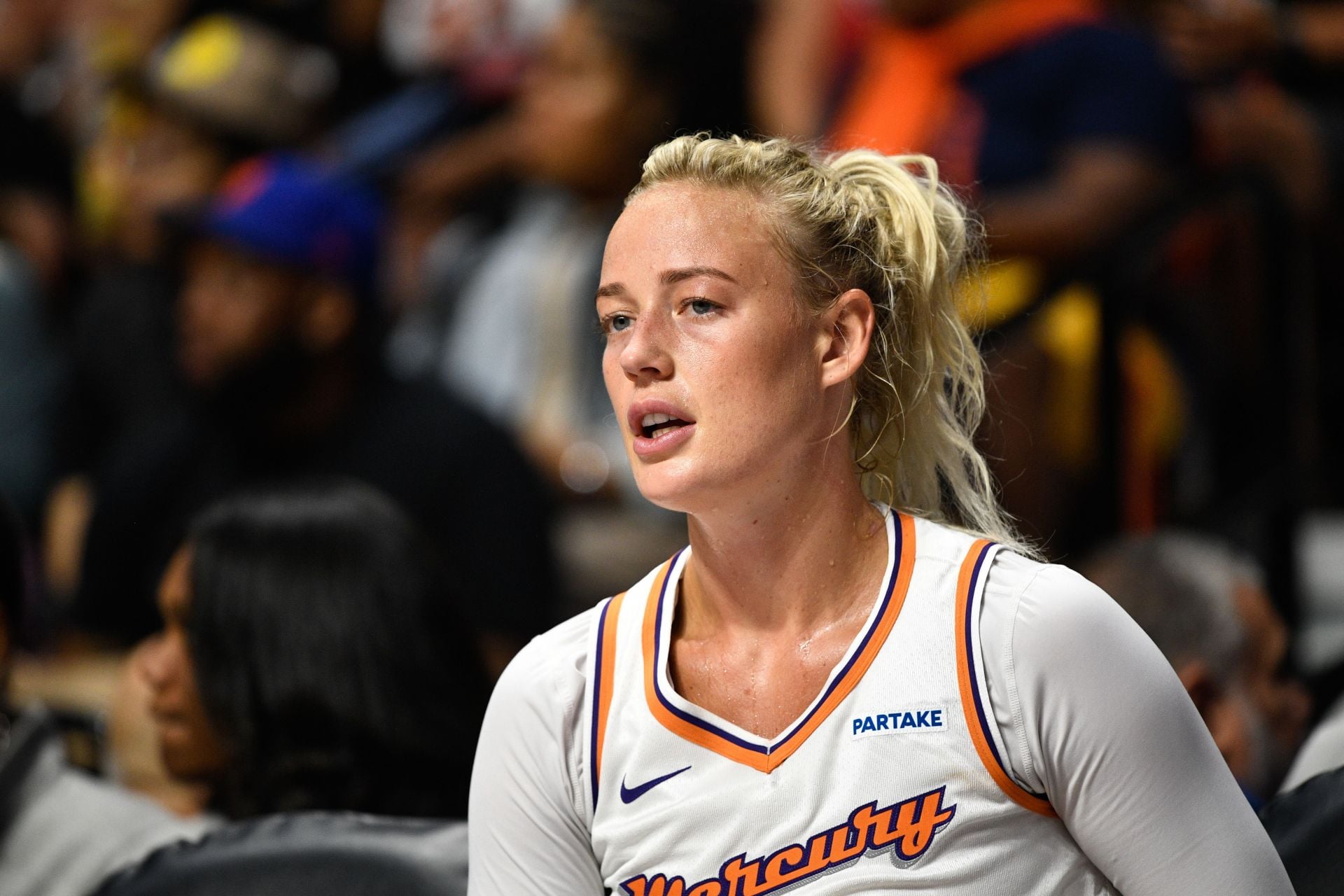
Tracking data shows layups make up nearly 36% of all shot attempts in the WNBA compared to 26.4% in the NBA, magnifying the impact of every missed finish.
That single tactical difference completely changes how basketball fans perceive close-range execution.
When a shot misses right at the rim, the reaction from the crowd is instant and unforgiving.
Sophie Cunningham brought that exact tension to the surface during a candid discussion on her platform.
The nine-year WNBA veteran did not hold back when analyzing what happens near the basket.
Her open evaluation of close-range finishing immediately sparked widespread debate across the basketball community.
AN UNFILTERED CONVERSATION ON NO HESITATION
Cunningham addressed the issue directly on an episode of her podcast, the No Hesitation Show.
She sat down with renowned basketball trainer Drew Hanlen to break down the mechanics of the game.
Hanlen is widely respected across the sport for his work with elite NBA stars.
His client list includes perennial All-Stars such as Joel Embiid, Jayson Tatum, and Tyrese Haliburton.
During their conversation, Cunningham pressed Hanlen on a recurring pattern that continues to baffle viewers.
"Why do women basketball players, why do we miss so many wide-open layups?" Cunningham asked Hanlen.
She emphasized that she was not referring to heavily contested attempts in deep traffic.
"It’s a joke because it actually happens," Cunningham added during the episode.
"Like, what the f*** is that?" she asked while searching for a concrete technical explanation.
Hanlen chuckled before attempting to break down the physical dynamics at play near the rim.
"I think the biggest thing is athleticism," Hanlen responded.
He pointed out that physical profiles dictate how closely a player operates relative to the rim.
"You’re not as close to the basket and stuff like that," Hanlen explained to Cunningham.
Hanlen also highlighted the role of raw physical power during collisions in the paint.

"I think another thing is strength isn’t the same as the men’s, where they can take the bumps and the hits of physicality when you’re finishing over," Hanlen said.
Yet when it came to uncontested attempts, even the experienced skills coach hit a wall.
"The open ones, I have no answer for you," Hanlen admitted candidly.
THE NUMBERS BEHIND THE RIM SCRUTINY
While the optical impression suggests a massive gulf in execution, official analytics tell a far more nuanced story.
According to Basketball Reference, WNBA players shot 67.4% on field goal attempts from 0 to 3 feet during the last full season.
Over that same span, NBA players converted at a 70.3% rate from that identical distance.
That represents an efficiency gap of just 2.9 percentage points between the two leagues.
A difference of under three percent shows that professional women finish at the rim at a remarkably high rate.
The true divergence lies entirely in shot distribution and offensive shot profiles.
Tracking data reveals that layups make up almost 36% of all attempted field goals in the WNBA.
In contrast, the NBA relies far less on layups, with those attempts accounting for only 26.4% of total shots.
Because WNBA offenses generate so many looks at the cup, the sheer volume of layups per game is substantially higher.
More rim attempts inevitably produce a higher raw tally of misses over the course of forty minutes.
When a shot under the basket does rim out, viewers notice it immediately.
The heavy concentration of interior attempts magnifies every single failed conversion on television.
THE PHYSICAL REALITY OF RIM ACCESS
Beyond offensive shot charts, player measurements provide essential context for how finishes are contested.
The standard basketball rim is set at exactly ten feet above the floor across both leagues.
However, the average height of an NBA athlete stands at roughly 6 feet 6 inches.
In the WNBA, the average player height is listed at 6 feet 0 inches.

That half-foot difference dramatically alters vertical reach and release angles on every drive.
The closer an athlete’s release point is to the iron, the easier the touch becomes.
Taller players naturally possess wider catch radiuses and higher extension points when challenging the basket.
League-wide roster compositions demonstrate just how profound this physiological difference remains.
According to CraftedNBA data, the NBA currently features only five active players listed under 6 feet tall.
By comparison, the WNBA rostered 89 players under that six-foot threshold during the previous season.
With nearly ninety players operating below six feet, finishes around a ten-foot rim require tremendous technical precision.
Guards must generate enough arc to clear shot blockers while maintaining complete control of their forward momentum.
STRENGTH, CONTACT, AND ATHLETIC LEVERAGE
Physical collisions inside the painted area further complicate routine finishing.
As Hanlen observed, male athletes often possess the upper-body mass required to absorb mid-air bumps.
Absorbing contact without losing balance allows a shooter to stabilize their hand right before releasing the ball.
In women's basketball, interior defenders contest aggressively without yielding vertical space.
Players must maneuver around stationary rim protectors rather than simply rising over them.
Even when a defender fails to alter the shot, the sheer threat of secondary help alters timing.
Cunningham herself has acknowledged that the misses cannot be explained by a lack of skill or talent.
She recently addressed the psychological and physical pressure during an appearance on Theo Von's This Past Weekend podcast.
"We have some phenomenal athletes," Cunningham pointed out when assessing her league's talent pool.
"We could kill people, right?"
Cunningham remarked about the competitive intensity of professional players.
"We’re good at it, but we do smoke a lot of layups… I don’t know what it is," she admitted.

Cunningham suggested that the issue might stem from internal pressure in critical moments.
"Sometimes it just happens," Cunningham reflected.
"It could be nerves," she added regarding the surprising misses that catch fans off guard.
COACHING PHILOSOPHY AND TOUGH ACCOUNTABILITY
Cunningham’s examination of missed layups connected directly into a broader critique of player development.
During her podcast discussion with Hanlen, the veteran guard sounded off on modern coaching standards.
Both Cunningham and Hanlen agreed that many coaches today are becoming far too gentle with their players.
They argued that this trend is particularly prevalent when instructors train young female athletes.
Cunningham insisted that high-level basketball requires relentless, uncompromising accountability.
"Bring back hard coaching," Cunningham asserted firmly.
She credited old-school discipline for shaping her into a professional athlete capable of surviving in the WNBA.
"That is why all of us pros are where we are, because we had coaches who truly cared about us and loved us and saw our full potential," Cunningham said.
She remembered that her developmental coaches never let bad habits slide on the hardwood.
"But with that, they didn’t let us slip… If we weren’t going hard enough, or we weren’t doing that, they were on our a**," Cunningham recalled.
She urged the next generation of players to embrace tough love rather than taking criticism personally.
"You can’t always listen to their tone," Cunningham advised younger competitors.
"You have to listen to the message… I do think that coaches are too soft on athletes nowadays," she stated.
Cunningham pointed out that outside influences often disrupt the coaching dynamic.
"Maybe it’s the parents, maybe it’s the athletes who can’t take it, but then y’all shouldn’t be in the sport because if your coach is on you, that means they see something in you," Cunningham stated.
For Cunningham, mastering fundamental shots like uncontested layups begins on the youth practice court.
Without rigorous repetition and intense accountability, mechanical flaws can follow players into the professional ranks.

THE GROWING SPOTLIGHT ON WOMEN'S BASKETBALL
These critical remarks come at a transformative time for the entire WNBA landscape.
The league has enjoyed explosive growth over the past several seasons across nearly every commercial metric.
In several key viewership areas, women’s basketball has grown at a faster pace than traditional men's sports properties.
Yet increased attention also brings relentless micro-analysis of every single play.
Cunningham’s candid commentary drew mixed reactions precisely because of that elevated spotlight.
Some observers worry that validating missed-layup narratives provides ammunition for critics looking to diminish the sport.
Others appreciate Cunningham's willingness to speak plainly about real on-court execution.
As a respected nine-year veteran, Cunningham speaks from direct experience at the highest level.
Her voice carries weight because she has competed through multiple eras of the league's tactical evolution.
FREE AGENCY AND THE ROAD AHEAD
Cunningham’s growing media profile coincides with a pivotal moment in her on-court career.
Her contract with the Indiana Fever has expired, putting her in position to evaluate her future options.
Known as a reliable perimeter shooter and fearless competitor, she remains an attractive target across the league.
Her profile will be closely watched as teams construct their rosters for the upcoming free agency periods.
While her off-court commentary generates headlines, her value on the hardwood remains tied to her sharpshooting.
As the WNBA continues its rapid rise, the tactical debate surrounding shot selection will only intensify.
Teams will continue to rely on layups for more than a third of their total offensive output.
The statistical reality proves that WNBA players convert inside at a rate comparable to the NBA.
Yet as long as 36% of all field goal attempts come directly at the rim, every missed finish will face an intense public spotlight.
Does the WNBA's heavier reliance on layups make every missed shot at the rim stand out more than it should?
Advertisement
You may also like

Willie Nelson Compares Looming Federal Hemp Ban To Prohibition, Urging Congress To Protect Farmers
Country icon Willie Nelson is speaking out against upcoming federal legislation that would outlaw all hemp-derived THC products in the United States starting December…
Harry and Meghan Pay Tribute as Key Docuseries Producer Chanel Pysnik Exits Archewell Productions
Chanel Pysnik, who served as executive producer on the docuseries Harry & Meghan and was one of the company's first hires, has officially left…
WWE Shakeup: AJ Styles Slated For Scouting Power As Bobby Roode Eyed For Major Role
Amid pushback over creative changes, reports indicate that AJ Styles is expected to receive more influence over WWE's scouting department while Bobby Roode is…
Wood Brothers Breaks Silence After Josh Berry Wrecked Alliance Partner Ryan Blaney At Martinsville
Team Penske shares a direct technical alliance with Wood Brothers Racing, making Josh Berry's race-ending collision with Penske driver Ryan Blaney an especially awkward…
How Saudi Arabia's PIF Strategy Shift After Iran War Triggered LIV Golf's Collapse
Months after the start of the Iran war, Saudi Arabia's Public Investment Fund changed its investment strategy in April and decided it would stop…
RFK Racing Replaces Brad Keselowski With Ryan Preece in the Iconic No. 6 Ford for 2027
RFK Racing announced that 36-year-old Ryan Preece will replace departing co-owner Brad Keselowski behind the wheel of the No. 6 Ford Mustang starting in…