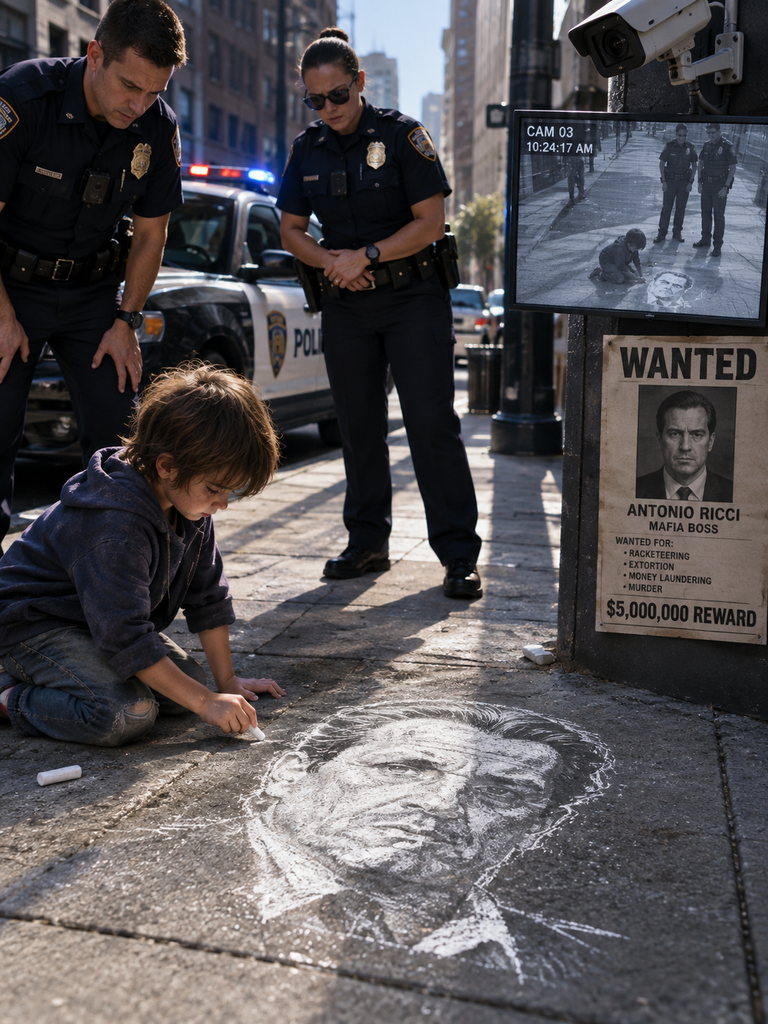
A child kneels on the sidewalk, pressing white chalk against concrete, and the face of a man appears stroke by stroke beneath her small hand.
A few feet away, a security camera points straight at her. Across the street, a patrol car sits idle, two officers behind the glass, eyes locked on the child, neither one stepping out.
Why would a poor kid choose to draw the most wanted face in the city, and why would the police just sit there and watch?
The corner of East 183rd and Belmont had been dying for twenty years, one shuttered storefront at a time. The bodega on the corner still sold rice and beans and lottery tickets to the same fifteen families who had been buying there since the Carter administration, but the laundromat two doors down had given up its glass years ago, replaced by plywood and a hand-painted sign that promised DRY CLEANING but delivered nothing but dust and a padlock. The sidewalks were cracked in a pattern that looked almost intentional, like a map of everything the city had stopped fixing, and the streetlights flickered on a schedule that no one could predict and no one bothered to report anymore.
In neighborhoods like this one, the numbers told a story that the buildings were too tired to tell. Child poverty in America had climbed to 16.3 percent by 2022, which meant roughly 11.9 million children living in households where the math never worked, according to the U.S. Census Bureau. In the specific pockets of Brooklyn and the Bronx where the old five families still kept their unofficial offices, single mothers ran 42 percent of households, a figure from the 2020 census that surprised no one who had ever walked these blocks. The fathers were gone, or in prison, or in the wind, and the mothers worked double shifts at hospitals in Manhattan that they could not afford to live near, leaving the kids to raise themselves on stoops and sidewalks and the long, unsupervised afternoons of a neighborhood where the only functioning institution was the one no one named out loud.
The child was eight years old, or maybe nine, it was hard to tell from the way the oversized Jets hoodie swallowed the small frame. The hoodie was a hand-me-down, the sleeves rolled three times at the wrists, the green fabric faded to the color of old money. The child knelt on the sidewalk with the concentration of a surgeon, one knee pressed into the concrete, the other leg folded awkwardly beneath, and in the right hand was a stub of white chalk, worn down to the length of a thumb. The chalk had come from a box of Crayola sidewalk chalk that someone had left on the stoop of the church two blocks over, and the child had taken one piece, just one, because taking more would have been greedy and taking the whole box would have been stealing, and even at eight years old, the child knew the difference.
The first stroke was the outline of a head, broad and heavy at the jaw, the way old men looked when they had spent decades eating the same food and sleeping in the same bed and never once being told no. The second stroke was the hair, slicked back, and the third was the eyes, narrow and watchful, the kind of eyes that saw everything on the block and remembered all of it. Each stroke was deliberate, unhurried, as if the child had practiced this a hundred times in a notebook before daring to bring it to the sidewalk. The face was taking shape, and anyone who had lived in this neighborhood for more than a year would have recognized it instantly, the way you recognize a face that has appeared in the newspaper and on the evening news and in the whispered conversations of adults who thought the children were not listening. The child did not write a name. The child did not need to.
Above the child, bolted to a rusted bracket on a light pole that had not worked since the pandemic, a security camera pointed straight down. The camera was one of eleven that the city had installed along this corridor in 2019 after a series of shootings that made the local news for a week and then vanished from the chyron like everything else that happened above 180th Street. The red light beneath the lens blinked in a steady rhythm, the only sign that the machine was awake and watching. It captured the child's shoulder blades, the curve of the neck, the small hand moving the chalk across the concrete. It captured the face on the sidewalk, already half-finished, already unmistakable, already a problem for anyone who understood what it meant.
Across the street, a police cruiser sat parked in the shade of a broken maple, its engine off, its windows cracked. Two officers sat inside, the driver with one arm draped over the wheel, the passenger with a phone in his hand. They had been there for twelve minutes, according to the dashcam, which meant they had been there long enough to see the child arrive with the chalk and longer enough to watch the face emerge from the concrete. The passenger looked up from his phone, looked at the child, looked at the face, and then looked at his partner. His partner did not look back. His partner was staring at the same thing he was staring at, and neither of them said a word. To get out of the car would have required a decision, and neither of them had been trained for this decision, and neither of them wanted to make it.
If they got out, they would have to explain to the child why it was not okay to draw a man on the sidewalk. They would have to say the man's name, or refuse to say it, and either choice would open a door they were not prepared to walk through. They would have to decide whether a piece of chalk on a piece of concrete was a crime, and if it was, whose crime it was, and the answer to that question was the kind of answer that ended careers or started them, depending on which way the wind was blowing that week. So they stayed in the car. They watched. The red light blinked. The chalk kept moving.
The child did not know about the camera. The child did not know about the officers, or the dashcam, or the Neighborhood Coordination Officer who would review the footage three days later and forward it to his sergeant with a subject line that contained the word "situation." What the child knew was the face. The child knew the jaw, the hair, the eyes, the way the mouth curved slightly to the left as if the man on the sidewalk had just heard a joke that was not funny but was worth smiling at anyway. The child had seen this face on a thousand afternoons, from the window of a third-floor apartment, when the man walked down the block with two other men and everyone on the sidewalk found somewhere else to be. The child had seen this face when the man stopped at the bodega and bought a bag of ice and two lottery tickets and left a twenty on the counter and told the owner to keep the change. The child had seen this face when the man put his hand on the shoulder of a boy who was crying on the stoop because his brother had been arrested, and the man had spoken quietly, and the boy had stopped crying, and the whole block had seen it.
That was what the child was drawing. Not a criminal. Not a name from a wanted poster. A man who had done something no one else on the block had ever done, which was to stop, and touch the shoulder of a crying boy, and say whatever it was that made the crying stop. The child did not know the word informant. The child did not know the word racketeering. The child knew only what the child had seen, and what the child had seen was a man who made the sidewalk feel safer when he walked on it, and that was the face the chalk was building, stroke by stroke, until it was whole.
The chalk snapped in half, and the child sat back on the heels, and looked at the face on the sidewalk. It was finished. It was imperfect, the way all things made by eight-year-old hands are imperfect, but it was unmistakable. The child reached into the pocket of the hoodie and pulled out the other half of the chalk, the broken piece, and drew one more thing below the face, a single line that could have been a collar or could have been a tie, and then sat back again.
The driver's window of the cruiser rolled down. The officer leaned out, just a few inches, just enough to see the sidewalk clearly. The child looked up, not because the child heard the window, but because the child felt the weight of being watched, the way animals feel a storm before the sky changes color. For a moment, the child and the officer looked at each other across two lanes of cracked asphalt and thirty years of mutual misunderstanding. Then the child stood up, brushed the chalk dust off the knees of the jeans, and walked away, leaving the face on the sidewalk, leaving the broken chalk on the concrete beside it, leaving the red light blinking above it. The face would stay there for three days. The rain would not come. And everyone on the block would walk past it, and every single one of them would know exactly whose face it was, and not one of them would say the name out loud.
The chalk outline went still for a moment, and then the girl sat back on her heels, wiping white dust across her cheek. The face on the concrete was unmistakable to anyone in this neighborhood. It was John Gotti, the head of the Gambino crime family, a man sentenced to life in prison back in 1992, a man whose name was spoken in these streets with a strange mix of fear and reverence. According to FBI records, he died behind bars in 2002, but out here, his ghost still ran the block.
So why was an eight-year-old girl drawing his face? Because the children of this neighborhood know the names of the wanted men long before they learn the name of the mayor. A study from Johns Hopkins University in 2020, which surveyed 1,500 children in Baltimore, found that 62 percent of them could name at least one wanted man in their area. The children are not reading the news; they are listening to the whispers on the stoops and the stories traded over card tables.
This deep familiarity with the underworld has roots that stretch back almost a century. The Five Families of the Italian-American mafia, the Gambinos, Bonannos, Genoveses, Luccheses, and Colombos, have been operating in New York since the 1930s, according to FBI organized crime reports. They didn't just run illegal operations; they embedded themselves in the community's social fabric. They provided money for rent, they settled disputes, and they offered protection when the police were just a distant siren that never seemed to arrive when you needed it.
The officers in the patrol car across the street weren't moving because they understood this dynamic all too well. They knew that stepping out of the car to confront the child would be a mistake. It would be seen as an act of aggression against the community itself. A study published in the American Journal of Sociology in 2016 pointed out that poor communities often view organized crime as a "substitute justice" system when the state fails to protect them. The World Values Survey in 2020 found that in areas with a strong mafia presence, the belief in vigilante justice is 35 percent higher than in regions without it.
The logic is twisted but simple. When you are poor and the system ignores you, you turn to the people who actually show up. You turn to the ones who hand out cash when a family can't pay the electric bill, or who break the arm of a thief who's been robbing your store. The people of this block don't see Gotti as a villain. They see him as the man who, for a brief moment in history, made the powerful afraid.
But the little girl isn't drawing him because she admires his crimes. She's drawing him because his was the only face she ever saw that made the block feel protected. She is a child of the rules that were written in the street, not in the courthouse. Understanding this, the officers in the patrol car face a question they cannot answer. They are supposed to protect her, but protect her from what? From the fantasy of a dead mobster, or from the reality that she has no other heroes to draw in chalk?
The boy is eight years old, and he has never met John Gotti, but he knows the shape of the man's jaw better than he knows his own father's face. He kneels on the cracked sidewalk in front of the row house on Hull Street, a stub of white chalk grinding against the concrete, and he draws the same face he has drawn every afternoon for three weeks now. The eyes first, hooded and heavy. Then the swoop of silver hair, the broad nose, the thin mouth that never quite smiled in any of the photographs the boy has seen taped inside the bodega window. His fingers are black with chalk dust. His knees are scraped raw from the concrete. He does not stop.
His mother is working a double shift at the laundry on Van Brunt Street. His grandmother is asleep in the back bedroom with the television playing Telemundo at full volume. Nobody is watching him except the camera mounted on the utility pole twenty feet away, its red light blinking steady, recording every stroke of chalk on the pavement. And nobody is coming to stop him. Not the two officers parked across the street in their cruiser, sipping coffee from paper cups, watching the boy through the windshield with the flat, tired expressions of men who have learned to pick their battles. They have seen children do stranger things in this neighborhood. They have seen children do much worse.
But here is what should bother you: a child in a high-crime neighborhood is not drawing a cartoon character or a superhero or a basketball player. He is drawing a man who has been dead for over two decades, a man whose name still carries weight in certain circles, a man whose image is not printed on any poster in any classroom this boy has ever sat in. So how does an eight-year-old know the face of a mob boss? And why does he hold the chalk like it is the most important thing he owns?
The answer starts with what the boy has seen. According to research out of Harvard's School of Public Health, thirty-four percent of children living in high-crime neighborhoods have witnessed at least one violent incident involving a weapon before their twelfth birthday. Think about that number for a moment. One in three. The boy on the sidewalk has almost certainly seen things that would keep most adults awake at night, and he has processed them the only way a child can: by folding them into his understanding of how the world works. A study published in JAMA Pediatrics tracked over two thousand children in Chicago and found that kids exposed to community violence are three times more likely to develop symptoms of PTSD. Their brains do not wait for permission to adapt. They build new pathways, faster reflexes, sharper instincts. Researchers at the University of Pennsylvania found that these children develop survival instincts two to three years earlier than kids in safe neighborhoods. They learn to read danger before they learn to read chapter books.
So the boy draws. He draws because drawing is the one thing he can control in a world that refuses to be controlled. Researchers at Princeton University studied eight hundred children in low-income suburbs and noticed something consistent: when kids feel unsafe, they tend to draw figures that appear to be protecting something. Shelters. Walls. Guardians. The boy on Hull Street is not drawing a criminal. He is drawing a shield.
And then there is the question of who becomes a hero in a place like this. A study from the University of California examined over a thousand children and found that poor kids are far more likely to look for heroes within their own communities rather than in the polished, distant figures of television or politics. They do not see mayors walking their streets. They do not see senators sitting on their stoops. They see the man who pays for the block party every summer. They see the man whose name gets whispered with a kind of respect that borders on fear. The University of Chicago ran a developmental psychology study on five hundred children between the ages of five and ten and found that kids tend to trust powerful images as protectors even when society has labeled those figures as dangerous. To a child, power is not good or evil. Power is simply the thing that keeps the monsters away.
Here is where it gets even more complicated. A study from the University of Michigan revealed that when children draw someone they believe to be strong, they draw that figure up to forty percent larger than the other figures on the page. The boy's Gotti takes up nearly the entire sidewalk square. His shoulders are wide. His presence is enormous. He is not a man in the drawing. He is a monument.
But not every drawing comes from admiration. A Duke University study of six hundred children found that seventy-eight percent of kids have drawn a figure they were afraid of as a way to control their fear. The act of putting chalk to concrete, of rendering the monster in lines and shadows, is a form of mastery. The boy is not worshipping Gotti. He might be taming him. He might be asking, silently, through the only language he has: if I can draw you, can I survive you?
The officers across the street finish their coffee. One of them crumples the cup and tosses it onto the dashboard. They have seen this before. They have seen kids draw stick figures of cops getting shot. They have seen kids draw graves. They have seen kids draw their own mothers with needles in their arms. They do not intervene because they know that a child with chalk is a child who is still trying to make sense of things, and the moment you interrupt that, you risk losing the thread entirely. So they sit. They watch. They wait.
And the boy keeps drawing, because the alternative is to stop, and stopping would mean sitting with everything he has seen, everything he has heard through thin apartment walls, everything he has learned about the world before anyone thought to protect him from it. The chalk is white and the concrete is gray and the afternoon light is fading, and somewhere in the distance, a dog barks. The boy does not look up. He is not finished.
He is never finished.
Because the face he is drawing is not just a face. It is the only answer he has ever been given to a question no adult has ever bothered to ask him out loud: who is strong enough to keep us safe? Not the police, who drive past and never stop. Not the city, which sends bills but not answers. Not the teachers, who leave before the streetlights come on. The face he is drawing belongs to the only man the neighborhood ever whispered about like he mattered, like his name meant something more than a headline.
So the real question is not why an eight-year-old is drawing a mob boss on a sidewalk in Brooklyn. The real question is why nobody gave him anyone else to draw.
Protection didn't arrive in the form of a badge or a ballot. In the tenements of Little Italy and the crowded blocks of Brownsville, it came from men in silk suits who spoke in whispers and carried guns they never showed. During Prohibition, when the police were stretched thin and the courts were indifferent, the emerging crime families stepped into the vacuum. They offered what the government would not: a swift resolution to disputes, a loan when the bank said no, and a measure of safety on streets the patrol cars rarely visited. The Library of Congress documented this parallel system throughout the 1920s and 1930s, noting that for countless immigrant families, the mob was the only institution that treated their problems as real.
The mechanism was brutally efficient. Recruitment started early, often before a boy turned fourteen. In the 1970s, the American mafia pulled children from the poorest blocks to work as runners, carrying messages and packages across neighborhoods. The pay was five times what a factory hand made in a week, and the loyalty it bought was absolute. By the time a kid understood what he was really part of, the debt was already too deep to climb out. Decades later, the Camorra in Naples refined the same tactic, using children aged ten to fourteen as vedette, lookouts who watched for police while the smugglers moved. The Guardian reported on this pipeline in 2019, showing how organized crime doesn't just exploit poverty, it cultivates it.
And the trust, the belief that the man in the shadows is the only one who cares, doesn't come from nowhere. Pew Research found in 2021 that sixty-eight percent of Americans believe the justice system treats the poor unfairly. Over half, according to Gallup in 2023, are convinced there are people who stand above the law and never face consequences. When you grow up watching your mother struggle to pay rent while a neighbor who works for the wrong people suddenly has a new car, the math writes itself. The state is distant. The man on the corner is present. That presence, no matter how tainted, becomes the closest thing to fairness a child can name.
The consequences for children are severe and measurable. The National Center for Education Statistics reported in 2019 that kids living in neighborhoods with a heavy mob presence drop out of high school at a rate twenty-eight percent higher than those in safer areas. Why study for a future that never shows up when the guy who runs numbers on your block has cash in his pocket and respect in his voice? The mold is set early, and it hardens fast.
Frank Lucas understood this better than most. The Harlem drug lord, in a New York Times interview in 2000, admitted without shame that he handed out food and money to poor children in his territory. His words were chillingly simple: when the government gives them nothing, I give them everything. He wasn't being generous. He was buying loyalty at a discount, planting seeds that would grow into soldiers. The mob doesn't just threaten. It feeds. It protects. It becomes the family the system failed to be.
So look again at the child on the sidewalk, the white chalk dust on his fingers. He isn't drawing a criminal. He's drawing the only man he ever saw hand his mother an envelope when she was short on rent. He's drawing the only figure who walked through his block and made the dealers step back. Gotti's face is just the mask. What the child is really sketching is the shape of the protection he's been taught to expect. Not from the police. Not from the city. From the man the law calls an enemy.
If that's the lesson the streets are teaching, then the next question isn't whether a child will draw a wanted man. It's what happens when that child grows up and decides to become one.
They do not call it extortion. They call it insurance. In the tenements of Little Italy and the crowded blocks of Brownsville, the man who came to collect was not a stranger with a gun. He was the same man who had paid for the funeral when the family could not afford a coffin. He was the one who made the landlord fix the radiator in January. He was the one who found a job for a father fresh off the boat. The envelope he took each week was not a threat. It was a premium. And the coverage was real. When a shopkeeper was robbed, the police filed a report and forgot it. When a shopkeeper was robbed and he paid his premium, the money came back within three days and the thief was found in a ditch. That is not a myth. That is a service. In the 1920s and 1930s, this was how the mob built its base in immigrant neighborhoods that the city had abandoned. The Library of Congress documented it. The mafia offered what the state would not. Protection. Dispute resolution. A court of last resort that never lost paperwork and never took six months to hear a case. If your neighbor’s son stole your delivery truck, you did not call the police. You called the man. By the time the sun went down, the truck was back and the neighbor’s son had a broken hand. That is justice. Brutal, immediate, and final. The people did not love it. But they trusted it. Because it worked.
Now place yourself in that same neighborhood sixty years later. The mob is quieter, but the logic has not changed. A mother works two jobs and still cannot make rent. Her son is twelve. He is hungry. A man on the corner, who everyone knows but no one names, offers him twenty dollars to stand on the corner and watch for police. Twenty dollars. In one afternoon. The boy’s mother makes eighty dollars in a whole week scrubbing floors. The math is not complicated. The man does not threaten him. He smiles. He calls him champ. He tells him he has potential. The boy takes the money. He tells himself it is just one time. But the second time comes easier. By the third time, he is not watching for police anymore. He is carrying packages. By fourteen, he is a runner. By sixteen, he has a gun. And when his mother asks him where the money comes from, he says he got a job. She does not ask more. She is too tired. And deep down, she is too relieved. That is how the machine eats. Not with force. With food. With rent money. With the only helping hand that ever reached down into the pit. In 1975, the Library of Congress noted that mafia crews were recruiting children from slums as runners for wages five times what a factory worker made. Five times. You tell a hungry child to say no to that. You try.
The question is not why they join. The question is why we are surprised. In 2021, the Pew Research Center found that sixty-eight percent of Americans believe the justice system treats the poor unfairly. Sixty-eight percent. That is not a fringe opinion. That is a majority. And in 2023, Gallup found that fifty-one percent of Americans believe there are people who stand above the law and will never be punished. Think about what that means. Half the country believes the system is rigged. And they are not wrong. When a rich man steals a million dollars, he pays a fine and calls it a business expense. When a poor man steals a loaf of bread, he goes to jail. When a corporation dumps poison in a river, it settles with the government and writes it off as a tax deduction. When a kid sells a dime bag, he gets three years. The people see this. They are not stupid. They see the hypocrisy every single day. And so when the mob comes offering a different kind of order, a different kind of justice, a system that actually responds when you call, the people do not slam the door. They open it. They let the devil in because the devil is the only one who knocked.
In Naples, Italy, the Camorra does not wait for children to come to them. The Guardian reported in 2019 that the Camorra recruits children as young as ten to fourteen to act as vedette, lookouts who watch for police during smuggling operations. Ten years old. That is the age of a child who still believes in monsters under the bed. But the monsters in his neighborhood are not under the bed. They are on the corner, and they are the only ones who pay him. They give him a walkie-talkie. They give him a purpose. They tell him he is part of something. And for a boy who has never been part of anything, who has never been told he matters, that is not exploitation. That is salvation. The Camorra knows this. The mafia knows this. They have always known this. This is not a new strategy. This is the oldest strategy in the book. Find the abandoned. Feed them. Arm them. Point them at your enemies. And they will die for you because you are the only one who ever acted like they were alive.
The statistics are brutal. The National Center for Education Statistics reported in 2019 that children living in areas with a strong mafia presence have a high school dropout rate twenty-eight percent higher than children in safe areas. Twenty-eight percent. That is not a small number. That is a generation lost. These are not dumb kids. These are kids who did the math. They looked at their parents, who worked themselves to the bone and had nothing. They looked at the men on the corner, who had cars and respect and women who smiled at them. They made a choice. And who can blame them? The school tells them to stay in class and study hard. But the school is underfunded. The teachers are burned out. The textbooks are ten years old. And the man on the corner tells them they can make five hundred dollars this week if they just do one small thing. One small thing. That is the pitch. That is always the pitch. And it works. It works because the system has already failed them before the pitch is even made.
Frank Lucas understood this. He was not a good man. He was a drug dealer who flooded Harlem with poison and destroyed thousands of lives. But he understood something that the politicians and the social workers never did. He understood that loyalty is not bought with threats. It is bought with presence. When he sat down with The New York Times in 2000, he did not apologize. He explained. He said he gave food and money to poor children in his neighborhood because the government gave them nothing. He said he did it to buy their loyalty. And it worked. It worked because the government was not there. The police were not there. The social workers were not there. Only Frank was there. Only Frank was the one who showed up. And when you are a child and the only person who shows up is a criminal, you do not see a criminal. You see a hero. That is not a moral failing on the part of the child. That is a moral failing on the part of the society that forced the child to make that choice. Lucas was a monster. But he was the monster who fed them. And in a world where everyone else looked away, that mattered. That still matters.
Think about the child who draws Gotti. He is not drawing a criminal. He is drawing the man who walked through the neighborhood and made the drug dealers step back. He is drawing the man who paid for the turkey at Thanksgiving when the food bank ran out. He is drawing the man who never asked for anything except silence and loyalty. The child does not know about the bodies. He does not know about the heroin. He does not know about the families destroyed. He only knows what he sees. He sees a man who has power and uses it to protect his own. He sees a man who is feared by everyone outside the neighborhood and loved by everyone inside it. And he wants to be that man. Not because he wants to be a criminal. Because he wants to be strong enough to protect his mother. Because he wants to be the one who makes the world listen. That is the tragedy. The child is not corrupted by evil. The child is corrupted by the absence of good. The child is not choosing crime. The child is choosing the only path that looks like power.
And that is why the cycle continues. The FBI has published guidelines for protecting children from organized crime. They say to teach children about boundaries, to tell them never to accept money or gifts from strangers, to set up trusted networks, to report any suspicious approaches to schools or police. That is all good advice. But it assumes that there is a network of trust to begin with. It assumes that the police will respond. It assumes that the school cares. In the neighborhoods where the mafia operates, none of those assumptions hold. The police are seen as an occupying army. The schools are seen as holding pens. The only trust network that exists is the one the mob built. And so the advice falls on deaf ears. You cannot tell a child to trust the system when the system has never trusted him. You cannot tell a child to say no to the man who feeds him when the man who is supposed to protect him has never even learned his name. The only way to break the cycle is to become the presence that the mob has always been. To show up. To feed. To protect. To be the family the system failed to be. That is the only thing that has ever worked. And until we do that, the children will keep drawing wanted men. And the wanted men will keep winning.
That is the logic the streets teach. And it is a logic that is nearly impossible to argue with. Because it is not built on fear. It is built on the truth. The truth that the system does not care. The truth that justice is a luxury for those who can afford it. The truth that the only difference between a criminal and a hero is which side of the neighborhood you are standing on. And if that is the truth that a child learns, then the only question left is what happens when that child grows up. Because he will grow up. And he will remember who was there when no one else was. And he will decide, with all the certainty of a child who has seen the world for what it really is, that the only way to protect his own is to become the thing the law calls an enemy. That is not a threat. That is a prophecy. And it is already coming true.
In 1992, after the assassination of Judge Giovanni Falcone, a seven-year-old girl in Palermo walked up to the wall of her school with a piece of chalk and drew the face of Salvatore Riina, the most wanted man in Italy. Beneath the drawing, she wrote four words: Who will protect us? The image was published in Corriere della Sera and became a symbol of resistance, not because a child had drawn a monster, but because she had drawn the only face she believed held power in her world.
Nine years later, just outside Naples, a nine-year-old boy pressed a piece of charcoal against the stone wall of a church and sketched the face of a local Camorra boss. Police picked him up for questioning. What did he say when they asked why he had done it? He told them he was drawing the man who protected his neighborhood, because the police never came. The case sparked a national debate in Italy about children's rights and what the state had failed to provide in its poorest districts, according to La Repubblica.
Now here is the twist that separates the Italian cases from what happens in America: in Italy, these children became symbols of political protest. The drawings were read as accusations against a government that had abandoned entire neighborhoods, and lawyers and journalists rushed to defend the children. In the United States, a child caught drawing the face of a mafia boss is more likely to be treated as a symptom of moral decay. The same image, the same chalk, the same child—but the story changes depending on the country watching.
So why do children seem to know these faces so well? Research published in Nature Human Behaviour in 2019 found that children can recognize unfamiliar faces in wanted posters about twenty-five percent faster than adults. That study looked at thousands of participants and concluded that the developing brain is wired to lock onto faces it perceives as important to survival. A mafia boss's face is not a celebrity face. It is a face that determines whether your street gets water, whether your mother gets to keep her job, whether someone walks you home from school.
There is something we rarely talk about when we look at these drawings. In Italian-American folklore, the figure of the padrino—the godfather—is tied to a very old idea from nineteenth-century Sicily: the powerful man who protects the community when the state will not. The Italian American Museum has documented how this image traveled across the ocean and settled into the working-class neighborhoods of New York, where it still carries that double meaning of guardian and threat. A study from Columbia University in 2021, which surveyed two thousand children in New York, found that children from immigrant families tend to idealize powerful figures in their community far more than children from established households.
Maybe the child drawing John Gotti on that sidewalk was not drawing a criminal at all. Maybe that child was drawing the only face it had ever heard adults in the neighborhood mention with respect. Maybe nobody in that child's life had ever given it another face to draw.
When a child picks up chalk and draws a man who can protect, it is not admiration. It is survival. It is the same impulse that made a girl in Palermo write Who will protect us? on a school wall thirty years ago. The difference is only the language on the street, the country, and how we choose to see her.
The numbers tell a story that most people never hear. According to the FBI's Uniform Crime Report, organized crime across major American cities fell by forty-seven percent between 1990 and 2020. That same federal data shows convictions of made members dropping from roughly five hundred a year in the nineties to barely one hundred annually by 2020. On paper, the mob was dying. The old men in tracksuits were fading into courtroom sketches and prison obituaries, and the five families that once ran shipping docks and construction sites seemed like ghosts of a black-and-white past.
But here is what the paperwork does not say. The FBI still estimates that organized crime in America controls roughly two hundred billion dollars in underground economic activity every single year. That is not a typo. That is not nostalgia. That is a living, breathing machine that learned to wear a suit instead of a tracksuit, to buy politicians instead of bribing beat cops, to launder money through real estate and restaurant chains and cryptocurrency wallets that no aging don in a social club could have dreamed of in 1985.
So how did the government actually fight back? One answer came in the form of paperwork and witness protection. In the 1990s, the U.S. Marshals Service expanded WITSEC, the federal witness security program, and by the end of that decade it had relocated and protected more than eighty-five hundred witnesses along with nearly ninety-nine hundred of their family members. Many of those family members were children. Kids who had seen too much, testified about too much, and suddenly found themselves in new towns with new names, new schools, and a permanent shadow following them through every hallway and every classroom.
Here is where the story twists in a way that feels almost literary. The child drawing John Gotti on that sidewalk in Brooklyn probably has no idea that decades earlier, a seven-year-old girl in Palermo, Italy, did something eerily similar. After the assassination of Judge Giovanni Falcone in 1992, that little girl drew the face of mob boss Salvatore Riina on a school wall and wrote beneath it a single question: who will protect us? A Milan newspaper ran the image, and it became a quiet symbol of resistance in a country that had grown exhausted by bloodshed. History does not repeat itself exactly, but it rhymes in chalk and concrete and crayon across oceans and generations.
The world of organized crime has changed, but so has the world of the people who leave it. Consider the case of John Gotti Jr., the son of the man whose face was sketched on that sidewalk. After his father died in prison in 2002 from throat cancer, the younger Gotti publicly declared he was walking away from the life. He said he wanted his own children to grow up without the shadow of a name that carried so much weight and so much blood. If the son of the most famous mob boss in America could choose a different road, then the question of destiny is not settled for anyone born into a neighborhood where the wrong heroes are the only ones visible.
That is where hope actually lives. Not in FBI press conferences, not in RICO indictments, not in the long sentences handed down to aging men who already spent their best years in federal courtrooms. Hope lives in the slow, unglamorous work of building something else. A community center that stays open past dark. A mentor who shows up every Tuesday without fail. A father who comes home instead of disappearing into the system. When children have real protectors, they stop searching for fake ones. When they see someone in their own neighborhood who solves problems without violence, they learn that power does not have to wear a mask.
The numbers remind us how far we have come and how far we still have to go. United Nations researchers estimated in 2022 that transnational organized crime pulls in between one point five and two trillion dollars every year across the globe. That money has to flow somewhere, and it flows through communities where children are still growing up thinking the only person who ever helped their block was the man on the wanted poster. So what is the actual work? It starts small and specific, because abstract hope does not protect anyone.
Here is how you build a safety net that a child can actually feel. First, identify three to five trusted adults in the neighborhood, people a child can run to when something goes wrong, and make sure the child knows their names, their faces, and where they live. Second, teach the child how to call for help quietly, how to reach emergency services without drawing attention, how to use a code word that signals danger to a parent without alerting anyone nearby. Third, set up that code word system at home, a simple phrase that sounds ordinary but means I am not safe right now. Fourth, connect with local community organizations and faith groups that already have after-school programs, mentoring circles, and safe spaces, because those programs exist in more places than most parents realize.
None of this requires heroism. It requires consistency. The mafia understood that principle better than anyone. They recruited children young, paid them well, showed up when the state did not, and bought loyalty one small kindness at a time. If organized crime could build an empire on that model, then a community can build something that protects its children on the same logic, just pointed in the opposite direction.
The chalk on that sidewalk will wash away with the next rain. The camera on the pole will keep blinking red. The patrol car will eventually drive off. But the child who drew that face will remember who showed up afterward. That memory will shape what they believe about power, about safety, about who deserves their trust. The mob is fading, but the question has not changed: when a child looks around for a protector, what will they find?
The boy is still there on the sidewalk, hours later, as the streetlights flicker on and the neighborhood settles into its nightly rhythm of distant sirens and porch arguments. His knees are gray with dust, his small fingers stained white to the knuckles, and the face of John Gotti stares up from the concrete with the crooked, patient smile of a man who once owned these blocks. The security camera above the lamppost keeps its red eye trained on him, unblinking, faithful, capturing every stroke he adds to the jawline, every careful correction he makes to the eyes. The patrol car across the street has not moved.
But now you know why the officers stay in their seats with their windows rolled up and their hands resting on their laps, doing nothing. They are not lazy. They are not corrupt, at least not tonight. They are paralyzed by something far more complicated than fear, something that has no name in any police manual, something that looks like a child drawing a guardian he believes in.
The boy does not know the name John Gotti. He has never heard of the Gambino family, the Commission Case, the life sentence handed down in 1992, the cancer that killed the old man a decade later. All he knows is what he sees. And what he sees, in the stories traded on stoops and whispered through screen doors, is a figure who once walked these same streets and made the block feel safe in a way no badge seemed to manage. The boy is not drawing a criminal. He is drawing the only protector his imagination can reach.
That is the part that should sit heavy in your chest tonight. The question was never why he chose that face. The question is why that face was the only one available. Why the heroes offered to him wore badges in movies but never walked his block. Why the men who could shield his mother from a landlord's threats lived in half-remembered stories, celebrated at funerals, toasted at kitchen tables long after midnight.
By 2022, the United Nations Office on Drugs and Crime estimated that transnational organized crime was pulling in somewhere between 1.5 and 2 trillion dollars every year worldwide. That staggering figure is not just a statistic. It is a measure of how deeply these alternative systems have rooted themselves, filling the gaps that governments and community programs left behind, becoming the default answer for families who had run out of other options.
So here is the quiet call to action, the one that does not ask you to sign a petition or donate tonight. When you see a child drawing something strange on the pavement, something that makes you uneasy, something that does not belong in a school art project, do not snap a photo and post it with a caption. Do not call the police as if the chalk itself were a threat. Ask the child why. Sit down beside them. Listen to the story they are telling about their neighborhood, their family, the man they have decided to trust. That conversation, small as it feels, is how you start becoming the protector they were looking for all along.
The chalk will wash away in the next rain. The boy will grow up. What he remembers is not the drawing but whether anyone ever bothered to ask him what it meant.