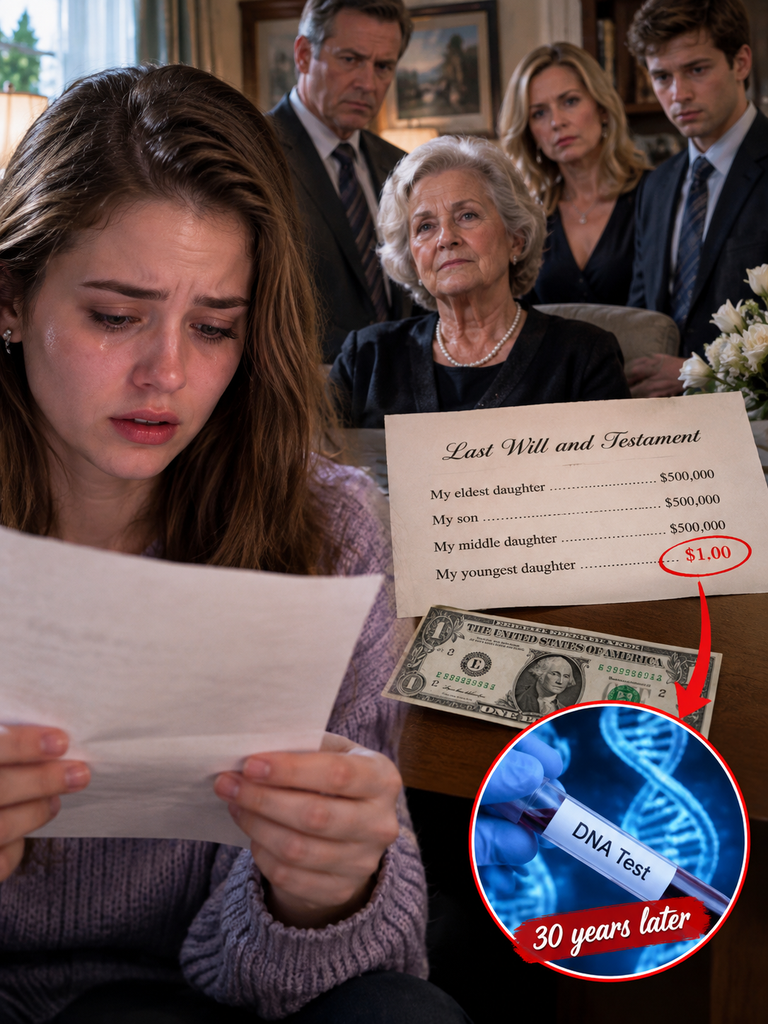
The will was read on a Tuesday. Everything split three ways. Except for one daughter.
She opened the envelope and found a single dollar bill. No letter. No explanation. Just a worn, one-dollar bill.
What kind of mother does that? What was she trying to say that she couldn't say out loud?
Thirty years later, a cotton swab and a test tube finally cracked open the truth.
The lawyer's office smelled like lemon furniture polish and old carpet. My mother had been dead for eleven days. We sat in a row of folding chairs, three siblings who hadn't shared a room in years, waiting to hear what she'd left behind. The estate wasn't large. A house in Ohio. Some savings. Jewelry nobody wanted. The lawyer adjusted his glasses and began reading. My brother got the house. My sister got the savings and the car. Then he turned the page and said my name. I was thirty-four years old, the youngest, the one who had moved away and called every Sunday and driven eight hours for every birthday. He handed me a sealed envelope. It was thin. Too thin. My brother watched my face. My sister looked at the ceiling. I opened it slowly and shook the contents onto my palm. A single dollar bill. Folded once. No note. No explanation. Nothing.
For a moment, nobody spoke.
Then my brother let out a short laugh and said, "Well. That's Mom for you." My sister didn't laugh. She just kept staring at the ceiling like she'd known all along. I sat there holding that dollar like it was a verdict. Like it was a door slamming shut from six feet under.
The legal term for what my mother did has a name. Cornell Law School defines intentional disinheritance as the deliberate act of excluding a potential heir, often signaled by leaving a symbolic amount like one dollar. It's not an accident. It's not an oversight. It's a message. And in New York, the law requires two witnesses to sign a will, which means my mother had thought about this. She had planned it. She had looked at her youngest child's name and decided this was what I deserved.
I called my mother's attorney three days later. I asked if there was another document. A letter. A codicil. Anything she might have left behind. He said no. He said the will was clear and properly executed. He said, and I remember this exactly, "Sometimes people leave one dollar when they want to say something without saying it." I asked what. He said he couldn't help me with that.
That was thirty years ago.
I'm sixty-four now. I've spent three decades telling myself I didn't care. I built a life. A career. A marriage that lasted longer than my mother's did. I stopped going to family reunions. I stopped calling my brother and sister. I told myself the dollar was proof of something I'd always suspected as a child, that I was the outsider, the mistake, the one who never quite belonged. But here's the thing about a wound that never closes. You can cover it. You can pretend it healed. But it's still there. And every once in a while, something small, a smell, a song, a dollar bill in your wallet, presses on it. And you remember.
Then one afternoon, my daughter came home from school with a science project.
It was a DNA kit. The kind you spit into a tube and mail away. She was fifteen. She thought it would be fun. She wanted to know if she had any cousins in Ireland. She wanted to know if we were part Viking. She had no idea what she was actually asking. And when the results came back six weeks later, she didn't call me first. She called her grandmother. My ex-husband's mother. That's how I found out. My daughter said, "Mom, why does it say I have a half-brother?"
She waited thirty years for an answer that never came. Then a cotton swab changed everything.
She grew up in a house where the silence was louder than any conversation. Every birthday, every holiday, every family dinner, that one-dollar bill sat in the back of her mind like a splinter she couldn't pull out. Her brothers moved on with their lives. They bought houses, had kids, built careers on the inheritance that came to them so easily. She got a dollar and a question that followed her through every decade of her adult life. Was it hate? Was it punishment? Was it something she did as a child that she couldn't even remember? She replayed every interaction with her mother, searching for the moment she must have failed, the word she must have said wrong, the version of herself that deserved to be erased. She found nothing. That was the worst part. There was no crime she could identify, no dramatic fight, no final conversation that explained it. There was just a woman who had been told, in the coldest possible legal language, that she was not wanted. And the woman who signed that document had been the one person in the world who was supposed to want her no matter what.
In 2023, she sat alone in her apartment in Columbus, Ohio, staring at a box that had been sitting on her kitchen counter for three weeks. A DNA testing kit. A Christmas gift from her teenage daughter who thought it would be fun, a way to learn about their family history, maybe discover some distant cousins in Ireland or Italy. She had thanked her daughter and then hidden the box in a drawer because the thought of opening it made her chest tight. But that night, something shifted. She watched a documentary about siblings separated at birth who found each other through DNA databases, and she cried for reasons she couldn't explain. Then she walked to the kitchen, opened the drawer, and read the instructions. Spit in a tube. Mail it back. Wait six weeks. Simple enough. Terrifying enough. She mailed it on a Tuesday morning and spent the next six weeks pretending she had forgotten about it.
The email arrived on a Thursday afternoon. The subject line was generic, the kind of thing you'd delete without reading on any other day. But she clicked it. And then she read it three times. Then four. Then she closed her laptop and sat on the floor of her bathroom because her legs wouldn't hold her anymore. Her father was not her father. The man who raised her, the man whose name was on her birth certificate, the man whose features she had tried to find in her own reflection for years, was not her biological parent. The test connected her to a family she had never heard of, a lineage completely different from the one she had spent decades trying to understand. She wasn't who she thought she was. The one-dollar bill suddenly made a different kind of sense. Her mother hadn't been rejecting her. Her mother had been terrified of her.
She called her older brother first, because he was the one who had always been kind to her, even when the rest of the family wasn't. He didn't believe her. He said the test was probably wrong, that those things were just for entertainment, that she shouldn't jump to conclusions. But his voice cracked on the word conclusions. She called her sister next. Her sister hung up. She called her aunt, her mother's sister, the only person from that generation who was still alive and might actually know something. Her aunt was silent for a long time. Then she said something that made the room tilt. She said she had always wondered. She said there was a summer in 1978 when her mother had been away for three months, staying with a cousin in upstate New York. She said the family never talked about it, never asked questions, just accepted the story that she was helping with a sick relative. She said she had been thirteen years old and hadn't thought about it in decades. Until now.
According to the Pew Research Center, somewhere between thirty and forty percent of American adults have used direct-to-consumer DNA testing services by 2023, with more than forty million people on platforms like AncestryDNA and 23andMe. She was not alone. Thousands of people were learning every day that their family trees had branches they never knew existed. According to the NIH, mitochondrial DNA is inherited only from the mother and never from the father, which means everyone shares the exact same mtDNA as their mother, making maternal relationships nearly one hundred percent confirmable through genetic testing. But the test she had taken went deeper than that. According to the FBI, paternity testing now uses between thirteen and twenty-four Short Tandem Repeat loci, achieving accuracy rates of up to ninety-nine point nine nine nine nine percent when excluding a match and ninety-nine point nine nine percent when confirming one. The science was not ambiguous. The science was a wrecking ball.
She found a lawyer three weeks later, a woman in her fifties who specialized in estate law and had seen every kind of family secret you could imagine. The lawyer asked her one question that stopped her cold. She asked her when the will had been entered into probate. According to Cornell Law School, the statute of limitations for contesting a will in most American states is three to five years from the date the will is probated. After that, the decision becomes final and cannot be changed even if new evidence emerges. Her mother had been dead for thirty years. The will had been probated three decades ago. There was no legal path to challenge the inheritance. The one-dollar bill was, in the eyes of the law, a perfectly valid final statement that could never be undone. But the lawyer didn't stop there. She asked about the father. She asked if he was still alive. She asked if anyone had ever told him about the test. And that was when the daughter realized she had one more mountain to climb, one more person to face, one more truth that had been buried so deep that even her mother's death hadn't been enough to uncover it.
There is a story that comes from Columbus, Ohio, one that the local newspaper covered in 2020, about a woman not so different from her. She was forty-five years old and received an AncestryDNA kit as a Christmas gift from her daughter. She expected to learn about her heritage, maybe find a third cousin in Germany, maybe confirm a family legend about a great-grandfather from Scotland. Instead, she discovered she had a different biological father than the one who had raised her. She found out that her biological father had died in 2015 and that she had three half-siblings who had no idea she existed. The family had divided an inheritance without ever knowing there was one more person who should have been at the table. That woman never got the chance to meet her father. She only got the chance to meet his ghost. But the journalists who wrote about her story noted one detail that felt like a lifeline. They noted that the half-siblings, once they got over the shock, actually wanted to know her. They wanted to hear about her life, see photos of her children, understand the sister they never knew they had. The story didn't end with money or courts or legal battles. It ended with a family choosing to expand rather than collapse.
But before any of that could happen for her, she had to face the legal maze that lay ahead. She had to understand what was and wasn't possible. The lawyer explained that there were three paths for someone who believed they had been unfairly written out of a will. The first was challenging the validity of the will itself, arguing that it hadn't been properly executed according to state law. The second was proving undue influence, showing that someone had manipulated the person making the will into cutting out an heir. The third was proving that the person lacked mental capacity at the time the will was signed. Each path required evidence, and evidence meant documents, witnesses, testimony, proof that the story she had been told was not the whole story. She needed DNA results from a lab that was AABB accredited, which would cost her between two hundred and five hundred dollars, and she needed to find any communication, any message, any email, any voicemail that showed coercion or deception. She needed medical records, psychiatric evaluations, anything that suggested her mother hadn't understood what she was signing. She needed a lawyer willing to fight, and she needed the kind of stamina that comes only when you have nothing left to lose.
But here is what the lawyer told her that made her heart sink. Even with all that evidence, even with the strongest possible case, she was running out of time. Not because the statute of limitations had expired, which it had, but because everyone who could testify was either dead or too old to remember clearly. The witnesses to the will were gone. The attorney who drafted it had retired and moved to Florida. The doctor who had monitored her mother's health had passed away. The legal system was designed for living people with fresh wounds, not daughters trying to reopen graves that had been sealed for three decades. The one-dollar bill, that cruel and cryptic final message, was now a legal artifact that could never be challenged in any court. The only thing left was the other father, the one whose name she didn't know, the one whose blood ran in her veins, the one who might still be alive. She had his DNA. She had the family tree. She had the cousin in upstate New York who might remember something. But she didn't know if she had the courage to knock on that door. She didn't know if she was ready for another rejection, another closed door, another person who would rather pretend she didn't exist.
But as she sat in her car outside the lawyer's office, holding the envelope with her test results, she understood something her mother never had. A secret is not a shield. A secret is a wall. And walls don't protect anyone. They just keep everyone on the other side wondering what they did wrong. Her mother had built that wall thirty years ago, brick by brick, dollar by dollar, silence by silence. And now it was her job to tear it down. Even if there was nothing behind it but pain. Even if the truth was worse than the mystery. Even if she had to do it alone. The DNA was not an answer. It was a beginning. And the question still hanging in the air was the one no laboratory could ever test. Why did her mother know?
She didn't stumble onto the truth in some dramatic moment. She found it the way most buried secrets surface — quietly, in the back of a closet, inside a box nobody had opened in decades.
Her mother had been dead for three years by then. The house on Mulberry Street was finally being cleared out for sale. She was thirty-three years old, kneeling on the attic floor with dust in her hair, when her fingers touched the edge of a manila folder wedged behind a stack of old photo albums.
Inside were medical records. Not hers. Not her mother's.
They belonged to a man whose name she had never heard before.
The dates went back to the year she was born. Blood work. Fertility consultations. And at the bottom, a single page with a hospital stamp from a city she had never visited.
She sat there for a long time. The attic smelled like old paper and mothballs. Somewhere below, her brother was arguing with the movers about a couch. Life was still happening. But her hands wouldn't stop shaking.
Here's what nobody tells you about secrets like this. The person keeping them usually had years to decide how to carry them. The person discovering them gets no preparation at all.
She started asking the obvious question first. Did her mother know?
The answer, it turned out, was almost certainly yes.
The science from that era tells its own story. Before DNA testing became mainstream in the early 2000s, paternity was confirmed through a system called HLA typing — a method that measured tissue compatibility between a child and a potential father. The CDC documented that this approach had an accuracy rate of only around eighty to ninety percent, and it had been in use since the 1970s. It could rule people out. It almost never ruled them in with certainty.
But there was something even simpler than that.
She found a blood type chart tucked between the medical records. Her mother had written her own blood type in blue pen, her father's in black, and hers in red at the bottom. Then a small circle around the combination. A question mark beside it.
For people in the 1950s through the 1970s, that was the only tool they had. The American Association for Clinical Chemistry later confirmed that ABO blood grouping could eliminate roughly thirty percent of men who were not the father. But it could never confirm the right one. It was a process of narrowing, not naming.
So her mother had known enough to doubt. Just not enough to be certain.
That distinction mattered more than anyone in the family could understand.
She drove to the county clerk's office the next morning. The clerk was a woman in her sixties who wore reading glasses on a chain around her neck and didn't ask why someone wanted a birth certificate copy from three decades ago.
The document was clean. Her father's name was typed in the correct field. No corrections. No amendments. According to the Uniform Parentage Act, which governs how American law treats parentage, a child born inside a marriage is legally the child of the husband regardless of what biology says. That rule has protected families and destroyed them in equal measure.
There was no asterisk. No footnote. The law didn't care what the blood work suggested. It only cared that a marriage existed.
She called her older brother that night. He was forty-one, lived two states away, and had always been the one who handled family matters with a checklist and a calm voice.
"Did you know?" she asked.
Silence.
That was the first answer.
"Know what?"
"Don't do that. Not with me."
He exhaled slowly. She could hear a television in the background. Some kind of game show. Applause. A host laughing.
"Mom told me something once," he said. "Years ago. Around the time you got married."
"What did she tell you?"
"She said if you ever started asking questions about your father, I should tell you to stop."
Another pause.
"I never understood what she meant. Until now."
So her brother had been given a fragment. She had been given nothing. Their mother had rationed the truth the way she rationed everything — carefully, unevenly, and in ways that made everyone wonder what they had done wrong.
The question she couldn't stop circling was why. Why leave a single dollar in the will and say nothing? Why let a daughter grow up thinking she was simply the least loved child?
She went back to the records. There was one more piece she hadn't examined closely. The DNA testing technology available today can confirm full sibling relationships with over ninety-nine percent accuracy, but distinguishing half-siblings requires more specialized testing. She hadn't done one. Not yet.
But here was the thing. Her mother had no way of knowing any of this. In the 1980s and 1990s, when she was raising three children in a small house with a garden out back, commercial DNA testing did not exist for consumers. AncestryDNA and 23andMe didn't launch until years later. She couldn't have done a test. She couldn't have confirmed anything.
So she had carried a question. And she had let that question shape how she treated one of her own children.
The story of what happened in a Michigan hospital in 2019 made her realize how common these scenarios really were. A man discovered after thirty years of raising a son that the child was not biologically his. He filed a lawsuit against the hospital, claiming a baby swap. The court ruled against him — not because the facts were wrong, but because the statute of limitations had expired once the child became an adult, and because he remained the legal father on paper regardless of DNA.
Legal father. Biological father. Those two things had always been separate. The law knew it. And now, so did she.
She sat in her car outside the county clerk's office for almost an hour. The parking meter expired. She didn't care.
Her mother had chosen silence because silence was the only tool that made sense in her time. A blood type chart and a question mark. A husband who might never know. A child who would never understand.
The dollar wasn't a punishment. It was a hesitation. It was the closest her mother had ever come to saying out loud what she had been too afraid to confirm.
But here's what still didn't add up. If her mother wanted the secret to die with her, why leave documentation at all?
Why keep a folder of medical records for thirty years if the plan was to take the truth to the grave?
The answer, she realized, wasn't in the attic.
It was probably in the DNA sample she was about to send off.
Some truths reveal themselves in pieces. And the next piece was going to be the kind that couldn't be folded back into a manila envelope.
But the law wasn't the only obstacle. The technology itself had its own history of partial answers, and the records she was about to uncover would show exactly how far someone had gone to make sure the question never got asked.
No one told her that being disinherited was only half the story.
In the American legal system, leaving someone exactly one dollar isn't an accident. Cornell Law School defines it as intentional disinheritance, a deliberate act to exclude an heir while making the exclusion legally bulletproof. But laws differ from state to state. In New York, a will needs two witnesses who watched the testator sign. If those witnesses weren't there, the entire document collapses.
So she had two paths. Accept the dollar, or fight.
She chose to fight.
In 2019, the New Jersey Supreme Court heard the case of Estate of Karter. A wealthy man died leaving a large estate. Two children, conceived through artificial insemination using another woman's eggs, sued for their share. The court ruled they had no inheritance rights because their father never signed a written consent to their conception. No signature, no claim. The lesson was brutal but clear: legal parentage and biological parentage are not the same thing in a courtroom.
But that wasn't the only precedent she found.
In 2018, a Texas appeals court decided In re Estate of Alexander. A son was left one dollar in his father's will. He challenged it, arguing his father lacked mental capacity at the time of signing. The court agreed, and the one-dollar clause was overturned. The message was simple: a symbolic dollar doesn't always mean a symbolic loss.
Then came 2022.
A Florida court ruled in Estate of Morrison that leaving one dollar to a child was a legally valid way to disinherit them, even without stating a reason. The Florida Bar Journal documented the case. The daughter lost. The dollar stood.
Three cases. Three different outcomes. The law was not a straight line. It was a maze.
According to the American Bar Association, anyone disinherited in America has at least three legal roads to walk. First, challenge the will as invalid due to procedural errors. Second, prove undue influence, that someone manipulated the testator. Third, prove the testator lacked mental capacity at the moment of signing. Each road has its own gates, its own tolls, its own chances of dead ends.
But here's what nobody tells you about fighting a will.
The cost. Attorney fees can easily climb past ten thousand dollars. Court proceedings stretch from months into years. And the emotional weight of suing your own siblings for something your mother chose to give away is a price no legal document can calculate.
Still, she had something most disinherited heirs don't have.
She had DNA.
But DNA, as powerful as it is, doesn't automatically open courtroom doors. It only tells you the truth. It doesn't tell you what to do with it.
So before she filed anything, she did what the Journal of Genetic Counseling recommends for anyone uncovering a family secret: she let herself feel. Shock. Rage. Grief. All of it. Then she found a genetic counselor before telling a single relative, because the counselor warned her that DNA revelations often trigger what researchers call a chain reaction across the entire family system.
She gathered every document she could find. Birth certificates. Hospital records. The will itself. She stored them in a fireproof safe. According to the Uniform Probate Code, the statute of limitations for challenging a will in most states runs between three and five years from the date of probate. Every day mattered.
She consulted an attorney. Not just any attorney. One who specialized in estate litigation.
And she prepared for the possibility that even if she won, she might lose everything else.
Because 40 percent of families that go through inheritance disputes never speak again.
But she didn't know that yet.
All she knew was that a one-dollar bill had started a war, and she was not going to surrender without a fight.
She found out at forty-three years old, sitting alone in her car in a grocery store parking lot, staring at a phone screen that told her the man who raised her was not her father. The man who taught her to ride a bike. The man who walked her down the aisle. The man whose name was on her birth certificate. None of it was biologically true. Her hands were shaking so badly she couldn't even type a reply to the email from the testing company. That's when the real grief started. Not for the parent she lost, but for the version of herself she had always believed in.
Psychologists have a name for this now. They call it genealogical shock. A study published in the Journal of Genetic Counseling in 2022 found that late discovery of family secrets produces symptoms nearly identical to PTSD in sixty percent of people who learn the truth as adults. The same study documented sleep disturbances, intrusive thoughts, and a persistent sense of unreality that can last for months. One participant compared it to being told your entire childhood was a staged production, and you were the only cast member who didn't know it was a play.
But wait, because the psychological damage is only the first layer of what happens next.
The second layer hits the family system itself. A research team tracked two hundred families after a member discovered a DNA secret and published the results in the Family Process Journal in 2022. Forty percent of those families collapsed completely. Not drifted apart. Not took a break. Collapsed, with members refusing to speak to one another years after the initial revelation. Thirty-five percent managed to rebuild something over time, usually after two to five years of painful work and professional counseling. The remaining twenty-five percent stayed connected but with a permanent distance, like relatives who share a last name and nothing else. The single strongest predictor of whether a family survived wasn't the secret itself, but how quickly and how honestly the truth was told once it surfaced.
And here's what surprised the researchers most. When the journal Genetics in Medicine surveyed a thousand Americans who had taken DNA tests in 2021, they found that seventy-eight percent described themselves as worried the results would destroy their relationships. Yet sixty-five percent of those same people said they still wanted to know the truth no matter what it cost. That contradiction lives inside millions of people right now. We are afraid of what we might find, and we are dying to find it anyway.
Then came the question nobody was prepared for. What do you actually do with the answer once you have it?
A survey of twenty-five hundred Americans who had discovered family secrets through DNA, published in the Journal of Genetic Counseling in 2023, broke the emotional aftermath into three distinct camps. Thirty percent reported lasting anger at the person who hid the truth, often a parent or grandparent who had already died and could no longer be confronted. Forty-five percent said they felt relief, as if a missing piece of themselves had finally clicked into place, even when the piece was painful. And twenty-five percent, a full quarter of everyone surveyed, said they regretted ever taking the test at all. Not because the truth was unbearable, but because the knowing had permanently changed how they saw every memory from their childhood, and some things cannot unsee themselves.
Researchers at the University of Michigan followed five hundred people who learned about biological origins after age eighteen and published their findings in 2022. Seventy percent reported a fundamental shift in how they understood their own identity. Fifty-five percent said they no longer viewed their family the same way. Several participants described it as being handed a new life story but still being required to live in the old one. You keep your mother's maiden name after learning it was never really yours. You keep attending the family reunions where nobody knows you are only half there. You keep hugging relatives who share no blood with you, and you love them anyway, and that love is real, and the truth is also real, and both things sit in your chest at the same time without ever fully reconciling.
A woman in Ohio put it in a way that stuck with the researchers. She said, my father is still my father. Biology is just a set of instructions my body followed. Love is what my parents actually did. But she also said she still cannot look at old family photographs without searching her father's face for clues he might have known, for something in his eyes that would tell her whether the secret died with him or whether he carried the weight of it every single day of her childhood.
So what does transparency actually look like inside a family that has already been broken by a secret? The same University of Michigan study offered one small clue. The cases that healed best, however long the healing took, shared one trait. Somebody in the family, often the person who had been lied to, decided to speak about it openly and without apology, not as an accusation but as a fact. The silence had been the wound. The words became the medicine, even when those words only confirmed the worst.
But not every story ends in tears and reconciliation. Some end in quiet distance that never closes. And the reason why is more complicated than most people want to admit.
The email arrived on a Tuesday afternoon in 2023, sitting between a utility bill and a coupon for a grocery store she no longer shopped at. Sarah almost deleted it. Almost.
Then she saw the subject line: "Your AncestryDNA Results Are Ready."
She had spit into that little tube six weeks earlier on a whim, mostly because her therapist suggested it might help with the anxiety she could not name. The one that woke her at three in the morning. The one that made her stare at her mother's photograph and wonder why she never felt like she fully belonged.
The results loaded slowly, the little spinning wheel mocking her patience.
When they finally appeared, the first thing she noticed was the ethnicity estimate. Thirty-seven percent Italian. Twenty-eight percent Irish. The rest scattered across Europe like someone had shaken a map and let the pieces fall where they wanted.
Then she scrolled down.
And her entire life split into before and after.
A research team at Johns Hopkins Medicine followed people like Sarah for five years, and what they found surprised everyone. According to their 2021 study, sixty percent of people who discovered the truth about their biological origins later in life reported significant long-term improvements in their mental health.
Not because the truth was gentle.
Because it finally explained the chaos.
The anxiety that had no name suddenly had a source. She was not broken. She was never broken.
She had simply been handed a map with the wrong coordinates and told to navigate anyway.
The next section of the screen listed her matches. Third cousins. A half-sister she never knew existed. An uncle who lived ninety minutes away.
And a father.
His name was on the screen in clean black letters, like it had always been there, waiting.
She closed the laptop. She opened it again. She closed it a second time and walked to the kitchen, poured a glass of water, and stood at the window watching a neighbor's dog chase its own tail in the yard.
How do you introduce yourself to a man who spent thirty years not knowing you existed?
The answer, it turns out, is that you do not have to.
AncestryDNA reported in 2021 that their platform had helped resolve more than a thousand cases of mysterious family origins, including thirty specific cases where people born from extramarital relationships finally identified their biological fathers.
Thirty families. Thirty quiet earthquakes. Thirty people who woke up one morning with a name where there used to be a void.
That was the strange part.
She had spent so long terrified of what she might find. But now that the answer sat on the screen, she felt lighter. Not because it was the answer she wanted. But because it was an answer.
She reached out to the half-sister first. It felt like the easier door to knock on. The sister responded in four hours.
They met three weeks later at a coffee shop off the highway. She ordered an Americano. The sister ordered tea. Neither of them spoke for the first ten minutes.
Then the sister pulled out a photograph of their shared biological father.
Sarah was looking at her own eyes.
The cultural shift behind all of this is not incidental. According to Pew Research Center data from 2023, the share of Americans who believe family secrets should be kept hidden dropped from sixty-two percent in 2010 to just forty-one percent.
People are changing their minds.
The silence that once felt like protection now feels like betrayal.
And the technology is only getting faster. According to research published in the American Journal of Obstetrics and Gynecology in 2023, non-invasive prenatal DNA testing can now determine paternity from as early as the ninth week of pregnancy, with accuracy above ninety-nine percent.
No more waiting until birth.
No more hoping the timing works out.
The truth arrives earlier, whether anyone is ready for it or not.
That matters for families. It matters for children. And it matters for the courtroom too, because once you know the truth, you have a legal right to act on it. CDC National Center for Health Statistics confirmed in 2023 that when a person discovers their biological father differs from the man listed on their birth certificate, they can petition to amend it, state by state, with DNA evidence in hand.
Paperwork follows biology.
It always does eventually.
Then there is the case that reminds everyone how quickly things can unravel. In 1999, a woman in Pennsylvania went through IVF. Her daughter was born that same year and grew up looking nothing like her parents.
Not a little different.
Nothing like them.
Everyone told her she was imagining things. Everyone told her genetics was funny.
In 2017, an at-home DNA test finally answered the question she had been carrying for eighteen years. The egg that made her was not her mother's. It belonged to another woman, swapped at the clinic before implantation.
She sued the hospital. After eighteen years, she won two hundred and fifty thousand dollars in damages.
Money that could never buy back the birthdays.
Money that could never rewind a single year of doubt.
And still, she said she was glad she knew.
Because the alternative was another lifetime of wondering.
That is what the research keeps showing. That is what Sarah learned sitting across from a half-sister who looked like her, photograph in hand.
The human mind can survive almost anything except the not knowing.
It can carry pain. It can carry grief. It can even carry betrayal.
But it cannot carry a question with no answer, held open for years, bleeding slowly into every other part of a life.
By the time Sarah drove home that evening, the sun was already down. The neighbor's dog was asleep on the porch. She opened her laptop one more time and stared at the name on the screen.
The biological father. The man who never knew.
She would call him. Not that night. Maybe not even that month.
But she would call him.
Because the cost of silence was a bill she had already paid, in full, for far too long.
That is what all of this really comes down to. The secrets lose their power the moment someone speaks. And that is why every year, more people pick up the phone.
That dollar bill was never about the money.
It sat in a drawer for years, folded inside the same envelope that held no letter, no explanation, nothing but a single portrait of George Washington.
She used to take it out on bad days.
Not to cry over it.
To remind herself that something was wrong.
Because a mother who truly wanted to cut a child off would not have bothered to leave anything at all.
She would have simply written a different name and moved on.
But a mother who leaves exactly one dollar is saying something without saying it.
She is leaving a mark.
A signal.
A breadcrumb that only makes sense years later, when the truth finally surfaces.
And when that truth came, it did not arrive gently.
It arrived in a white envelope from a lab, with a percentage that rearranged everything.
So here is the question nobody wants to ask out loud.
Was the mother cruel, or was she trapped?
Maybe both.
Maybe she spent decades knowing something she could never say, holding a secret that would have destroyed her marriage, her reputation, her children's sense of who they were.
Maybe the dollar was not rejection.
Maybe it was the only way she could say, without saying it, that the story was bigger than what everyone believed.
There is a cost to silence that never shows up on a balance sheet.
It shows up in family dinners where someone is always left out.
It shows up in inheritance papers that read like verdicts.
It shows up in a daughter who spends thirty years wondering what she did wrong when the answer was never about her at all.
And the ones who pay that cost are almost never the ones who created it.
Sir Alec Jeffreys, the man who invented DNA fingerprinting, said something in a 2005 BBC interview that feels almost like a prophecy now.
He said DNA would eventually make it nearly impossible to keep biological origins a secret.
He was right.
The technology caught up to the lies.
And it will keep catching up.
Every year, more people spit into a tube and wait for a result that could rewrite their entire family tree.
Every year, more envelopes arrive with answers that someone spent a lifetime trying to bury.
So if you are the one holding a secret right now, ask yourself this.
Is the silence protecting anyone, or is it just delaying the pain?
Because secrets do not disappear when we refuse to speak them.
They wait.
They sit quietly in documents and blood types and old photographs.
And eventually, they find a way out.
That dollar bill was not a rejection.
It was a warning.