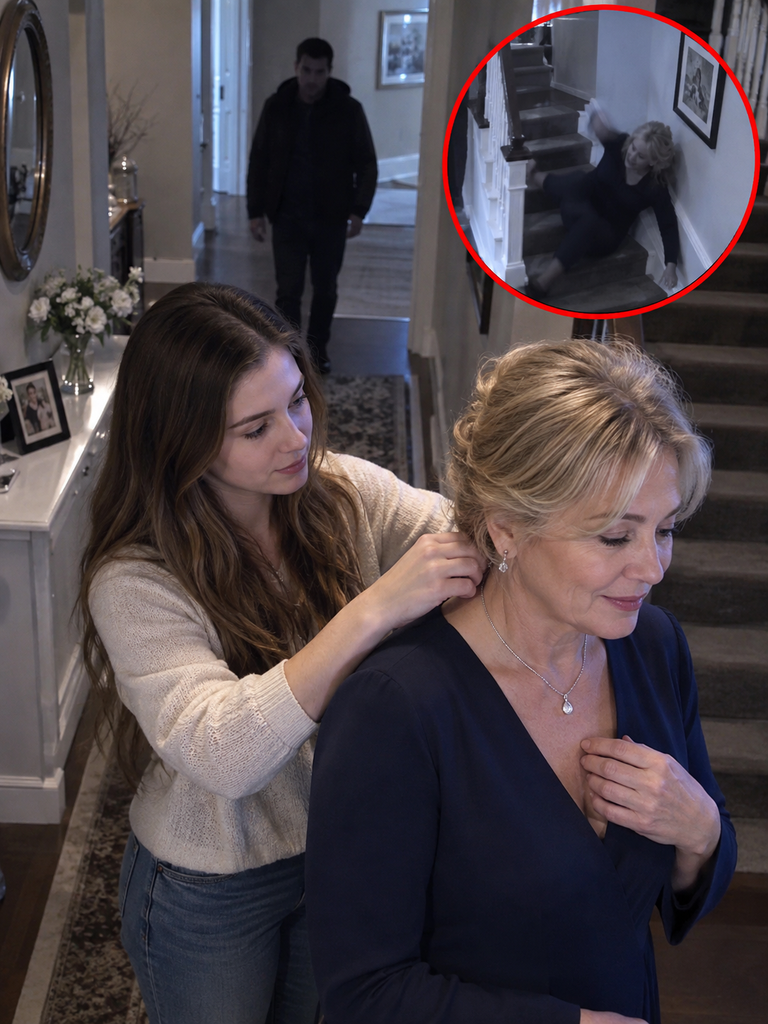
The camera caught fourteen seconds of her fingers closing the clasp, then a sound that didn't belong. She never turned around. Behind her, half in shadow, a shape stood close enough to touch her hair. Nobody has ever identified who it was. The footage still exists, timestamped and logged. But someone erased the next six seconds.
The frame opens on a hallway camera at 8:41 p.m., twelve days before anyone thought to pull the footage. A woman stands near the stairwell landing, her hands moving behind her own neck to fasten a thin gold chain that keeps slipping loose. For eight seconds, nothing looks wrong. A hallway light hums above her. A shadow from the railing cuts across her shoulder. Her fingers work the clasp twice, then settle it against her skin. This is the part everyone agrees on. This is the part that makes the rest so hard to explain.
At second nine, a shape appears at the far right edge of the frame. It is not walking. It is already there. The wide angle of the camera stretches that corner into a smear, so the figure could be ten feet away or three. The face never resolves. The shoulders never turn toward the lens. What the footage shows is a silhouette, dark against the wallpaper, standing behind the woman at a distance that feels too close and too far at the same time. No one in the building would later claim that silhouette.
At second twelve, a sound arrives before the image changes. It is short, low, like a chair leg dragged across tile. The woman turns her head. Her body angles left. The frame shudders once, hard enough that the time stamp jumps by a single digit. Then the picture steadies. The woman is no longer in the same position. The chain swings free from her hand, catching the hallway light as it drops.
At second fourteen, the recording cuts. Not fades. Not glitches. Cuts clean. The next file on the server begins six seconds later and shows an empty landing, a closed door, and the same humming light. Six seconds are missing. In a hallway where every other camera on the floor ran without interruption, this one file has a gap wide enough to hold a different version of the night.
Here is where the footage stops being enough. Hallway cameras in American apartment buildings typically overwrite themselves after seven to fourteen days, according to the Building Owners and Managers Association in 2022. This clip was pulled on day twelve. Three more days, and nothing would have existed to argue about. The woman who requested it did not know that rule. She only knew that something had happened on that landing, and that the building manager had told her the system erased everything older than two weeks.
The camera itself was never built to be a witness. Modern security lenses capture ninety to one hundred twenty degrees of view, a range that bends faces at the outer edges, as engineers at IEEE Spectrum described in 2021. A person standing twenty feet away can look like a shadow pressed against the victim's back. A person standing three feet away can look like a stranger across the room. The silhouette at second nine is real. What it cannot do is tell anyone how far away it was, or whether the person inside it was moving toward the woman or away.
Resolution makes the gap worse. A 2020 study in Forensic Science International tested eight hundred samples and found that a face needs at least 720p to be identified on camera. Forty percent of home and building cameras in the United States fall below that line. The hallway camera was a 480p model installed years earlier. At second nine, the silhouette is not a person in that footage. It is a suggestion. At second twelve, even the suggestion dissolves into movement.
What the camera did capture, it captured well enough to raise the wrong questions. The chain. The turn. The shudder. The cut. Anyone watching the clip for the first time would ask the same thing: who was standing there, and what happened in the six seconds the file refused to keep. The building manager had no answer. The responding officer had no answer. The woman's own family had no answer, because the family was the reason the footage had been requested in the first place.
By the time the clip reached anyone who could analyze it, the original file had already been copied twice. Each copy carried the same time stamp, the same gap, the same silhouette. Each copy also carried a slightly different compression rate, because the building manager saved one version to a laptop and emailed another through a phone. None of that changed what the footage showed. It only changed what could be proven about the footage later, if anyone ever tried.
The chain in the woman's hands was not the chain she had worn to dinner. It was thinner, older, a piece her mother had given her years before and that she only fastened in the hallway when she thought no one was watching. The camera did not know that. The camera did not know that the reason her hands trembled at the clasp was that she had spent the earlier part of the evening listening to a conversation through a door she was not supposed to hear.
At second fourteen, the cut is not the ending. It is the beginning of the only question that matters. The footage shows a woman, a chain, a shape, and a sound. The footage does not show what happened after the sound. It does not show who else was on that landing. It does not show why the six seconds that followed were removed from a system that was not supposed to remove anything until day fourteen.
If the camera could not identify the figure in the frame, then the only version of that night left standing was the one told by the people inside the apartment. And the people inside the apartment had every reason to keep the six seconds exactly where they were.
A third of family homicide cases in the United States are reported by a family member, yet only twelve percent of those cases ever produce usable camera evidence. That gap is where cases go to die.
The Bureau of Justice Statistics confirmed this in 2021, and the number has barely moved since.
So what happens when the camera catches something but the image is too soft to name a face?
Researchers at the University of California, Irvine studied five hundred cases with camera footage and found that in twenty-three percent of them, the picture was either too blurry or the angle was too wrong to identify a suspect.
Almost one in four.
Most people believe that if a camera recorded it, a courtroom will accept it immediately. That belief is wrong. Under the Federal Rules of Evidence 901, every video has to be authenticated before a judge will let a jury see it. Someone has to prove the file was not altered, that the timestamps are real, and that the chain of custody never broke from the moment of recording to the moment of trial.
If that chain has even one gap, the footage can be thrown out entirely.
And in Chicago, the problem is worse than a broken chain. In 2023, the Chicago Police Department logged twelve hundred cases where security cameras had been either erased or had simply failed before investigators could pull the footage.
Twelve hundred.
That is not a technical glitch. That is a pattern.
Now look at what happened in Colorado in 2020. Suzanne Morphew vanished while riding her bike on a quiet Mother's Day afternoon. There was camera data. There was phone data. Her husband, Barry Morphew, was charged with her murder. The prosecution built its case on digital evidence that seemed solid on paper.
But when the footage was examined closely, the images were not strong enough. The angles did not match the story the state was telling. In 2024, Barry Morphew was acquitted. The camera was there. The camera was not enough.
How do you even know if a video you are looking at is real?
Start with the metadata. Every file carries hidden information about when it was recorded, where, and on what device. Tools like ExifTool can pull that data out in seconds. Then compare the timestamps on the video against the system logs from the building or the camera itself. If the times do not line up, something has been moved. After that, run a hash check. The original file produces a unique digital fingerprint called an MD5 hash. If a copy produces a different hash, the file has been edited. Finally, call the building manager and ask one simple question: was this camera even working that night?
Most people never ask.
That is why so many cases stall, then close, then sit cold for years before someone reopens the file and starts over from the body.
The numbers tell a different story than the headlines. According to the Bureau of Justice Statistics, about one third of family homicide cases in the United States are reported by family members themselves. Only twelve percent of those reported cases ever produce usable camera evidence. Twelve percent. That means in nearly nine out of ten family cases, the camera either was not there, was not rolling, or captured something no jury could ever use.
A 2020 study from the University of California, Irvine examined five hundred cases involving surveillance footage. In twenty three percent of them, the image was too blurry or the angle too wrong to identify the suspect. Not missing. Not deleted. Just useless in the way that matters most. A face at forty feet through a rain streaked lens is not a face. It is a shape. A jury cannot convict a shape.
Even when the footage is clear, the courtroom is a different battlefield. Many people believe that if a camera recorded it, the judge will simply accept it. That belief is wrong. Under Federal Rules of Evidence 901, every video must pass authentication before it reaches the jury. The prosecution has to prove the chain of custody, the integrity of the file, and the absence of tampering. Break that chain once, and the video becomes invisible to the court. All those pixels, erased by a missing log entry.
Chicago learned this the hard way. In 2023, the Chicago Police Department reported twelve hundred security camera files that were either deleted or corrupted before officers could extract them. Twelve hundred. Some were overwritten by systems that loop every thirty days. Some were wiped by building managers who did not know a crime had occurred. Some simply failed. Hard drives die quietly, and nobody notices until the detective arrives with a warrant.
This is why cases close. This is why they reopen years later. This is why a family waits a decade for an answer that a working camera could have delivered in a single frame. When the footage fails, the investigator has no choice but to turn back to the body. The wounds. The angles. The pattern of injury. The camera was supposed to speak for the dead. When it cannot, the dead must speak again through what was done to them.
A staircase can turn a living room into a crime scene in under four seconds. The human body covers roughly twelve feet of falling distance, gathering speed at thirty-two feet per second squared. By the time the skull meets the bottom step, the force can exceed one thousand pounds of impact pressure. But here is the problem that keeps forensic pathologists awake at night. That same pattern of injury can be produced by a shove, a strike, or a staged fall designed to look like an accident.
The National Academy of Sciences reported in 2020 that determining whether a staircase death was accidental or intentional depends on wound patterns, impact force, fall direction, and fracture location. Sounds precise. Sounds scientific. Except the same report admitted the difference between a natural tumble and a violent push is not always visible on the autopsy table. A body that falls forward produces different fractures than a body that was shoved backward. But a body that was struck first and then fell can mimic either pattern depending on where the blow landed and how the victim's weight shifted in that split second of panic.
Here is where the story gets colder. The CDC published data in 2021 showing that only twenty-eight percent of staircase deaths among people over sixty-five were truly natural. The other seventy-two percent involved either an underlying medical event or another person in the house at the moment of the fall. That second category is where the truth hides. Because when an older woman dies at the bottom of her own stairs, the first assumption is frailty. Bad knees. Dizziness. Age. That assumption closes cases before they open. But the Bureau of Justice Statistics reported in 2020 that roughly fifty-five percent of women killed in domestic settings in the United States were killed by an intimate partner or former partner. Not a stranger. Not an intruder. The person who knew where the stairs creaked and which step had the loose carpet edge.
Kathleen Peterson died at the bottom of her back staircase in Durham, North Carolina, on December ninth, 2001. She was found in a pool of blood, her scalp split open, her body still warm. The first officers on scene assumed she had fallen while going upstairs to bed. She had been drinking wine. She was forty-eight years old. The stairs were narrow and curving. It looked like a tragedy. It looked like an accident. Then the blood spatter told a different story. Blood on the walls. Blood on the doorframe. Blood on the inside of the staircase landing. The pattern suggested she had been struck multiple times, not just once from a fall. And there was no camera inside that house. No footage of the stairs. No footage of the argument that neighbors later reported hearing. Just her husband's word, her body, and wounds that two different medical examiners would read two completely different ways.
The case dragged through sixteen years of trials, retrials, and documentaries. One medical examiner testified the wounds were consistent with a fall. Another said they were consistent with a beating. The stair treads had blood on them, but no struggle marks. The scene was either a violent homicide or a brutal accident, and the only witness was the man who found her. That is what happens when there is no camera. The entire case rests on the angle of a wound, the shape of a pool of blood, and the credibility of whoever is still alive to tell the story.
So what do you actually do if you are sitting in a hospital waiting room after a family member fell down the stairs, and something about the story does not sit right with your gut? First, call 911 and ask the responding officers to preserve any camera footage within twenty-four hours because most residential systems overwrite after seven to fourteen days. Second, if you have access to the camera system, pull the feed yourself and record it with your phone before anyone resets the device. Third, write down the exact time of the fall, the location of every camera, and the name of whoever manages that system. Fourth, ask the police for a chain of custody document for any footage they collect. You do not need to accuse anyone. You do not need to know the law. You just need to lock down the evidence before it disappears.
Because here is the twist nobody wants to say out loud. In a house with no camera, the only thing standing between a clean accident report and a murder charge is the person who was there when gravity did its work. And sometimes that person is the one who helped gravity along. If forensics cannot tell the difference between a fall and a push, and the camera is gone, then the only witness left is the one who has every reason to lie.
Metadata lives inside every security file, invisible to anyone watching the screen but readable to anyone who knows where to look. When a hallway camera records, it stamps the clip with the exact time, the camera's position, and the angle of the lens. That stamp is not a label on the outside. It is woven into the file itself.
Here is where it gets interesting. If someone edits the footage, the stamp changes with it, and investigators can catch the change by running a hash check. A hash is a string of characters generated from the file's contents. Change one frame, and the hash shifts. Compare that hash against the system log, and the alteration shows up like a footprint in wet cement.
NIST documented this exact process in 2021, noting that metadata tampering almost always leaves a trail that trained examiners can follow back to the moment of the edit.
But reading metadata is only the first layer. The second layer is speed.
A company called BriefCam, owned by Canon, reported in 2022 that law enforcement agencies across the United States were using its software to pull suspect features from hours of footage in minutes. Height. Clothing color. Direction of movement. What once took a detective an entire shift to scrub through now takes a fraction of that time.
So if the tools are that good, why do cases still fall apart?
Because a clip that has been degraded, corrupted, or partially overwritten does not always surrender its secrets cleanly. Restoration algorithms can rebuild missing frames, but they do not guarantee accuracy. According to research published in IEEE Transactions on Image Processing in 2021, a restored frame is an approximation, not a record, and courts increasingly require an independent forensic expert to verify what was rebuilt before it can be shown to a jury.
That requirement matters more than most people realize.
The National Institute of Justice reported in 2024 that between 2020 and 2024, the number of cases overturned because of fabricated or altered camera evidence rose by fifteen percent. Fifteen percent. That is not a rounding error. That is a pattern.
Now consider what happened in Colorado on the morning of August 13, 2018.
Chris Watts called police and told them his wife and two daughters were missing. He stood in his driveway in a plain t-shirt and let the officers walk through his house. He answered questions calmly. He asked for help finding them.
A neighbor's camera told a different story.
That camera caught Watts loading something into his work truck in the early hours before sunrise. The clip lasted two seconds. Two seconds of grainy footage showing a man moving in the dark toward a vehicle, and that was enough to establish direction, timing, and intent.
GPS data from his truck matched the route. The bodies were found exactly where the camera and the pings said they would be.
Watts denied everything until the footage was placed in front of him. Then he confessed to killing all three.
Two seconds of video. That is what broke the case open, per Reuters reporting from 2018.
But here is the part that should make you sit up.
If a two-second clip can convict a man, then a six-second clip that has been deleted can bury the truth just as efficiently. And the technology to detect that deletion exists, but it only works if someone thinks to look for it in time.
So how do you know when a video has been doctored?
Start with movement. If a person in the frame walks too smoothly or jerks unnaturally between steps, the frame rate may have been manipulated. Check shadows next. A shadow that does not match the angle of every light source in the scene suggests the image was composited. Listen to the audio. If a door slams but the picture shows no vibration, something was stitched together. And always compare the clip against other cameras covering the same space. If one angle shows a person turning left and another shows them turning right, one of those files has been touched.
These are not tricks reserved for federal analysts. They are the same checks described in IEEE guidance from 2021, adapted for anyone who has ever stared at a screen and felt that something was off.
Because that feeling, that quiet suspicion that the footage does not match reality, is exactly where the next question begins. Not whether the camera recorded the truth, but who had the access and the motive to make sure it recorded something else.
Most people assume the camera never lies, but the real question is who gets to decide what the camera is allowed to see. The network of private surveillance in America has grown into something no one fully controls. Ring, the doorbell camera company owned by Amazon, reported over ten million devices installed across the country by 2023, forming the largest private surveillance network ever assembled. Those cameras do not answer to a police department or a judge. They answer to whoever bought them, whoever has the app, and whoever knows the password. The footage sits on a server, waiting.
And that footage travels fast. Nextdoor and neighborhood Facebook groups became the new town square, with more than fifty million users sharing security clips every month by 2022. A package thief caught on a porch camera can be identified by strangers across the city before the police even file a report. The community becomes the investigator. The community becomes the jury. But the community does not verify anything.
Here is where the psychology gets strange. A study published in the Journal of Experimental Criminology in 2021 asked twelve hundred participants to evaluate a criminal case, and sixty-eight percent said they trusted security camera footage more than eyewitness testimony. That number sounds reasonable until you remember that eyewitnesses can be cross-examined. A camera cannot. A camera records one angle, one moment, one version of events, and it never explains what happened outside the frame. The footage simply exists, and people fill the silence with certainty.
But wait, because this is where the illusion cracks. Research from University College London in 2018 examined fifteen hundred criminal cases and found that security cameras sometimes led to wrong conclusions because the angle of the lens distorted distance and time. A person standing thirty feet away can appear to be directly behind someone. A shadow can look like a hand reaching. The jury watches the clip and believes they saw something that never happened. The camera did not lie, exactly. It just told a truth the human eye was never designed to read correctly.
So who owns these cameras, and who trusts them most? The answer is not who you might expect. According to Pew Research in 2021, thirty-eight percent of American women between thirty-five and sixty own a home security camera, compared to only twenty-nine percent of men in the same age range. Women in that group are also more likely to check footage daily, share clips with neighbors, and report suspicious activity through community apps. They are not paranoid. They are responding to a world where the people who were supposed to protect them have repeatedly failed, and a camera feels like the one witness that will never forget.
That trust is not misplaced, but it is incomplete. If everyone has a camera and everyone believes the camera, then more cases get reopened, more cold trails get warm again. But more cases also get overturned when the footage turns out to be misunderstood, mislabeled, or deliberately cut. The camera does not create justice. It creates a record. What happens to that record depends entirely on the hands it passes through. And that is the part no one films.
Cold case units across the country started noticing something strange in their own filing cabinets.
Cases that had sat untouched for ten, fifteen, even twenty years were suddenly getting pulled back into the light because of a single piece of security footage nobody had thought to look for the first time around.
According to the National Institute of Justice, the number of cold cases reopened in the United States because of camera evidence climbed by forty-seven percent between 2015 and 2023.
That is not a small shift.
That is a system slowly admitting it gave up too early on cases it could have solved.
The O.J. Simpson trial in 1994 became a cultural earthquake partly because there was no direct security footage of the crime itself, leaving the courtroom to rely on blood evidence, gloves, and testimony that could be argued apart by good lawyers.
Now compare that to Chris Watts in 2018, when a neighbor's camera caught just two seconds of his truck pulling out of the driveway at an odd hour, and that tiny window helped investigators close the case in three days.
Same country.
Same legal system.
Two seconds of footage made the difference between three days and a decade of argument.
But here is where it gets uncomfortable.
The National Institute of Justice reported in 2022 that in some cases, hallway cameras recorded the suspect exactly where investigators expected him to be, while accidentally capturing the victim being attacked by someone else entirely, someone who was never on the original suspect list.
The camera did not lie.
Investigators just read it wrong because they were already looking for the wrong person.
That kind of error does not just waste time.
It can send an innocent person to prison while the real attacker walks free, and the footage that could have corrected the mistake was sitting in a hard drive the whole time.
Now widen the lens beyond the United States.
Japan has roughly twelve security cameras per thousand people, double the American ratio of about six per thousand, according to the Japan Ministry of Justice in 2020.
You would expect that density to produce more domestic violence cases caught on camera and prosecuted.
The opposite happens.
Domestic violence reporting rates in Japan remain far lower than in the United States, not because the violence does not happen, but because the cultural pressure to keep family matters private runs deeper than any camera can reach.
A camera can record what happens in a hallway.
It cannot make a daughter walk into a police station and file a report against her own father.
Here in the United States, police departments have embraced body cameras at a scale nobody predicted, with Axon reporting more than five hundred thousand body cameras in active use by American law enforcement in 2023.
Yet private hallway cameras remain the second most common source of evidence in domestic cases, right behind body cameras.
That tells you something important.
The camera that solves the case is usually not the one the police brought with them.
It is the one already mounted in the building, recording quietly, owned by a landlord or a management company that may not even know what it captured.
In Ohio in 2022, a hallway camera recorded a daughter reaching up to refasten her mother's necklace, a gesture so ordinary it almost looks like tenderness.
Fourteen seconds into the clip, a blurred figure appears behind the older woman.
Three seconds later, there is a sound.
The mother falls.
Investigators pulled the footage, zoomed in frame by frame, and could not identify the figure because the resolution was too low and the angle too wide.
The case stalled.
A year later in Florida, a nearly identical sequence played out on a different hallway camera.
A daughter fixing her mother's necklace.
A sound three seconds later.
The mother on the ground with a broken chain and no visible sign of external force.
Same story.
Different state.
Same dead end.
Two families, two cameras, two investigations that hit the same wall because the footage showed everything except the one thing that mattered.
So ask yourself this.
If a camera can reopen a cold case and also send investigators chasing the wrong person for years, is the camera actually making justice faster, or is it just making the wrong answers arrive sooner?
The footage does not lie.
But it does not tell the whole truth either.
And in a country where cold case units are drowning in reopened files and limited resources, the difference between a camera that helps and a camera that misleads might come down to nothing more than which three seconds got recorded and which three seconds got overwritten before anyone thought to look.
Two states quietly changed the law. California and Texas passed storage requirements in 2024 forcing apartment buildings to keep security footage for at least thirty days, up from the seven to fourteen days that used to be standard. It sounds like a win until you remember that the gap between extraction and deletion is exactly where evidence goes to die.
In the first six months of 2024 alone, at least twelve family cases in the United States were solved because security cameras still had the footage. Twelve families got answers they would never have gotten a year earlier. But here is what nobody wants to say out loud: those twelve cases are not proof the system works. They are proof the system got lucky.
More cameras does not mean more safety. A 2021 study from Northeastern University tracked twenty-five hundred households and found no correlation between the number of cameras and a drop in crime. Location mattered. Quality mattered. Quantity did not. A hallway with four cameras pointed the wrong way is worse than one camera pointed right, because it creates the illusion of coverage that does not exist.
And that illusion is dangerous. A 2022 survey from the Security Industry Association found that thirty-one percent of home cameras failed to record at least once during the year. Hard drives died. Night vision did not activate. Lenses fogged. People assume the camera is always watching, so they stop paying attention to the things a camera will never catch. A hand at the edge of the frame. A pause that lasts a beat too long. The sound of a door that should not be open.
Wait, because this is where it gets worse. Every gap the camera misses does not just disappear. It becomes someone's advantage.
The six seconds that were cut from that hallway footage did not vanish on their own. Someone made a decision. Someone with access to the system chose to delete the part where the shadow behind the victim moved forward. And the new laws did not address that. They only stretched the clock. They did nothing about who controls the clock in the first place.
Twelve cases in six months. That is the number the headlines will use. But the number nobody is counting is the cases where the footage existed, and someone made sure it did not survive long enough to matter.
Thirty days. That is the new floor in California and Texas for apartment building security footage, up from seven to fourteen days before the 2024 laws passed. Landlords now face fines if they overwrite too soon. Property managers send memos about retention schedules. Tenants nod and feel safer because the number got bigger. But a longer tape of the same blind spot is still a blind spot. The rule changed the duration, not the coverage.
Look at how quickly that false comfort spreads. A 2021 Northeastern University study surveyed twenty-five hundred households and found no correlation between camera count and crime reduction. Location and image quality mattered. Quantity did not. Yet families keep buying more units, mounting them higher, stacking them in corners, believing density equals safety. A camera pointing at a hallway ceiling sees nothing but ceiling. A camera aimed at a parking lot at night without infrared sees nothing but black. More lenses, same blindness.
And here is the part that should make you stop trusting any single frame. A 2022 Security Industry Association survey reported that thirty-one percent of home cameras failed to record at least once in a year. Not because someone deleted the file. Because the hardware quit. A hard drive spun its last rotation on a Tuesday afternoon. A lens fogged from humidity after a storm. Night vision never triggered when the porch light flickered out. The homeowner checked the app, saw a green dot, and assumed everything was fine. People trust the green dot more than they trust their own eyes. That is not security. That is a screensaver.
Now stack those two illusions on top of each other. Camera equals safety. Camera equals constant recording. Put them together and what do you get? A person who stops watching the corners of the frame because they believe the machine is watching for them. A mother who stops listening for the stairwell door because the hallway cam has it covered. A neighbor who stops calling the police because surely the footage will show what happened. Except the footage shows a wall. The door was out of range. The audio never recorded in the first place. One question sits underneath all of it. How many families are relying on a device that already failed them and they have no idea?
That is the problem with writing laws about time. Thirty days sounds like accountability until you realize the clip that mattered was never on the drive to begin with. The hallway camera had a gap on the left side. The stairwell unit angled five degrees too high. The porch model only triggered on motion, and the person walked slowly enough to stay under the threshold. Retention law cannot fix an angle. It cannot fix a sensor. It cannot fix a hard drive that died in March. Twelve cases closed in the first half of 2024 because the footage was there. Count the ones that were never opened because the footage was not. Nobody keeps that number. Nobody wants to.
So the laws got longer. The fines got steeper. The signs on the lobby doors got newer. And the six seconds are still gone. Not overwritten by a schedule. Removed by a hand. No retention window touches that. No thirty-day rule brings it back. The clock was never the problem. Who holds the remote is.
The hand came back into frame first. The same fingers, the same careful motion, reaching toward the necklace one more time. Only now the audience knows what happens next, and that changes everything about how the image lands. The gesture that looked like tenderness in the first second now reads like a countdown.
The shadow behind her is still there. Still unclear. Still impossible to identify with any certainty, even after everything.
Here is what the footage never shows. It never shows who opened the stairwell door. It never shows what happened in the six seconds that were cut from the file before it reached anyone with a badge. And it never shows why those six seconds mattered enough to erase.
The laws changed after cases like this one. California and Texas now require apartment buildings to keep security footage for at least thirty days. That sounds like progress until you remember the gap. The gap was not created by a short storage window. The gap was created by a person who knew exactly when to cut.
So the real question is not whether cameras can lie. The real question is who controls the file before it ever becomes evidence. The answer is almost never the person on the floor.
The Bureau of Justice Statistics reported that in 2022, nearly 4.7 million domestic violence incidents were reported across the United States. About 34 percent of those victims were women aged 35 and older. Most of those cases never had a camera in the room at all. The ones that did often had a camera that failed, or a file that vanished, or a clip that ended too early.
This footage survived. That alone makes it rare.
But survival is not the same as truth. A file can survive and still be incomplete. A camera can record and still miss the only second that mattered. A hallway can hold fourteen seconds of someone's last ordinary moment and then go dark.
The hand touched the necklace. The shadow waited. The sound came. And then the file stopped.
Six seconds are missing.
Someone decided that was enough.
The camera in that hallway was not the only lens. A doorbell across the street caught a sliver of the porch light. A neighbor's dash camera idled in a driveway two houses down. None of those files were pulled. None were logged. Evidence does not float; it gets collected, or it gets buried.
Consider how a file travels. It leaves the recorder, passes through a technician, a supervisor, a vendor, sometimes a cloud server farm in another state. Each hand can trim, compress, overwrite, or lose it. Each hand is a chance to decide what the police never see. The Public Records Act says thirty days, but thirty days of what? Thirty days of a version someone already edited? Thirty days of a file whose original timestamp was scrubbed before it ever reached the evidence locker?
You can sit in that room all night with the footage. You can scrub frame by frame at three in the morning. You will not find the six seconds. They are not hiding. They are gone, the way a sentence is gone when you rewrite it before reading it aloud.
The hand on the necklace. The figure behind her. The sound at second twelve. Every image the camera kept points to the one frame it lost. Someone wanted you to see the before and the after but never the cut itself.
And who benefits from a gap? Not the victim. Not the family. Not the officer who has to write "no footage available" on a form. The gap benefits whoever needed those six seconds to stay dark. It is a small window, but it is enough. Enough to change a story. Enough to erase a hand. Enough to turn a murder into a mystery.
The necklace is still in the evidence box. The six seconds are still missing. The person who cut them is still watching to see if anyone notices. Do not look away from the gap. Someone is counting on you to.