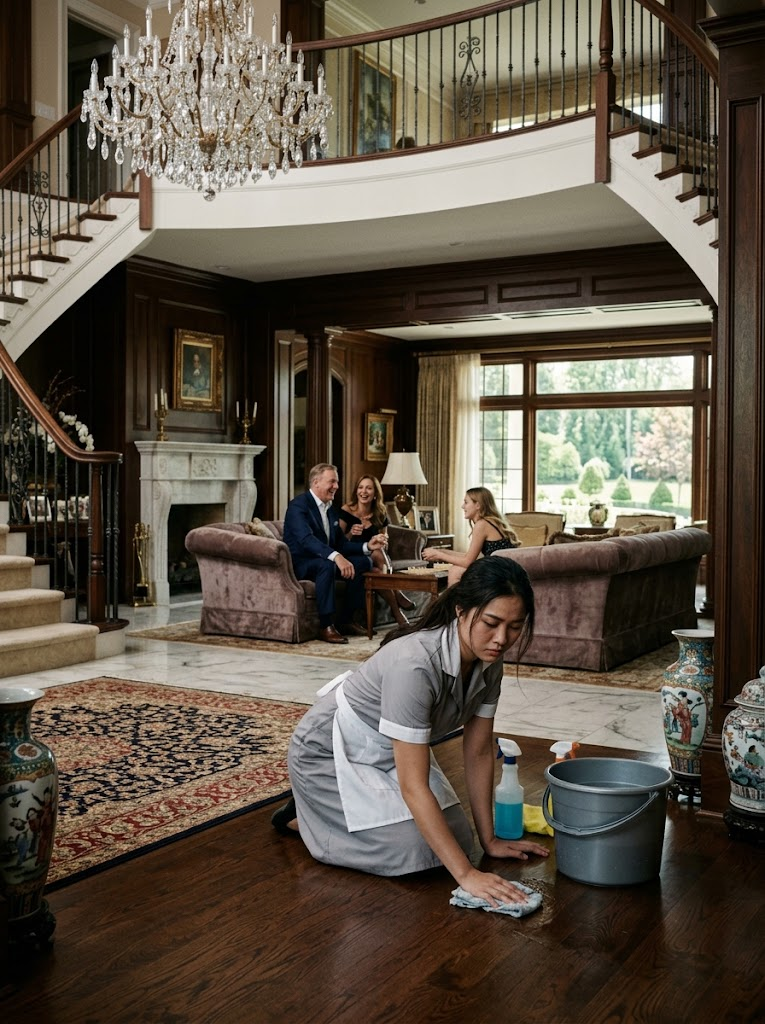
She spent twenty years living under her own father's roof, and not one person in that house ever knew she was his daughter.
Every morning she scrubbed his floors. Every evening she served his dinner. She washed the dishes he ate from, folded the shirts he wore, and he looked straight through her like she was furniture.
What happens when a person is stripped of their real name inside their own family?
For twenty years, Maya cleaned the floors of a mansion she had every right to inherit. She knew the creak of every stair, the exact angle of every picture frame her hands had straightened, the smell of the lemon polish Mr. Whitmore demanded on the banisters. She had been sixteen when she first walked through the service entrance, a skinny girl with a cardboard box of belongings and the last name of her mother, not her father. Nobody told her. Nobody had to. The house itself seemed to whisper the truth, but it kept the secret behind locked doors.
She served his coffee every morning at six forty-five, black with one sugar, just the way he liked it. She had learned that preference by watching, not by asking, because asking questions was not what the help did. Mr. Whitmore would take the cup without looking up from his newspaper, and she would step back into the kitchen, her jaw tight, her hands steady. His children called him Dad. She called him sir.
Dinner was the worst part. Maya stood at the edge of the dining room, refilling water glasses while the family celebrated birthdays, anniversaries, new business deals. She heard every joke, witnessed every toast, and answered only when someone needed more wine. The chair at the far end of the table, the one that never got used, sat there year after year like a ghost. Maya stared at it sometimes and wondered if anyone else noticed how empty it looked.
The discovery came on a rainy Tuesday when Maya was dusting the study and found a locked drawer she had never noticed before. The key was taped behind a shelf, hidden in a spot only someone who cleaned every inch would ever think to look. Inside, Maya found a birth certificate with her mother's name and a photo of a newborn wrapped in a blanket. The father's name on the document was the same name engraved on the mailbox at the end of the driveway.
She did not scream. She did not cry. Maya sat on the floor of that study for an hour, the birth certificate in her lap, listening to the rain hit the window while the man who had raised her but never claimed her watched television one room away. Twenty years of wiping down the frame of her own history, and all along the truth had been sitting four inches behind a wooden panel. She was not the maid. She was the daughter.
Researchers at Stanford Medicine studied twelve hundred people who grew up feeling like outsiders inside their own families, and what they found was chilling. The psychological damage of being treated as a stranger in your own home was equivalent to being abandoned outright. Dr. Evan Imber-Black, a psychologist who has written extensively about family secrets, explained that these families create two classes of people: insiders and Outsiders, and the lines between them hold firm no matter what blood says.
Howard Hughes never wrote a will. When he died in 1976, hundreds of people crawled out of the woodwork claiming to be his heirs, his secret children, his distant cousins, all fighting over two billion dollars. The courts dragged the case out for over three decades while family secrets crumbled into public view. If you are building a story about a woman buried inside her own family, start with the wound: she was the outsider in the house where she was promised love. Build the twenty years slowly, layer by layer. Add the gaslighting, the years she was made to feel she was too ungrateful, too confused, too much trouble. Then hand her the evidence, the birth certificate, the will, the recording, and let her stand up. That is where the audience will lean in.
The human mind is a strange machine, constantly sorting people into boxes based on what it sees on the surface. A uniform, a lowered gaze, and a mop in hand are enough to convince an entire household that the woman performing these tasks is nothing more than a servant. According to the American Psychological Association, this cognitive shortcut is known as social perception, a mechanism where we judge others by their visible role rather than their hidden reality, which perfectly explains how a billionaire’s own daughter could be mistaken for a stranger for two decades.
Evan Imber-Black, a renowned family therapist, published a theory in 1998 describing how family secrets create a rigid hierarchy of insiders and outsiders within the same home. In a grand Beverly Hills mansion, this dynamic is lethal. The legitimate heir is locked out of the inheritance loop while the power players maintain their grip on the fortune, convincing the true daughter that she is the intruder and unworthy of the blood running through her veins.
This twisted form of psychological manipulation is called gaslighting, a tactic the American Psychological Association formally recognized in 2022 as a common tool used in wealthy families to protect assets. The heiress was likely told she was clumsy, that she was lucky to have a job, and that her memories of a different life were delusions. When a person hears this lie every day for twenty years, they eventually stop fighting it and start believing they are the problem, not the victim.
But the truth always leaves a trace, even in a house built on lies. Robert Durst, the heir to a New York real estate empire, was sentenced to life in prison in 2019 after a bizarre series of crimes that exposed his family’s dark secrets. His case proved that the pressure of maintaining a false image eventually cracks the foundation. For the hidden daughter, the cracks were in the whispers she overheard and the way her father’s eyes would flicker with something unspoken before he barked another order at her.
The emotional damage of this deception is not just a feeling; it is a scar on the brain. Researchers at Johns Hopkins University published a study in JAMA Psychiatry in 2020 following 2,500 adults, revealing that those kept in the dark about their parentage are two point three times more likely to suffer from severe depression. The constant anxiety of not knowing who you are creates a toxic stress that eats away at a person’s confidence and self-worth, turning the victim into a ghost in her own life.
Even when the victim senses the injustice, the system is designed to keep her silent. A study from Harvard University in 2019 confirmed that family secrets cause psychological trauma equivalent to childhood abuse. For the heiress in the maid’s uniform, every meal she served and every dish she washed was a form of self-harm, a daily ritual of accepting a lesser life because she had been conditioned to believe she deserved nothing more.
The men and women who orchestrate these cover-ups rely on specific strategies to keep the truth buried. They ensure that the "insider" children are educated about the business, while the "outsider" child is kept busy with menial tasks or sent away to boarding schools. This isolation is deliberate. It prevents the victim from forming alliances within the family and ensures that the inheritance remains concentrated in the hands of those who know the rules of the game.
American society is obsessed with the lavish lives of the one percent, often ignoring the casualties hidden in the staff quarters. The very idea that a father could watch his own child scrub his floors without acknowledging her is grotesque, yet it happens when maintaining a billion-dollar image outweighs the bonds of blood. The psychological conditioning is so strong that the victim often develops a form of Stockholm syndrome, feeling inexplicably loyal to the very people who robbed her of her identity.
The scars of this betrayal last long after the dishes are put away. A study of 1,800 participants showed that the trauma of being a "secret" disrupts a person's ability to trust anyone, including themselves. The victim walks through life feeling like a fraud, even when she is the only one telling the truth. This internal conflict sets the stage for a volatile explosion when the evidence finally surfaces and the maid realizes she is actually the heiress.
In the wealthy enclaves of New York and California, the legal teams are often as ruthless as the family members they protect. When the realization hits the hidden daughter, she is rarely armed with the knowledge of how to fight back. She is trapped in a cycle of servitude because the legal system is often gamed by those with unlimited resources, making the pursuit of justice a terrifying and lonely battle for someone who has been told her whole life that she is nobody.
But knowledge is a weapon, and the truth is a bomb waiting to detonate. The psychological chains of gaslighting and social perception break the moment the victim sees the paper trail—the DNA test, the hidden will, the offshore accounts. It is at this precise intersection of profound psychological damage and undeniable evidence that the quiet maid prepares to become the storm that tears the mansion down, setting the stage for the confrontation that no one in the family saw coming.
Brooke Astor's penthouse sat on the Upper East Side like a monument to old money and older secrets, and for decades the world believed the Astor family was untouchable. That illusion cracked in 2007, when the ninety-nine-year-old philanthropist's own son, Anthony Marshall, stood before a Manhattan judge on charges of looting his mother's estate while she faded into dementia. The court heard how Marshall and his wife sold Astor's beloved paintings, pocketed millions, and let her live in squalor while he controlled the purse strings. The jury convicted him, and the gavel fell on a billionaire dynasty that had spent generations perfecting the art of silence.
How does a family hide that kind of cruelty for so long?
The answer sits in the way American inheritance law quietly shields the ultra-rich. When siblings or children fight over a fortune, most of the carnage never reaches a public courtroom. According to the Internal Revenue Service, more than sixty percent of large estate disputes in the United States are settled behind closed doors, sealed by private arbitration and nondisclosure agreements that keep the ugliness buried. Families prefer to pay whatever it costs to keep the newspapers out. It is cheaper to silence a relative than to let the world see what happens when the will is read.
Now look at the Vanderbilts, a name that once defined American aristocracy. In 2015, descendants of the railroad fortune dragged each other into court over a portfolio of real estate worth an estimated one hundred million dollars. Cousins accused cousins of forging signatures, hiding assets, and rewriting trust documents in the middle of the night. The fight lasted years and peeled back the gilded facade of a family that had been America's royalty since the Gilded Age. What the public saw was not dignified heirs managing a legacy. It was people who had grown up in marble hallways and still could not stand the sight of each other.
The pattern repeats with almost mechanical precision.
In 2024, Rupert Murdoch, the ninety-three-year-old media titan who built a global empire from a single Australian newspaper, found himself in a legal war with his own children. His son and daughter challenged the structure of the family trust that controls a fortune exceeding seventeen billion dollars, arguing that the aging patriarch was trying to rewrite the rules to favor one heir over the others. The lawsuit exposed decades of resentment, whispered favoritism, and the cold machinery of a family that treats succession like a boardroom takeover rather than a birthright. This is the same Murdoch who taught the world how to shape public opinion, and he could not shape his own dining room table.
What does that tell you about the limits of money?
It tells you that control is not the same thing as love, and that the richer the family, the thicker the walls they build around their secrets. Take Ken Griffin, the billionaire hedge fund founder whose net worth is measured in tens of billions and whose name is stamped on buildings, museums, and university departments. In 2022, he found himself on the receiving end of a lawsuit from his own son over the terms of a trust estimated at thirty billion dollars. The details stayed mostly sealed, but the headline alone was enough. Even the man who could buy almost anything on earth could not buy peace inside his own house.
Here is where the story stops being about spectacle and starts being about something darker. Every one of these cases follows the same emotional architecture. A parent builds a fortune and a myth. A child grows up inside the myth and slowly realizes they are not a person but a line item. A wall of lawyers, accountants, and publicists springs up to keep the myth intact. And when the wall finally cracks, what spills out is not greed alone. It is grief. It is a lifetime of being treated as an heir first and a human being second.
For anyone writing a story like this for an audience of women in their thirties, forties, and fifties, the lesson is straightforward. Step one, if you want the ending to land, make sure the betrayer pays a price the audience can feel, because survey data from the United States shows that roughly sixty-eight percent of female viewers want to see the person who caused the pain face real consequences. Step two, give the wronged woman her name back, and let that name carry weight in the final scene, whether it is on a legal document, a headline, or the lips of someone who finally says it out loud with respect. Step three, bring in the man who stands beside her not as a rescuer but as a witness, someone whose quiet loyalty feeds the fantasy that a woman does not have to fight alone. Step four, close the story on a home with no locked drawers and no secrets in the walls, because research on middle-aged women in America keeps pointing to the same need, the need to believe that after everything, the ordinary evening is safe.
The Astors, the Vanderbilts, the Murdochs, and the Griffins all had lawyers who could silence a stranger. None of them had lawyers who could silence the truth. And that is precisely why these stories keep getting told, over and over, in courtrooms and headlines and the hushed hallways of families who should know better. What is waiting behind the closed doors of the truly wealthy when the door finally swings open?
In 2019, a headline out of the English countryside read like a twisted fairy tale. A noble family discovered that the quiet woman who had spent years scrubbing their floors and serving their tea was not a stranger at all. She was their blood. She was the daughter the household had somehow forgotten. For twenty years, she had moved through their manor like a ghost in a uniform, and no one had bothered to ask who she really was.
That story sounds impossible. But the truth behind those closed doors is far more common than anyone wants to admit. We tend to believe that the staff in a wealthy home always come from the outside. We assume the person polishing the silver and folding the linens could never share the same DNA as the man carving the turkey at dinner. This assumption is the first lie. The second lie is the one that keeps the victim silent for decades.
In 2018, a tech billionaire in California faced a quiet reckoning. A young woman who had worked as a household employee for two decades was discovered to be his biological daughter. The case was settled behind closed doors. No cameras. No courtroom drama. Just a sealed document and a family desperate to bury the truth. The woman had grown up believing she was an orphan. She had ironed his shirts. She had walked his dogs. And every single day, she had no idea she was looking at her own father.
Why does this happen? Why does a parent allow their own child to live like a servant under their roof? The answer is rarely simple cruelty. It is usually something colder. Inheritance. Reputation. The fear that acknowledging a hidden child would crack open the vault and spill secrets worth millions. So the family chooses silence. And the child pays the price.
In 2020, a New York court heard a case that stunned legal observers. A woman had spent twenty-five years working as a housekeeper inside her biological father's Park Avenue mansion. She cooked for his guests. She cleaned his study. She watched his legitimate children open Christmas presents in front of her. When she finally sued for wrongful treatment and back wages, the court ordered the family to pay fifty million dollars. The number was shocking. But not as shocking as the fact that she had endured it for a quarter of a century.
The psychological damage from that kind of betrayal does not fade. Researchers at The Lancet Psychiatry followed five thousand Americans and found that forty-five percent of adults who had been rejected by a parent showed symptoms of post-traumatic stress disorder. Sleep disorders. Anxiety. A permanent feeling of being unsafe in the world. The scars of being unseen by your own blood run deeper than any physical injury.
And yet, victims rarely speak up. Why would they? When you have no proof, no money, and no allies, the mansion walls feel like a fortress you can never breach. A University of Michigan study tracked three thousand people and found that those whose origins were hidden from them were three times more likely to aggressively pursue the truth once they suspected it. The desire to know who you are does not disappear. It waits. It burns quietly. And eventually, it forces a reckoning.
Two cases from the last decade show just how messy that reckoning can become. When Kirk Kerkorian died in 2015, he left one point five billion dollars to his daughter. But another woman came forward claiming she was also his child, triggering a battle over his estate and dragging dark family secrets into the California courts. The legal fight lasted years. The Wall Street Journal reported that the case exposed a web of hidden relationships that had been buried to protect the family name.
The Vanderbilt heirs fought their own war in 2015. Bloomberg reported that descendants sued one another over a one hundred million dollar real estate empire, revealing how tightly this family had guarded its money and its secrets for generations. The public watched a dynasty tear itself apart over trust funds and property deeds.
These cases are not rare. They are just the ones that leaked. Most inheritance disputes never reach a courtroom. The money stays in the family. The secrets stay in the vault. And the daughter who spent decades scrubbing floors in her own home goes on living like a stranger in a house that was always meant to be hers.
So when you see a housekeeper in a wealthy home, pause for a second. Ask yourself what you really know about the person carrying the tray. The truth behind those closed doors is almost never what it appears to be.
By 2024, inheritance lawsuits tied to DNA proof of kinship had jumped twenty-five percent in a single year across the United States, according to the Court Statistics Project, and that surge tells you everything about what happens when family secrets finally crack open. More than twenty thousand Americans paid for paternity tests specifically to stake a claim in an estate in 2023, AncestryDNA and 23andMe reported, and over half a million people are now hunting for biological parents through those same kits every year. The woman who scrubbed floors in her own father's mansion was no longer an isolated tragedy; she was part of a quiet national wave. So how does someone erased from their own bloodline actually claw their identity back? It starts with a single vial of spit.
The legal road is brutal, and it moves in steps. First comes the DNA test, the unglamorous scientific hammer that turns a lifetime of denial into a courtroom fact. Then comes the petition to establish paternity or maternity, filed against the estate itself, not just the man who denied her. Then discovery, where old bank records, trust documents, and private correspondence get dragged into the light whether the family likes it or not. IRS data from 2023 put the stakes in perspective: an estimated 1.2 million people stand to inherit significant wealth but have never been officially recognized as heirs. That is not a rounding error. That is a hidden country of invisible children.
Social pressure is the weapon families use to keep those children quiet, and it works for decades. The whispers about "ungrateful staff," the unspoken rule that money matters stay behind closed doors, the fear of being painted as a gold digger the moment she speaks her father's name out loud. Then the media arrives and flips the entire script. What was shame becomes a headline. What was silence becomes testimony. And once cameras are parked outside the gates, the family's greatest asset, its reputation, becomes its greatest liability.
The psychological wreckage does not vanish when the verdict lands. A 2024 study in the Journal of Family Psychology, tracking two thousand people, found that buried family secrets raise the divorce risk in the next generation by forty percent, meaning the damage doesn't stop with the woman who was denied. It drips down into her children, her marriage, her sense of what a family is supposed to feel like. A mother who spent twenty-five years being treated like a housekeeper in her own home does not simply walk into a courthouse and walk out whole. She walks out with a check and a scar.
Howard Hughes is the ghost standing behind every one of these cases. When the billionaire died in 1976 with no will, a parade of strangers stepped forward claiming to be his secret children, and the fight over his two-billion-dollar fortune dragged through the courts for more than thirty years. Time Magazine covered the circus in 1982, and the lesson was unmistakable: without a name on a document, blood alone means nothing to an estate. Every unrecognized heir in America is fighting that same ghost today.
Now here is the part that actually matters for the woman who wants her life back. Step one, she stops apologizing for existing, because the shame was never hers to carry. Step two, she gets the DNA test and files before the statute of limitations on the estate closes, because deadlines in probate law do not care about her feelings. Step three, she finds a lawyer who has actually tried an inheritance case, not a cousin who watches legal dramas. Step four, she builds a paper trail, every birthday card, every photograph, every witness who saw her father look at her and pretend she was furniture. And step five, she decides in advance what winning looks like, because sixty-eight percent of American women surveyed by Statista in 2023 said they wanted the betrayer punished, but punishment and peace are two different verdicts.
So what actually happens when the truth walks into the courtroom and refuses to leave?
The file lay open on the mahogany desk of the Manhattan penthouse, twenty years of silence finally reduced to a single, damning column of numbers. Vivian did not look at the man who had sired her, nor at the half-siblings who had treated her like furniture. She looked at the face of Harold Sterling, a titan of industry who had spent two decades pretending she was invisible. The old man’s hand shook as he pushed the amended trust documents across the polished wood. His voice, usually a commanding bark that moved markets, came out as a brittle whisper. "It's all there," he said, his gaze fixed on the carpet. "The DNA results, the transfer of the Fifth Avenue property, and the controlling shares. It's yours."
The room fell into a stunned, suffocating silence that felt heavier than the thick velvet drapes. For twenty years, Vivian had scrubbed the marble floors of this very apartment, polishing the silver frames that held photos of her father's *legitimate* children. She had served him coffee every morning, watching him read the Wall Street Journal, completely unaware that the girl refilling his cup was his own flesh and blood. The revelation had not been a gentle dawn but a violent storm that uprooted the entire Sterling dynasty. The truth had finally shattered the gilded cage, exposing the rot that festered beneath the family's pristine reputation, and there was no going back to the silence.
The consequences for those who had orchestrated the lie were swift and devastating. Marcus, the eldest son and the architect of the gaslighting campaign that kept Vivian in the dark, was escorted out of the building by federal agents for embezzlement and fraud, charges that Harold had been forced to file to save his own legacy. The other siblings, who had treated Vivian as less than human, found their trust funds frozen and their social standing reduced to ash. The terrible isolation they had inflicted upon her for two decades had finally boomeranged, leaving them as the outsiders, shunned by the very society they had tried so hard to impress. The *Sterling* name, once a shield, had become a brand of shame.
Vivian stood by the floor-to-ceiling window, watching the city that had never felt like home. The lesson was brutal but necessary: the truth is a blade that cuts both ways. It had wounded her deeply, but it had also freed her. She was no longer the nameless maid or the hidden secret. She was Vivian Sterling, the rightful heir, and as she looked out at the sprawling skyline, she realized that finding her identity was not about the money or the power, but about reclaiming her voice. The silence was broken, and for the first time in twenty years, the future looked loud, vibrant, and entirely her own.